When $SPY crashes 10%-20% this summer, everything will be on sale.
Add these 16 stocks for the reversal of a lifetime:
1. $NOW — AI automates every enterprise workflow at scale
Buy zone: $85–$100 | Near 52-week lows, massive AI re-rating
2. $BE — Fuel cells powering AI data centers off the grid
Buy zone: $200–$220 | $ORCL deal de-risks demand story
3. $ASTS — Satellite broadband direct to your phone, globally
Buy zone: $65–$70 | Post-earnings flush, thesis intact
4. $GOOG — Gemini + TPUs + Search = AI moat unmatched
Buy zone: $300–$320 | Key support, 52-week low area
5. $LITE — Optical switches are the nervous system of AI
Buy zone: $600–$700 | Pulled back from $1,000+, still growing 85% YoY
6. $MU — HBM memory is the oxygen inside every AI server
Buy zone: $700–$750 | Key support after Broadcom-induced selloff
7. $SNDK — NAND flash storage exploding on AI inference demand
Buy zone: $1,100–$1,200 | Bull flag on the weekly chart
8. $TE — Data center power infrastructure, critical AI backbone
Buy zone: $6–$7 | Oversold, government energy tailwinds building
9. $RKLB — Launch provider + space systems for AI-connected satellites
Buy zone: $80–$90 | Pulled back hard, $816M SDA contract intact
10. $AAOI — 800G transceivers shipping to hyperscalers at scale
Buy zone: $120–$130 | Volatile beta, best entry on deep dips
11. $NVDA — Designs the GPUs that run every AI model on earth
Buy zone: $165–$175 | 52-week support zone, Jensen demand still intact
12. $ONDS — Drones + autonomous rail powering AI-enabled defense
Buy zone: $7–$8 | Near prior base breakout level
13. $IONQ — Trapped-ion quantum computers for post-classical AI computing
Buy zone: $27–$40 | 52-week range low, government funding tailwind
14. $AMD — EPYC + MI300X chipping away at NVDA's AI market share
Buy zone: $350–$360 | Key technical support from prior consolidation
15. $ARM — Architecture inside every AI chip ever designed
Buy zone: $220–$240 | Pulled back from highs, royalty model scales forever
16. $ORCL — Cloud infra + AI database layer for the enterprise
Buy zone: $130–$140 | Near 52-week lows pre-earnings catalyst
Remember, when $SPY sells off, you should the strong companies and hold for a massive move back towards $820+ by year end.
♻️ RESHARE this post and write 1 comment, I'll DM you my $SPY contract I'm getting for 1000% winner
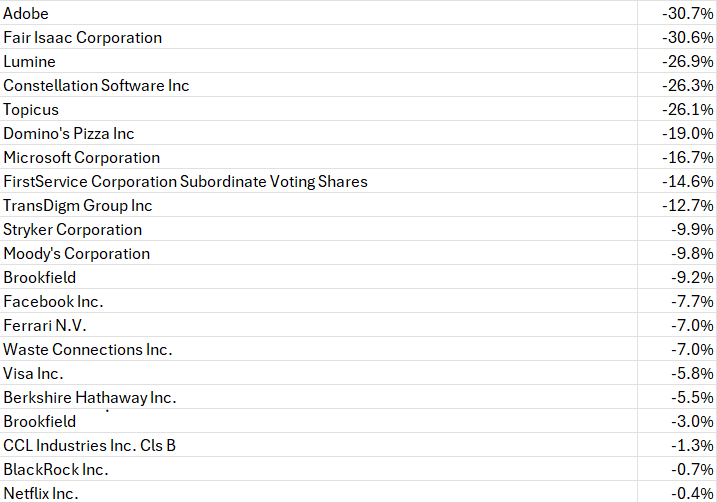
His portfolio currently consists of only 15 high-conviction positions. He is effectively invested in just four sectors: aerospace (40%), infrastructure (27%), credit ratings (15%), and payments (11.5%). He recently made headlines when he sold his 8bn USD stake in $MSFT. The reason for this is the increased risk of AI disruption to the business.
Many of you asked what the ~200 investable companies actually are.
Hohn won’t publish his list.
Here are 50 names that fit his framework.
Real moats, irreplaceable assets, pricing power above inflation. The hunting ground.
AEROSPACE & ENGINES (duopolies, IP, installed-base lock-in)
– GE Aerospace
– Safran
– Rolls-Royce
– Airbus
– TransDigm
– HEICO
– MTU Aero Engines
– Howmet Aerospace
PAYMENTS NETWORKS (network effects, “toll roads on commerce”)
– Visa
– Mastercard
– American Express
RATINGS, DATA & EXCHANGES (regulatory and natural-monopoly moats)
– Moody’s
– S&P Global
– MSCI
– Intercontinental Exchange
– CME Group
– Deutsche Börse
– London Stock Exchange Group
– Experian
– Equifax
– Fair Isaac (FICO)
AIRPORTS, TOLLS & CONCESSIONS (irreplaceable physical assets, regulated dual-till)
– Aena
– Ferrovial
– Vinci
– Eiffage
– Getlink (Channel Tunnel monopoly)
– Flughafen Zürich
– Grupo Aeroportuario del Pacífico
– Grupo Aeroportuario del Sureste
– Auckland Airport
– Transurban (Australian toll roads)
RAILS (natural monopoly networks, irreplaceable rights of way)
– Canadian National Railway
– Canadian Pacific Kansas City
– Union Pacific
– CSX
– Norfolk Southern
TOWERS & ESSENTIAL INFRASTRUCTURE (irreplaceable physical sites)
– American Tower
– Crown Castle
– Cellnex
– SBA Communications
ESSENTIAL SERVICES (permits, route density, switching costs)
– Waste Management
– Republic Services
– Veralto
– Ecolab
– Rollins
INDUSTRIAL GASES (oligopoly, irreplaceable on-site infrastructure)
– Linde
– Air Liquide
– Air Products
SEMICONDUCTOR INFRASTRUCTURE (irreplaceable IP and capital intensity)
– ASML (lithography monopoly)
– TSMC (leading-edge foundry monopoly)
– Tokyo Electron
CONSUMER & MISC (membership economics, real installed base)
– Costco
What unites them: high barriers to entry, pricing power above inflation, decades of installed-base lock-in, and businesses that an AI agent cannot replicate in a weekend.
What’s missing: every bank, every airline, every auto, every traditional retailer, almost all SaaS, every wireless telecom, every advertising agency, every fossil fuel utility, every luxury brand, almost all of pharma, almost all of life sciences tools. The exclusion list does more work than the inclusion list.
The list isn’t the alpha. The framework is. Find businesses where the moat is physics, regulation, scarcity, or installed base. Not code. Hold them for 8 years. Don’t trade.
That’s the game.
La acción de $MELI generó un CAGR del 34.1% durante los últimos 10 años, a pesar de llevar una caída del 27% desde su ATH reciente.
Es convertir USD 10 mil en USD 192 mil en 10 años. Es muy alto, teniendo en cuenta que el Nasdaq 100 $QQQ en ese período generó un CAGR del 18.5%
Suena fácil mirándolo ahora, no? Simple de entender pero nada fácil de lograr. Hace falta mucha convicción, estómago y posiblemente alejarse de la pantalla un tiempo.
Supongamos que confiabas en la visión del management y en la capacidad de ejecución de la compañía en el largo plazo. Eso es muy importante pero no lo es todo.
Tendrías que estar psicológicamente preparado para resistir la muy alta volatilidad que tiene toda compounder. Altos rendimientos de largo plazo implican tolerar una mayor volatilidad. Pero mas volatilidad no es mayor riesgo.
Ese inversor que puso USD 10K en acciones de $MELI diez años atrás se encontró con que a los 3 meses de abrir posición la acción llevaba una caída del 32% respecto a máximos. Lindo arranque. Y tuvo que resistir la tentación de no vender a pérdida mirándo la dinámica de ese momento.
La cotización se fue recuperando a medida que el negocio crecía. 3 años mas tarde volvió a tener una corrección del 38%. Unos años despúes vino el sell off del Nasdaq por la abrupta suba de tasas post Pandemia, donde la cotización se desplomó 69%.
También tuvo que resistir a eso. Siempre vamos a encontrar buenas razones para vender un excelente negocio.
En definitiva, los rendimientos de largo plazo de un activo no suben en forma lineal. La volatilidad es parte del paisaje. El precio que tuvo que pagar ese inversor para lograr esos rendimientos tan altos fue resistir esa volatilidad mientras el negocio seguía creciendo.
Las acciones de excelentes compañías son riesgosas de corto plazo y menos riesgosas cuanto mas tiempo estas dispuesto a mantenerlas.
Simple de entender pero difícil de lograr.
@realroseceline Since you appreciate Nick Sleep’s philosophy, do you aim to concentrate your portfolio into around three core holdings (or converging in that direction) and hold them indefinitely?
Despite revenue compounding over 30% per year, $MELI has been almost flat over the past 5 years.
A high valuation in the past, along with a current investment cycle has made Wall Street worried. 2 of the last 3 price target revisions have been bearish.
None of this changes the quality of this business though. The growth is strong, the flywheel is tight, and management continues to reinvest to ensure it remains that way for decades to come.
Like Amazon of the 2000s, $MELI is not trying to appease short term investors, and the stock has reflected that.
After listening to Google, Amazon, Microsoft and Meta earnings call:
The AI buildout just got bigger. Combined 2026 capex now tracking $700B+
- $GOOGL: raised to $180-190B (from $175-185B). Cloud +63%, backlog doubled to $460B
- $META: raised to $125-145B (from $115-135B). Pure internal spend, no cloud resale
- $AMZN: $200B maintained. AWS +28%, fastest in 15 quarters. TTM FCF collapsed to $1.2B
- $MSFT: $31.9B in Q (below $34.9B est). Demand still > supply. AI run-rate $37B (+123%)
Theme: Every CEO said the same thing - capacity constrained, not demand constrained.
Winners downstream:
GPUs/Accelerators: $NVDA, $AMD, $AVGO, $MRVL, $ARM
Custom ASIC/Silicon: $AVGO, $MRVL,
Foundry/Equipment: $TSM, $ASML, $AMAT, $LRCX, $KLAC, $ICHR, $UCTT
Memory/HBM: $MU, $HBM (SK Hynix), $WDC, $STX
Connectivity/Interconnect: $CRDO, $ALAB, $MRVL, $AVGO
Networking/Switching: $ANET, $CSCO
Optical/Transceivers: $COHR, $LITE, $CIEN, $FN, $AAOI
Power Generation: $CEG, $VST, $NRG, $TLN, $OKLO
Power Equipment/Grid: $VRT, $GEV, $ETN, $PWR, $HUBB, $NVT, $BE, $FPS
Cooling/Thermal: $VRT, $MOD
Cabling/Components: $APH, $GLW
My take: demand is still accelerating, supply is still catching up - this cycle likely runs longer than most expect.
Thoughts on $SPGI
Revenue grew 10% and EPS grew 14%, and margins expanded again, which is exactly what you want to see at this scale. This isn’t growth you have to question or adjust, it’s growth that converts directly into profit. That’s always the first signal you’re dealing with something high quality.
When you look deeper, the operating leverage really stands out. Operating profit grew 27% on just 10% revenue growth, which tells you a lot about the underlying economics. That only happens when you have real pricing power and very low incremental costs.
The growth is also coming from the right places. Ratings grew 13%, Market Intelligence grew 8%, and Indices grew 17%, each with very different characteristics. Together they create a model that is both durable and scalable, with transaction upside, recurring revenue, and asset linked growth all feeding into each other. That combination is very hard to replicate.
Indices is really the crown jewel here and they are still underestimated. Asset linked fees grew 18%, which basically means as more money flows into ETFs and passive investing, $SPGI gets paid. There is almost no incremental cost, so most of that revenue turns into profit. It’s not just a good business, it’s a toll road on global capital flows, and those flows continue to move in one direction over time.
What’s important to understand is that this is not really just a ratings business anymore. It’s a data, benchmark, and workflow tied to global capital markets.
The reason margins can stay this high is because the product actually improves with scale. Every new issuance, every ETF, every dataset strengthens the moat. Instead of competition compressing returns, scale reinforces them. That’s a very different dynamic than most businesses.
There is also a simple but powerful structural tailwind here. Every dollar that moves from active to passive is effectively a small tax paid to $SPGI. You don’t need to predict markets perfectly, you just need to understand where capital is flowing. Over time, that flow continues to benefit them.
Capital allocation is good, they bought back $1b of stock and are planning to return 100% or more of free cash flow this year through buybacks and dividends. Free cash flow was about $919m, which shows how little this business needs to reinvest to keep growing. That combination of high margins and high returns is where the long term compounding happens.
They have $1.8b in cash and continue to generate consistent, high quality cash flows. This is not a business that needs heavy reinvestment so it funds growth internally and still sends a large portion of cash back to shareholders. That’s a very powerful position to be in.
They expect 6% to 8% revenue growth and EPS around $19.50, which on the surface may not look exciting. But considering margins, buybacks, and capital returns, you still get strong EPS compounding over time. This is not a hypergrowth story, it’s a durability story.
Strategically, they are simplifying the business. The mobility spin off and energy asset sales suggest a focus on higher return segments and better structure. Over time, that usually leads to a better business and often a higher multiple if execution is solid. It also makes the story easier to understand.
There is also a second order dynamic that is easy to miss. The more volatility and uncertainty you have in global markets, the more people rely on benchmarks, ratings, and data to make decisions. In other words, the same conditions that hurt most businesses can actually increase the relevance of $SPGI. That’s a very unique position.
Of course, there are risks. Ratings is still tied to debt issuance cycles, competition will evolve especially with AI, and margins won’t expand forever from these levels because they are already very high. But those are normal tradeoffs for a business of this quality. The key question is not whether it’s perfect, but whether the core advantages remain intact.
🌹
You have to stay grounded and can’t just assume your stocks are going up 10-20x because it sounds good.
In my opinion, if things go right, you’re looking at something like a 2–3x over the next five years with $MELI and $NOW. That’s already an incredible outcome and far more realistic than most of the projections people throw around.
A 2–3x might not sound exciting in a world chasing quick wins, but that’s roughly 15–25% annual returns. That’s how real wealth is built, quietly, consistently, without needing everything to go perfectly.
What matters isn’t predicting some massive multiple expansion. It’s whether the underlying business can keep compounding revenue, expand margins, and generate more cash per share over time. If that happens, the stock will eventually follow.
The part people underestimate is what it takes to actually earn that return. You’re going to sit through flat periods, drawdowns, and narratives that sound convincing but are completely wrong. Most people don’t lose money because they’re wrong, they lose money because they can’t sit still long enough to be right.
So instead of asking “can this 10x,” the better question is “can this business compound at a high rate for a long time?” If the answer is yes, you don’t need anything heroic.
That’s where names like $MELI and $NOW stand out. Not because they’re guaranteed winners, but because their economics are strong and moats are wide with plenty of growth in the tank.
🌹
🌹
Carl Jung believed life truly begins at 40, viewing the first four decades as "research"—a preparatory phase focused on building an ego, establishing a career, and meeting societal expectations. The second half of life, starting around 40, is for inward exploration, authenticity, and fulfilling one’s true self (individuation) rather than pursuing external validation.
@realroseceline How do you deal with long-term conviction holdings that have rerated to such high valuations that their expected forward returns look materially less attractive—especially when you see more compelling opportunities elsewhere? (E.g. switching $ASML for more $MELI and some $DLO)