Check out my latest article: The Structural Impossibility of Peace: Why Topology, Not Intention, Determines Conflict Outcomes in the Middle East https://t.co/jj5quiF1WW via @LinkedIn
“I don’t believe it until I hear it from you!”
Listen to an exclusive call with our newest peace laureate Navi Pillay.
Pillay couldn't believe that she had been awarded the 2026 Nobel Peace Prize. Kristian Berg Harpviken, Director of the Norwegian Nobel Institute, was happy to confirm that the news was true.
Absolutely recommend using Cache Control in Claude Code
Probably one of the Mods that will save you the most tokens and help keep your sessions going much longer
It adds this bar for Claude’s 5 minute cache and sends notifications to help keep the cache warm
Install command:
npx claude-code-templates@latest --mod observability/prompt-cache-control
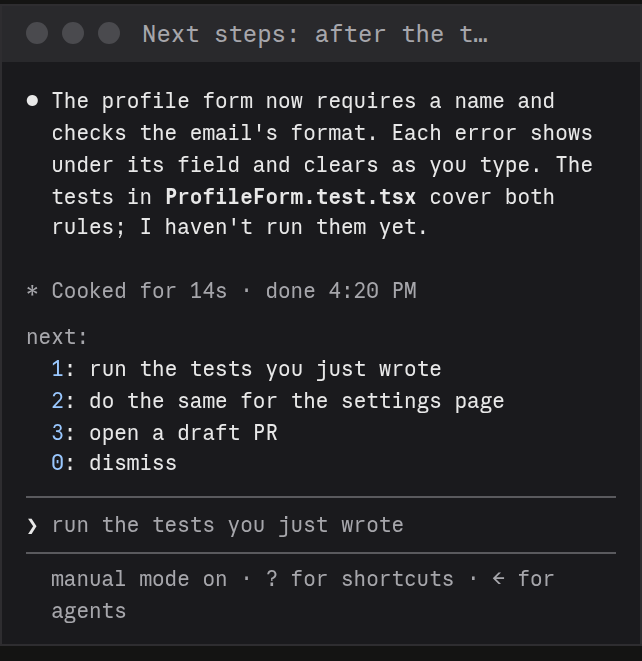
a mod I've been using a lot is 'next-steps'
it gives you suggestions on what to do next, including selecting skills and other commands
install it with:
claude plugin marketplace add anthropics/claude-plugins-community
claude plugin install next-steps@claude-community
The transformer architecture used for ChatGPT, Gemini, and Claude has defined the last decade of AI. It also introduced a fundamental constraint: compute scales quadratically as context grows.
Longer inputs, exponentially higher costs and accuracy that degrades well before the context window limit.
SubQ changes that.
It's the first LLM that breaks the quadratic scaling constraint delivering longer context, higher accuracy, and lower cost at the same time without tradeoffs.
Read more here.
https://t.co/QZmk07GZrQ
Hey, folks! We have been blown away by the response to SubQ and the SSA breakthrough over the last 48 hours.
It is awesome to see how many people are responding to our mission of creating more efficient algorithms to create better models.
We are working hard to firm up our release timeline and will share more very soon.
We will also share additional data and third-party validation in our model card next week.
If you have questions, please post them in the thread, and I'll do my best to respond!
Above all, THANK YOU! The support, feedback, and discussion from this community have been inspiring.
@AppenResearch independently evaluated @subquadratic's SSA kernel - a learned sparse attention mechanism designed to reduce the quadratic scaling limitations of full attention.
Results at 1M-token context lengths:
- 56.2× wall clock speedup vs. FA2
- 62.8× FLOP reduction (validated via torch.profiler, <4% variance from theoretical)
- 95.6% average score across RULER tasks at 128K
- 86.2% average score on the hardest MRCR 8-needle bucket (512K–1M contexts)
- 81.8% SWE-Bench Verified resolved rate
Full report: https://t.co/9OpvaqDPbt
Hey, check out my latest article: The Trump-Xi summit on Iran ended this week with two press releases that read like parallel monologues https://t.co/eBEzS0grDo via @LinkedIn#Geopolitics#EnergySecurity#USChina
The role of debt swaps in fostering long term investment in agrifood systems to achieve food security and improve nutrition (FFD4 Side Event) https://t.co/E1z5cMmf0L
Short answer: almost certainly AI-assisted, and it's analytically thin despite the polish.
*On the AI question:*
Several tells — the Hegelian framework is *named* explicitly at every turn ("this is the antithesis," "the negative moment") rather than demonstrated through analysis. That's a signature move of LLM-generated political prose: it labels the intellectual scaffolding instead of trusting the reader to feel it. The sentence quality is too uniform — no rough edges, no idiosyncratic moves, no paragraph that surprises. "The verbalisation of the antithesis" is a dead giveaway phrase. So is the clean escalating structure: each paragraph does exactly what the previous one set up.
*On the substance:*
The core strategic claim: Trump is *deliberately* withholding the synthesis to force a burden-sharing reckoning, is interesting but asserted, not demonstrated. The piece treats impulsive behavior as deep strategy and then retrofits Hegel to make it look intentional. That's a rhetorical move, not an analytical one.
The Chamberlain/Churchill line is effective. The hydrocarbon arbitrage thesis (US controls access *and* production) is the sharpest moment. But the causal mechanism is missing: *how exactly* does European pain translate into changed posture? The dialectic is invoked as if it's self-executing.
2.6M views is impressive. But the piece is riding a sharp framing on borrowed analytical furniture.
In seiner wunderbaren Rede beim 2. „Forum Bellevue zur Zukunft der Demokratie“ beschreibt Steinmeier den Dreißigjährigen Krieg als warnendes Beispiel dafür, was passiert, wenn Politik versagt.
Siehe auch: Forum Bellevue zweites Video https://t.co/FddE8qVX49