New from me in @WEPsocial (open access):
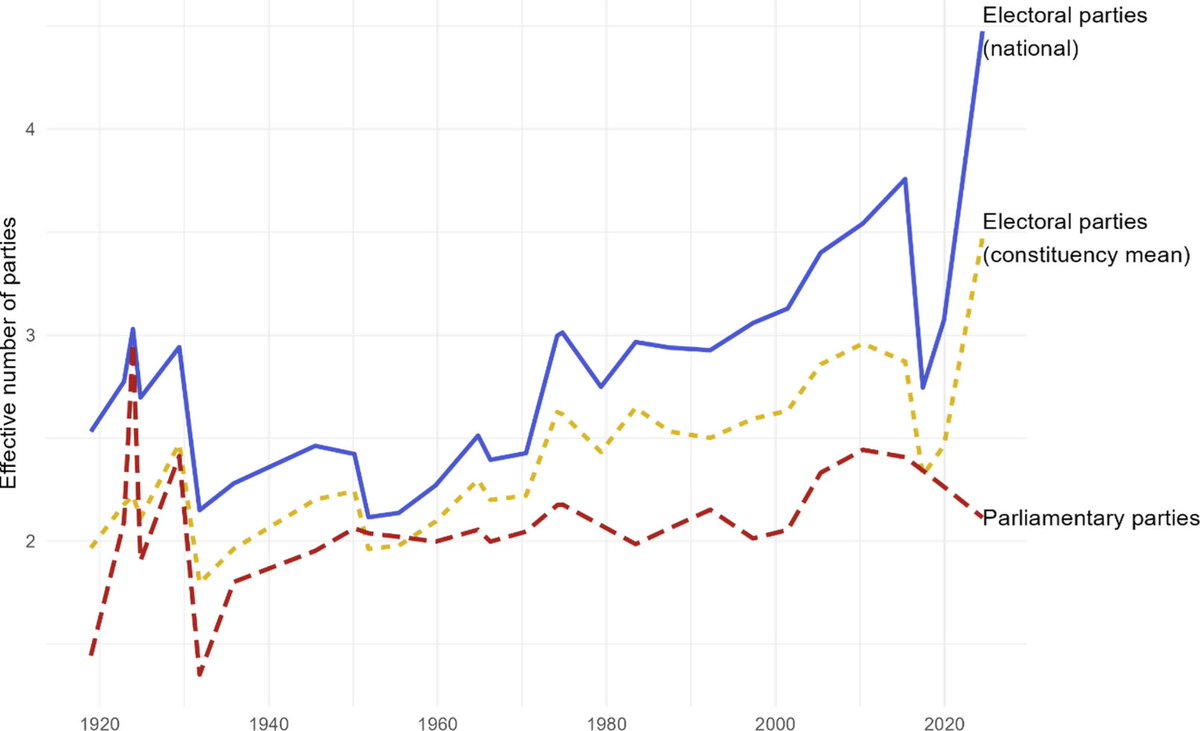
Fragmentation revisited: the UK General Election of 2024
4,000 words on the who, what, where, why of the 2024 UK General Election - the most fragmented election in British democratic history.
https://t.co/Lu7kGhXHcw
If you're interested in doing a PhD in something to do with elections, political psychology, public opinion, or anything to do with British politics (or know someone else who is), then get in touch - we have an open funding competition at the moment!
New from @olhe, me, Humphrey Southall and Paula Aucott (@gbhgis ) in @po_qu:
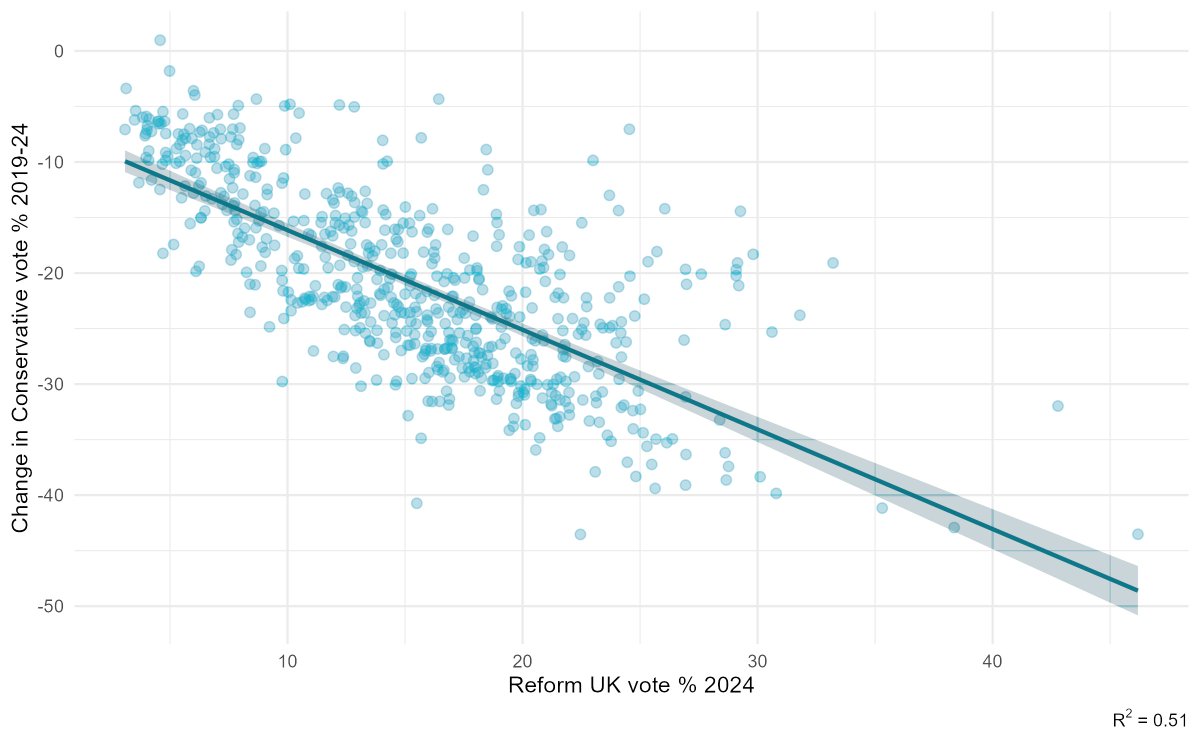
The 2024 General Election and the Rise of Reform UK https://t.co/8KmGFQcMEV
Unsurprisingly then, the relationship between Reform performance and Conservative performance in 2024 is pretty obvious - in the places where Reform did the best, the Conservative vote went down a lot!
New paper w/ @caprosser at @apsrjournal. A recent paper claim rising mass polarization in US is actually declining survey cooperation rates (only diehard partisans responding). We show evidence that this actually results from overly strong regularization
https://t.co/J8a2IFwxuL
Just published on APSR First View: "Regularized Regression Can Reintroduce Backdoor Confounding: The Case of Mass Polarization" by Jonathan Mellon (@jon_mellon) and Christopher Prosser (@caprosser). https://t.co/Xmv0Q99ag7
New from @jon_mellon and me in @apsrjournal looking at the impact that regularization (e.g. Ridge regression, LASSO etc) can have on adjusting for confounders, with particular application to claims about the effect of survey non-response on estimates of polarization.
Thread⬇️
Along the way we touch things of wider relevance to social scientists like the equivalence of informative priors and different types of regularization, and the utility of simulation as part of our workflows.
Check it out ⬇️⬇️⬇️ https://t.co/UonCgZ2vrb
We argue that a recent claims that survey non-response has inflated estimates of mass polarization (https://t.co/3bP6Jbmi1P) are driven by the use of ridge regression.
See this thread from @jon_mellon https://t.co/6tytRr6RaS
New paper w/ @caprosser at @apsrjournal. A recent paper claim rising mass polarization in US is actually declining survey cooperation rates (only diehard partisans responding). We show evidence that this actually results from overly strong regularization
https://t.co/J8a2IFwxuL
Looking forward to chairing this evening's round table on Populism and the British and European Elections of 2024 at @RoyalHolloway. Panellists: @sarahobolt @MiriamSorace @caprosser, cc: @rhulpirp @EESresearch https://t.co/USflVKGh20