A kid drew himself sleeping in bed between mom and dad and labeled it 'safe.'
In Japan, this exact sleeping arrangement has a name. They call it 'the river.' Mother is one bank. Father is the other. The child between them is the water. Roughly 70% of Japanese mothers sleep this way with their kids, sometimes through the teenage years. The Western model of putting a kid alone in their own bedroom is barely 200 years old. For most of human history, in most cultures still alive today, kids slept beside their parents.
James McKenna runs the Mother-Baby Behavioral Sleep Lab at Notre Dame. He spent decades watching what happens when parents and kids share a bed. The bodies sync up. Heart rates align with the parent's, breathing falls into the same rhythm, and by morning even sleep stages have started matching. The parent's body, in McKenna's words, acts as a kind of biological jumper cable for the child's.
In 2013, researchers in the Netherlands tracked 193 babies through the first year of life. They measured cortisol, the brain's main stress hormone. Babies who had spent more weeks co-sleeping in the first six months produced less cortisol under stress at 12 months. Sleeping near a parent had rewired the kid's stress system to be calmer under pressure.
Inside the kid's brain at night, the amygdala, the fear alarm, gets more sensitive as the body gets tired. Darkness makes it worse. A 2021 paper in PLoS One from Australian researchers showed that light directly suppresses amygdala activity. Lights off, alarm louder. The whole brain is wired to read 'alone in a dark room' as a threat.
Now add a parent's body to that bed. The kid's nervous system reads warm body, breathing nearby, familiar smell. The threat alarm dials down. Two parents on either side dial it down twice. The drawing is the kid's brain calculating maximum safety: I am surrounded by the people who keep me alive, and nothing can reach me without going through them first.
The arrangement in this drawing is what most of human history called 'sleeping.' Sleeping the kid alone in another room is a 200-year-old Western invention that we forgot was an invention. Every kid who has ever padded into your room at 3am and crawled into the middle of the bed is just trying to redraw the picture.
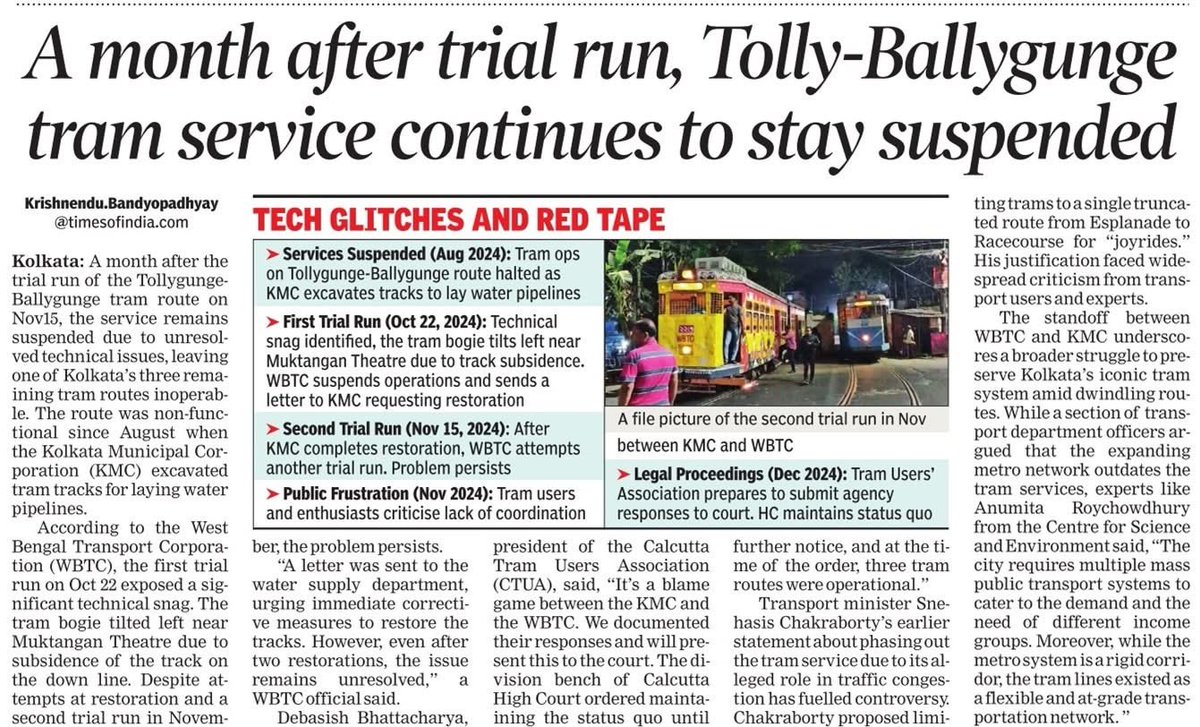
Appeal to the new GovofWestBengal
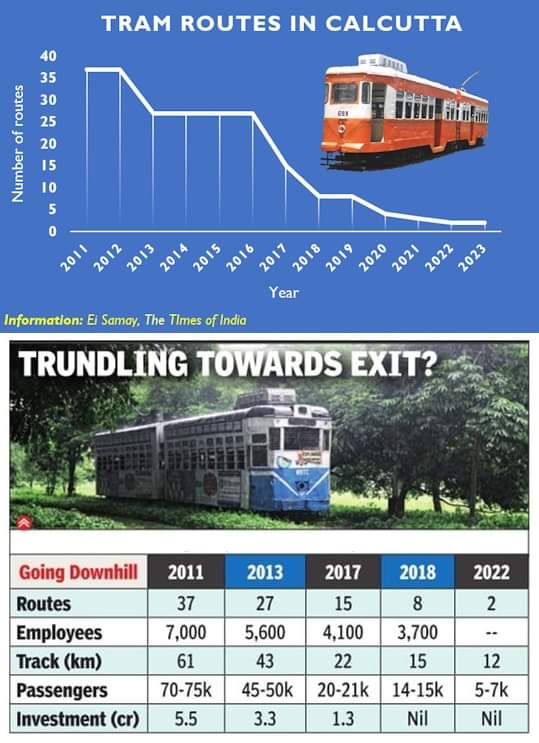
Kolkata trams have survived two world wars and are still alive today. Reducing them to joyrides and removing lines is a disservice to our heritage. It's time to revive and modernize this iconic symbol of Kolkata!
Bring back CTC instead of WBTC
As Iam thrilled with the positive response to my post - There is and should be a critical reading of my views. It is entirely possible that I am, in part, romanticising an idea . I do not deny that crimes against women persist, that public spaces can still be unsafe and it' could be the lived reality of many women or that political and sexual violence particularly in rural belts remains a harsh and undeniable truth. The bar, in many ways, is still far too low.
And yet, this is what I have seen, felt, and documented as a political journalist. Despite these contradictions, there is a certain free-spiritedness among women here an ease, a presence, a refusal to shrink. That, to me, does not emerge in isolation. It suggests something about the social fabric at large, about the interplay between its women, its men, it’s politics , and the state itself.
This is not a conclusion, but an observation imperfect, contested, and open to question :)
.. also exit polls was word play - leaving Bengal etc .
.. p.s not meant for trolls🙄 but those with well meaning genuine feedback !
My exit poll! As I leave #Bengal, it would be a disservice not to say this: I have come to deeply admire the way women inhabit space here. There is a quiet, almost subconscious elevation of women as independent beings . something that stands in stark contrast to the entrenched misogyny that still finds resonance across much of northern India. Perhaps it stems from a cultural understanding of shakti. A form of empowerment that manifests here in ways both subtle and profound, unlike anywhere else in the country, even in the south.
Any woman journalist who has covered political rallies across India will recognize the difference immediately. Other states, a crowd is not just a logistical challenge, it carries risk. the inevitability of wandering hands, the violation masked by chaos. Here, the crowds are no less dense, the air no less heavy with sweat and alcohol—but the hands, for the most part, do not grope. Men step aside to make way. When contact happens, as it inevitably does in chaos, there is visible embarrassment rather than entitlement. What you encounter is not chivalry, but something far rarer: equality. And equality feels far more meaningful. Was never a fan of chivalry in any case :)
There is more. Women politicians across party lines campaign with a striking freedom, aggressive, sharp, unapologetically irreverent, often using what would elsewhere be labelled as ‘masculine’ rhetoric. In most states, such behaviour would invite judgment, even censure. Here, it is met with acceptance, applause. What feels liberating to an outsider is, in Bengal, simply normal. What we frame as empowerment here is a cultural undercurrent.
I have covered four elections in this state, and each time I have returned with the same sense of awe. Bengal, meanwhile, ambles on with a certain bemusement, as if unaware of what sets it apart. But it is a big deal. And perhaps the most remarkable part is that Bengal does not think so.
Governments will come and go. One can only hope that this constant endures, not just how Bengal sees its women, but how, in many ways, it doesn’t. ♥️♥️♥️
Iran's Won the Narrative War thanx to humour of Viral LEGO War Videos that meme Trump! I meet the team behind them in a World Exclusive- with mentions of Gabbar Singh & Sholay! FIRST on-camera intvw with Iran's LEGO ARMY @ExplosiveMediaa - In full here https://t.co/n3aM0uuoNP
More power to her. She absolutely cooked the haters.
Because life has 2 types of people:
those who dare to be different… and those who never had the courage to.
And the second kind will always try to bad-mouth the first.
Simple truth.
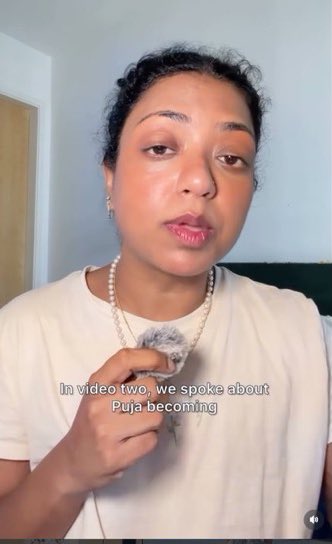
This is the post for those who aren’t aware about recent controversy on Instagram about an influencer called @lifeofpujaa, She is from a village in West Bengal who posts about movies, religion, feminism and capitalism while wearing a normal saree and in modest surroundings. The drama started when so called privilege influencers specifically Niharika Jain and Otherwarya questioned her "authenticity." The claim? She’s an "industry plant." They found it suspicious that a "village girl" has such high-quality edits and a curated aesthetic. Pujaa’s brand deals with Netflix etc, a rural woman being financially savvy and "too polished" for her background is a red flag. 🚩
This is seated classism and gatekeeping by these influencers and their coterie. The elite are just mad they no longer have a monopoly on intellectualism and they have birth right of global cinema, literature and culture.
If you’re mad that a woman from rural setup having better film recommendations. maybe the problem isn't her "authenticity." Maybe it's your insecurity.
Shillong's St. Mary's Higher Secondary School Choir has gone viral on social media for their breathtaking performance of 'Legend' by The Score, drawing widespread admiration from audiences across the country.
More than a viral moment, this rendition evoked a real-life 'School of Rock' vibe.
#StMarysShillong #ShillongChoir #LegendByTheScore #NorthEastIndia #Meghalaya
@PRATEEK22THAKUR@manoj_216 No, but it shows vehicles driving on the right side of the road—opposite India's left-side rule. This points to AI generation or horizontal flip/mirroring, not authentic unedited Assam footage. The smooth F1-like flow and lack of oncoming traffic add to the unnatural feel.
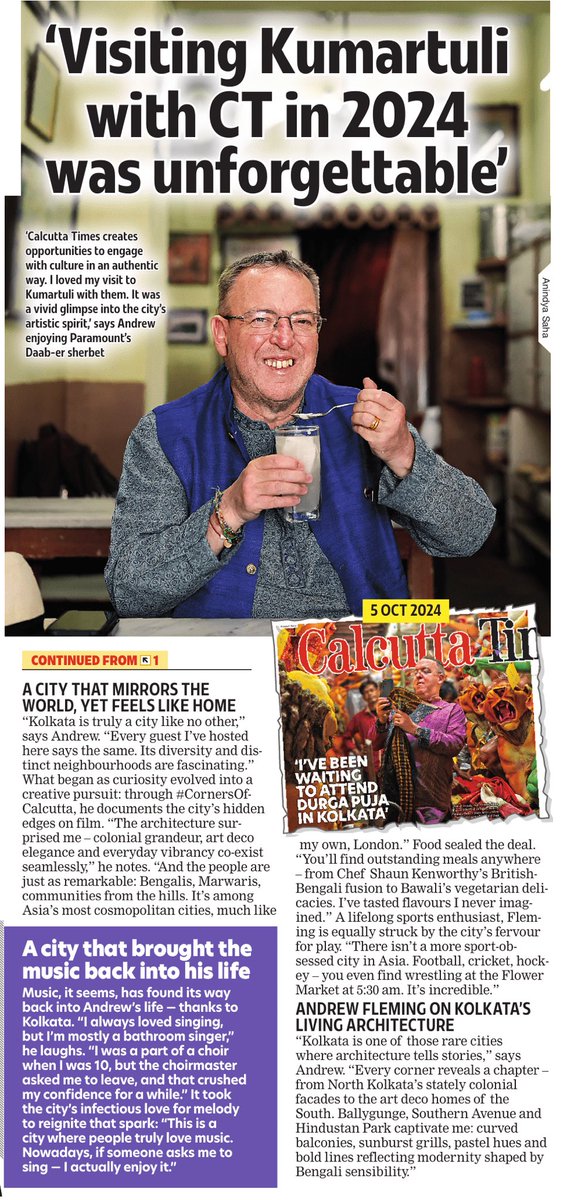
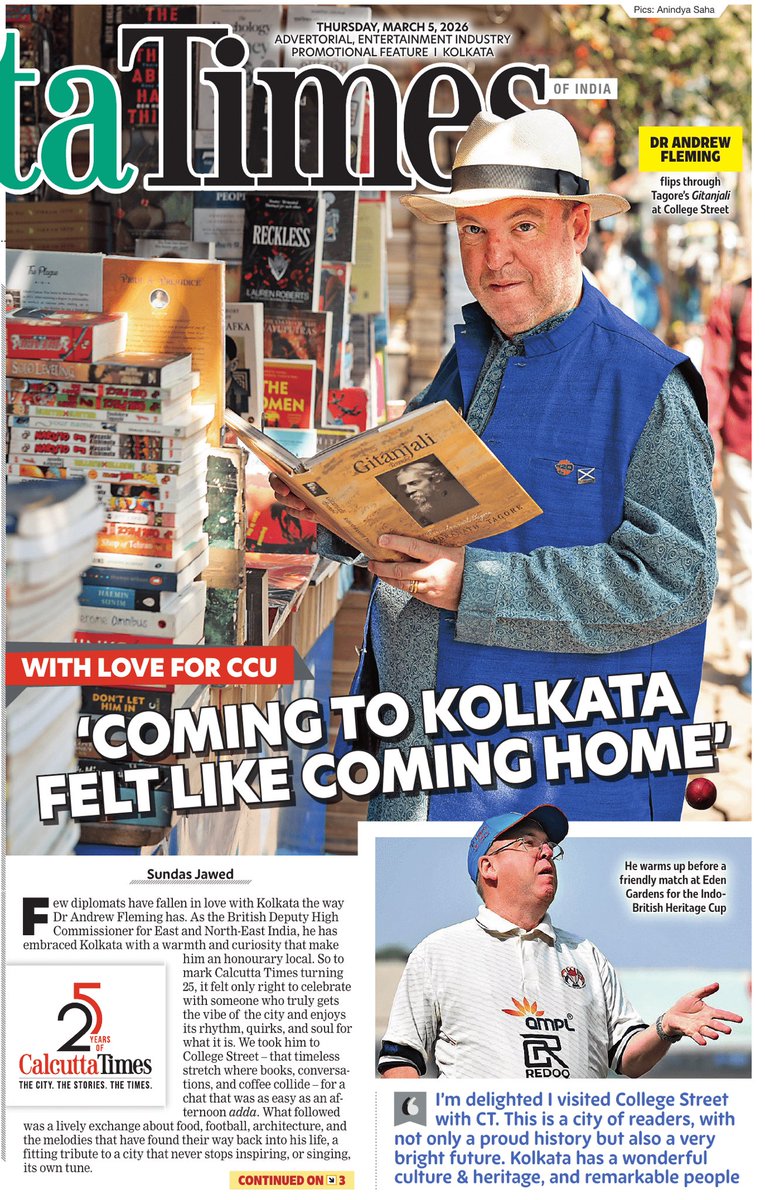
Our DHC @Andrew007Uk bares his heart out to @Calcutta_Times in this exclusive Tête-à-tête.
We all know what Andrew wants to say:
“কলকাতা, আমি তোমাকে খুব ভালোবাসি।” ❤️
There is a reason why contemporary Hindi music is pale compared to Old songs which are not only ahead of time and immortal, but composed for every era and generation!
Here is a magical song composed by #ShankarJaikishan in 1965, covered by Les Fanfoireux, a Belgian musical group
A Bird From Afar is now four years old.
Vivekananda and Bose have been my personal and political reference points since my teens, and perhaps writing a book each on them has been some sort of acknowledgment of that.
Bose is many things to many people, and attracts a range of extreme emotions – but, to me, he is, in a distant way, of course, someone I empathize with, am almost fond of.
I cannot find one easy and conflict-free phase of his life. I cannot find easy, obvious or universally acceptable choices coming his way. I admire the manner in which he faced the endless series of conflicts and dilemmas life sent his way, without, at any point, being a man of compromise or adjustment. I admire even more how, instead of being just hardened by all this, he retained and sustained his sensitivity, his concern, his inclusiveness, his objectivity.
Like many, I too have at some points mulled over some “if this had been” aspect of his life. ‘Yun hota to kya hota….’ Given that I have been almost an obsessive consumer of WW2 histories, even as I parallelly read (and wrote a little) about Subhas, over time, the mind drew up its own stories, its conjectures, its responses to “what would Subhas had done if - ?”
I searched for some such stories to read, stories such Robert Harris’s fabulous Fatherland, in the Indian context. A space to reimagine, reconstruct. I could not find much, perhaps because there is in any case so much mystery, intrigue and speculation about his real life. And then, as it happened in the case of the Vivekananda Handbook, I ended up writing the book that I wanted to read.
There is a commonality that I felt bound me to Subhas over the distance of these years. For he wrote - “I was barely fifteen when Vivekananda entered my life. Then there followed a revolution within and everything was turned upside down.” I was 17, but this thought, and the details thereafter, resonated intensely.
And from there, this story came into being: A story of WW2 changing track in 1942, and Subhas and his Indian Legion, raised in Germany, seeing if that presented an opportunity to ‘Chalo Dilli’ from the west, not the east.
With much trepidation, I had then requested Mihir Bose, who wrote a great biography of Subhas, The Lost Hero, to read and hopefully say a couple of lines. He sent back a note that ended with – “He combines a sure grasp of history with an ability to convert little-known facts into a marvelous fictional page-turner, establishing himself as the Robert Harris of India.”
Robert Harris I am not (yet, who knows how tomorrow goes?), but at least that meant the novel isn't boring!
Then, Sumantra Bose, Director of the Netaji Research Bureau at Netaji Bhawan, Kolkata, asked me to come there and speak on the book. That session served as an internal validation of sorts - that I probably hadn't got the essence of Subas wrong in my fictional recreation. To admire the Audi in which he fled home was a bonus!
#subhaschandrabose #bose #netaji
@nilamadhabpanda@amitabhk87@Suhelseth@virsanghvi@rickykej@mihirbose@Chandrakbose@Sahil_m17@ShreyaPunj@_AdilHussain@kaushikcbasu@visually_kei@MandviSharma@vanityparty