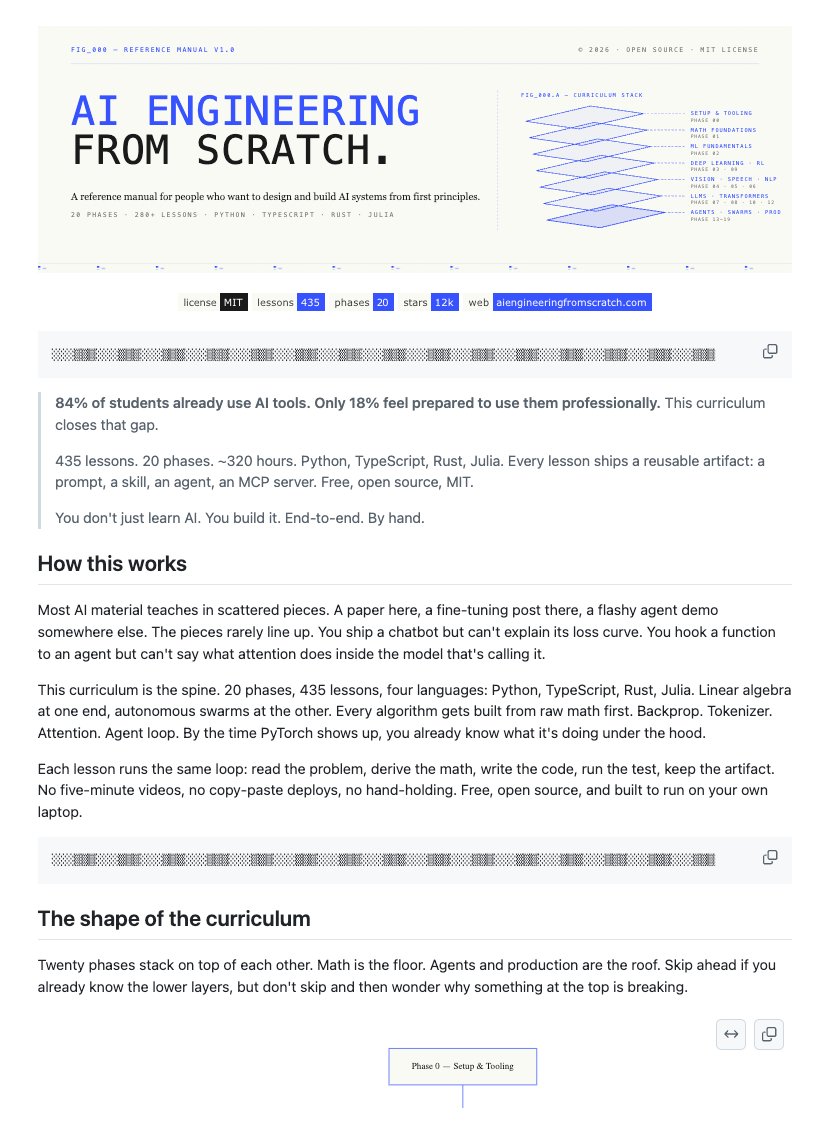
My friend made $2 million last year by running his own quantitative trading system.
No MIT. No Stanford. No hedge fund background.
I asked him how he built the strategies from zero.
He sent me a course that was never supposed to get out. A quant researcher walks through 3 full strategies from data to backtest.
You won't find anything better about building quantitative strategies like hedge funds than this.
I watched it last night.
Halfway through, I realized building hedge fund strategies is embarrassingly simple.
Bookmark this & read the self-improving trading agent guide in the article below.
• 00:00 - algorithmic trading basics
• 15:25 - quant strategy 1
• 2:05:08 - quant strategy 2
• 2:28:08 - quant strategy 3
Andrej Karpathy just dropped a 6-hour course on how to build LLMs from scratch:
• 00:00 - Deep dive into LLMs like ChatGPT
• 03:31:23 - Building ChatGPT from scratch in live
• 05:27:43 - How to use LLMs (Karpathy method)
This course will replace a $90K Stanford LLM master’s degree.
Start watching today, then read how to become an AI engineer in article below.
Anthropic engineer:
"At Antropic, >80% of our engineers are building with self-improving loops. in 3-6 months, it will be 100%.
my agentic loops can run for hours without spending hundreds of $$$."
in 30-minute podcast, an Antropic engineer shows how to build the right spec for an agentic loop.
Loop + plan + PRDs + spec + markdown - that’s the secret stack.
Worth more than a $500 agentic course on the internet.
Watch it now, then read how quants are building trading loops from scratch.
this is f*cking gold
A senior Google engineer dropped a 424-page doc on agentic design patterns.
424 pages.
Most engineers bookmarked it and never opened it again.
if I had this a year ago, I would've shipped my first app in a day instead of 2 weeks
in the right hands, this changes everything:
Anthropic just dropped a 33-page blueprint for building effective AI agents. Zero theory, just production architecture patterns used by Claude, Coinbase, Stripe, and Intercom.
Every system follows one cycle: Perceive -> Decide -> Act -> Evaluate -> Repeat.
Here are the 5 core patterns to know:
Single Agent: One model in a loop. Solves 80% of problems, don't over-engineer it.
Sequential: Step-by-step handoffs. Predictable and easy to audit.
Parallel: Tasks split across agents at once, then merged. Built for speed.
Hierarchical: A supervisor agent managing a team of specialists.
Evaluator-Optimizer: A 2-agent loop (generator + critic) refining quality over 2-4 cycles.
The Bottom Line: Multi-agent architectures outperform single models by 90.2% on complex tasks. Just match your complexity to the value.
Read the manual, then check out the "Loop engineering" article below.
If you’re building an AI trading system, BOOKMARK this.
These are some of the best free tools I’ve come across:
> Charts
https://t.co/Ia6ylaWVvr
TradingView’s own charting library. Probably the easiest way to get beautiful charts into your app.
>Exchange APIs
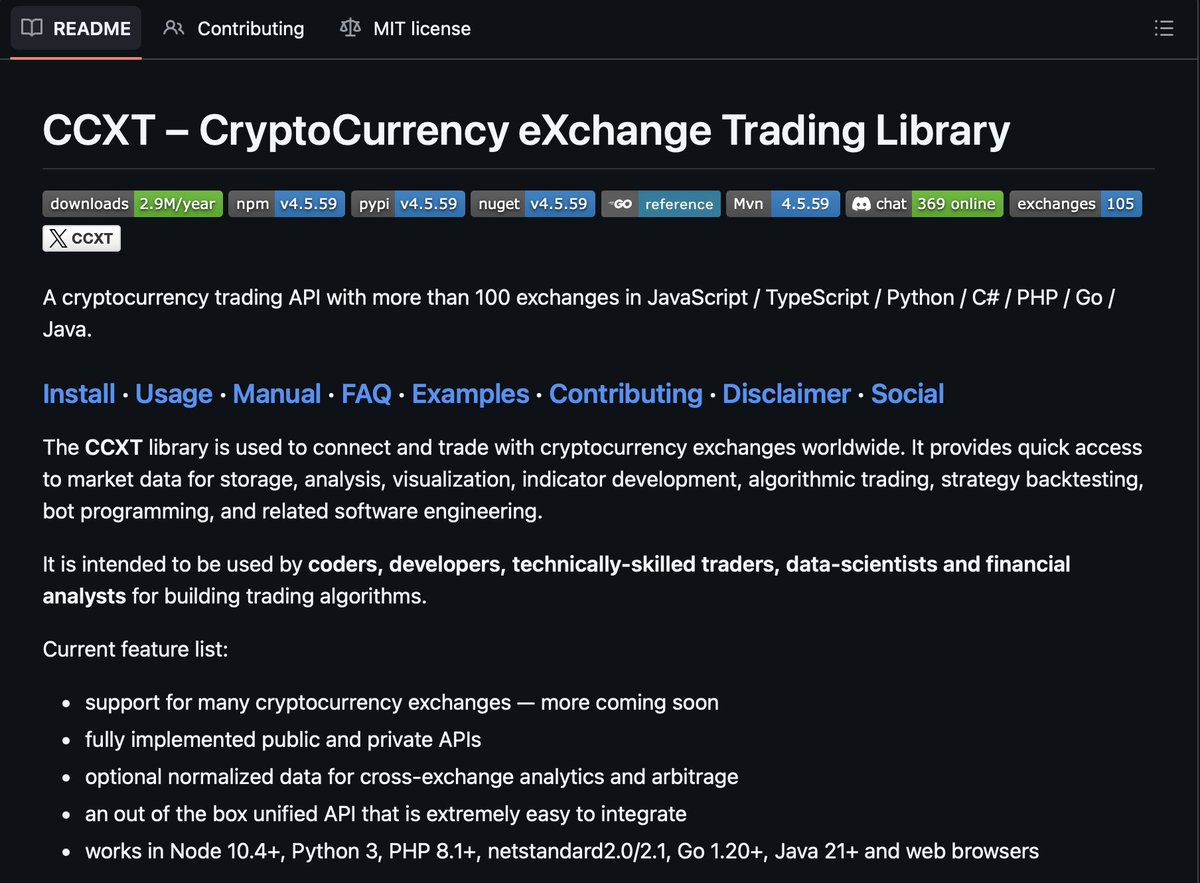
https://t.co/jjOlfNSx2X
One library that works with 100+ exchanges. Saves you from writing the same integration over and over.
>Execution
https://t.co/vWKI7GO2pl
If your bot is trading on Binance, you’ll end up here.
>Perpetuals
https://t.co/TfU7SUdb1n
The official Python SDK for Hyperliquid.
>Macro Data
https://t.co/7Vx3B3cEVB
Need CPI? Fed rates? GDP? Treasury yields? It’s all here.
>Backtesting
https://t.co/CvHH8i1xQs
Find out whether your strategy actually works before you let it touch real money.
>Paper Trading
https://t.co/LhMAqWsR9L
Same order books. Same fee model. No money at risk.
>Dashboard
https://t.co/X2hbZCWThB
Live order books, market depth, Chainlink feeds, technical indicators, and CSV logging in one terminal.
Every repo here solves a problem you’d otherwise spend weeks building yourself.
If you’re building AI tools, trading bots, or automations, you’ll probably like my Discord.
Join here: https://t.co/rdqr4JtUxF
Raphael Townshend, Stanford AI PhD and founder of Atomic AI (Forbes 30 Under 30):
""Wall Street will pay you $500K a year to build these models. I'd rather teach them to you for free."
this free stanford lecture holds the entire "77% win rate, pure math" random forest the 2026 quant threads sell you. and the guy teaching it didn't take the wall street money either, townshend went on to found an ai drug-discovery company and land forbes 30 under 30.
at the board he builds it from scratch: one decision tree overfits, so you grow hundreds on random subsets of the data and features and average them. the errors cancel, the signal survives. that's the whole "100 ai agents auditing the market" idea, minus the marketing.
the √N feature rule, the out-of-bag error, the probability output, all of it is standard ensemble learning, taught free by stanford for years. random forests came out of leo breiman's public paper in 2001. the thread didn't discover it. it renamed it.
and here's the honest part the win rate hides. a model that scored 77% on past data is describing the past, not promising the future. ensembles cut variance, they don't turn a weak edge into a real one, and markets shift under the model in ways the training set never warned about. the lecture is free. knowing whether your 77% survives out of sample and on live capital is exactly the part the post skips."
this is f*cking dangerous
someone just open sourced the entire "LOOP ENGINEERING" framework for free
build a hedge fund printing alpha 24/7 by feeding it into claude code with my article below
bookmark before someone takes it down
9) Project-based learning
This GitHub repo contains a 75+ projects on AI Engineering.
Everything is 100% open-source, covering
• LLMs and RAGs
• Real-world AI agent applications
• Examples to implement, adapt, and scale in your projects
•
https://t.co/3ftFQHSljw
A senior Google engineer dropped a 424-page doc on agentic design patterns.
424 pages.
Most engineers bookmarked it and never opened it again.
I read the whole thing.
Here are the 15 patterns that actually matter — explained in plain English, with exactly when to use each one ↓
One of the better agentic AI courses I've seen
Nearly 10 hours of great content. Covers LangChain, LangGraph, RAG, deepagents, guardrails, and more
Any other good Lang* resources out there for folks who are interested in learning?
https://t.co/OXNPMeGiyd
New codebase, 200k lines, zero map? This repo builds the map.
Understand Anything is an open-source Claude Code plugin and multi-platform AI coding tool for turning codebases, docs, and knowledge bases into interactive knowledge graphs.
It helps you onboard, debug, and review changes faster by scanning your project with a multi-agent pipeline, extracting files/functions/classes/dependencies, and opening a visual dashboard you can search and explore.
Key features:
• Structural code graph – turns files, functions, classes, and dependencies into clickable nodes
• Guided tours – auto-generates architecture walkthroughs in dependency order
• Fuzzy + semantic search – lets you ask questions like which parts handle auth and find relevant graph results
• Diff impact analysis – shows which parts of the system your changes affect before commit
• Multi-platform install – works across Claude Code, Codex, Cursor, Copilot, Gemini CLI, and more
It’s open-source (MIT license).
Link in the reply 👇
10 repositorios de GitHub tan potentes que no sé como siguen siendo GRATIS
[guarda esto compadre]
1. Maybe
Era un SaaS de finanzas personales. Cerraron. Lo open-sourced todo.
https://t.co/XUg64MamAi
2. Dify
Plataforma para construir apps con cualquier LLM. Lo que los AI builders cobran $500/mes.
https://t.co/JFMSMYoeKH
3. Open WebUI
Interfaz de ChatGPT para correr cualquier modelo en tu máquina. Sin suscripción. Sin enviar datos.
https://t.co/KgDtyCI49A
4. Continue
GitHub Copilot open source. Funciona en VS Code y JetBrains. Copilot cuesta $19/mes.
https://t.co/ysvnxuGxcQ
5. Chatwoot
Intercom y Zendesk open source. Soporte al cliente en tu propio servidor. Intercom: $74/mes mínimo.
https://t.co/glfctBtxRr
6. Docuseal
DocuSign open source. Firmas electrónicas sin límites ni coste por documento.
https://t.co/mioqMm0ikV
7. Metabase
Tableau open source. Business intelligence visual sin código. Tableau: $70/mes.
https://t.co/akdw89fZjb
8. Activepieces
Zapier open source con más de 200 integraciones y sin límite de operaciones.
https://t.co/ldWS37VMRY
9. Huly
Linear + Notion + Slack todo en un solo repositorio.
https://t.co/2H0AbpX7w5
10. Flowise
Constructor visual de agentes de IA con drag & drop. Sin código. Sin suscripción.
https://t.co/sIZ3Ua96F2
Esto no son proyectos de hobby.
Son alternativas reales al software que pagas cada mes.
Lo mejor de internet no tiene marketing.
Está en GitHub.
Train your own language model from scratch in 5 minutes. 🥹
Most people think training LLMs is rocket science.
it ridiculously simple:
No PhD, No massive cluster, you can Runs in browser,
Just one Colab notebook The entire pipeline data gen, tokenizer, training, inference,
This is the best "how LLMs actually work" demo I've seen. Perfect for beginners
- https://t.co/S0D2NOCyET
KARPATHY JUST HANDED EVERY DEVELOPER THE EXACT FILE CLAUDE CODE NEEDED FROM DAY ONE.
65 lines. 110K stars. the cheat code for every broken workflow you've been blaming on the model.
if I had this a year ago, I would've shipped twice as fast.
make sure to bookmark it before it gets lost in your feed.
I was losing 2 hours a day to Claude rewriting code I didn't ask it to touch.
then I found CLAUDE. md.
90 seconds to set up. changed everything.
Karpathy identified 4 failure patterns Claude Code repeats constantly, in his own words:
→ silent assumptions: Claude makes decisions without checking with you
→ code bloat: 1000 lines written when 100 would do
→ collateral damage: Claude edits code unrelated to the task
→ no success criteria: Claude loops with no finish line
these aren't model failures. they're missing instructions.
CLAUDE. md gives Claude the 4 rules it needed from day one:
→ think before coding, state assumptions. ask before assuming.
→ simplicity first, minimum code. nothing speculative.
→ surgical changes, touch only what is required. nothing adjacent.
→ goal-driven execution, define success before starting. loop until verified.
65 lines. no build step. no framework. no dependencies.
just the 4 principles every developer already knew, but needed Karpathy to write down.
ClaudeKit is the only team you need to build something like this (https://t.co/aW94IVKzGN)
the guide on how to learn Claude below (every resource you need)
https://t.co/8pon0x7bcI




![Fluyeporlaweb's tweet photo. 10 repositorios de GitHub tan potentes que no sé como siguen siendo GRATIS
[guarda esto compadre]
1. Maybe
Era un SaaS de finanzas personales. Cerraron. Lo open-sourced todo.
https://t.co/XUg64MamAi
2. Dify
Plataforma para construir apps con cualquier LLM. Lo que los AI builders cobran $500/mes.
https://t.co/JFMSMYoeKH
3. Open WebUI
Interfaz de ChatGPT para correr cualquier modelo en tu máquina. Sin suscripción. Sin enviar datos.
https://t.co/KgDtyCI49A
4. Continue
GitHub Copilot open source. Funciona en VS Code y JetBrains. Copilot cuesta $19/mes.
https://t.co/ysvnxuGxcQ
5. Chatwoot
Intercom y Zendesk open source. Soporte al cliente en tu propio servidor. Intercom: $74/mes mínimo.
https://t.co/glfctBtxRr
6. Docuseal
DocuSign open source. Firmas electrónicas sin límites ni coste por documento.
https://t.co/mioqMm0ikV
7. Metabase
Tableau open source. Business intelligence visual sin código. Tableau: $70/mes.
https://t.co/akdw89fZjb
8. Activepieces
Zapier open source con más de 200 integraciones y sin límite de operaciones.
https://t.co/ldWS37VMRY
9. Huly
Linear + Notion + Slack todo en un solo repositorio.
https://t.co/2H0AbpX7w5
10. Flowise
Constructor visual de agentes de IA con drag & drop. Sin código. Sin suscripción.
https://t.co/sIZ3Ua96F2
Esto no son proyectos de hobby.
Son alternativas reales al software que pagas cada mes.
Lo mejor de internet no tiene marketing.
Está en GitHub.](https://pbs.twimg.com/media/HLMflEXXkAI0FKk.jpg)
![Fluyeporlaweb's tweet photo. 10 repositorios de GitHub tan potentes que no sé como siguen siendo GRATIS
[guarda esto compadre]
1. Maybe
Era un SaaS de finanzas personales. Cerraron. Lo open-sourced todo.
https://t.co/XUg64MamAi
2. Dify
Plataforma para construir apps con cualquier LLM. Lo que los AI builders cobran $500/mes.
https://t.co/JFMSMYoeKH
3. Open WebUI
Interfaz de ChatGPT para correr cualquier modelo en tu máquina. Sin suscripción. Sin enviar datos.
https://t.co/KgDtyCI49A
4. Continue
GitHub Copilot open source. Funciona en VS Code y JetBrains. Copilot cuesta $19/mes.
https://t.co/ysvnxuGxcQ
5. Chatwoot
Intercom y Zendesk open source. Soporte al cliente en tu propio servidor. Intercom: $74/mes mínimo.
https://t.co/glfctBtxRr
6. Docuseal
DocuSign open source. Firmas electrónicas sin límites ni coste por documento.
https://t.co/mioqMm0ikV
7. Metabase
Tableau open source. Business intelligence visual sin código. Tableau: $70/mes.
https://t.co/akdw89fZjb
8. Activepieces
Zapier open source con más de 200 integraciones y sin límite de operaciones.
https://t.co/ldWS37VMRY
9. Huly
Linear + Notion + Slack todo en un solo repositorio.
https://t.co/2H0AbpX7w5
10. Flowise
Constructor visual de agentes de IA con drag & drop. Sin código. Sin suscripción.
https://t.co/sIZ3Ua96F2
Esto no son proyectos de hobby.
Son alternativas reales al software que pagas cada mes.
Lo mejor de internet no tiene marketing.
Está en GitHub.](https://pbs.twimg.com/media/HLMflCIXEAA84ll.jpg)
![Fluyeporlaweb's tweet photo. 10 repositorios de GitHub tan potentes que no sé como siguen siendo GRATIS
[guarda esto compadre]
1. Maybe
Era un SaaS de finanzas personales. Cerraron. Lo open-sourced todo.
https://t.co/XUg64MamAi
2. Dify
Plataforma para construir apps con cualquier LLM. Lo que los AI builders cobran $500/mes.
https://t.co/JFMSMYoeKH
3. Open WebUI
Interfaz de ChatGPT para correr cualquier modelo en tu máquina. Sin suscripción. Sin enviar datos.
https://t.co/KgDtyCI49A
4. Continue
GitHub Copilot open source. Funciona en VS Code y JetBrains. Copilot cuesta $19/mes.
https://t.co/ysvnxuGxcQ
5. Chatwoot
Intercom y Zendesk open source. Soporte al cliente en tu propio servidor. Intercom: $74/mes mínimo.
https://t.co/glfctBtxRr
6. Docuseal
DocuSign open source. Firmas electrónicas sin límites ni coste por documento.
https://t.co/mioqMm0ikV
7. Metabase
Tableau open source. Business intelligence visual sin código. Tableau: $70/mes.
https://t.co/akdw89fZjb
8. Activepieces
Zapier open source con más de 200 integraciones y sin límite de operaciones.
https://t.co/ldWS37VMRY
9. Huly
Linear + Notion + Slack todo en un solo repositorio.
https://t.co/2H0AbpX7w5
10. Flowise
Constructor visual de agentes de IA con drag & drop. Sin código. Sin suscripción.
https://t.co/sIZ3Ua96F2
Esto no son proyectos de hobby.
Son alternativas reales al software que pagas cada mes.
Lo mejor de internet no tiene marketing.
Está en GitHub.](https://pbs.twimg.com/media/HLMflBdWIAAfxXr.jpg)







![Fluyeporlaweb's tweet photo. 10 repositorios de GitHub tan potentes que no sé como siguen siendo GRATIS
[guarda esto compadre]
1. Maybe
Era un SaaS de finanzas personales. Cerraron. Lo open-sourced todo.
https://t.co/XUg64MamAi
2. Dify
Plataforma para construir apps con cualquier LLM. Lo que los AI builders cobran $500/mes.
https://t.co/JFMSMYoeKH
3. Open WebUI
Interfaz de ChatGPT para correr cualquier modelo en tu máquina. Sin suscripción. Sin enviar datos.
https://t.co/KgDtyCI49A
4. Continue
GitHub Copilot open source. Funciona en VS Code y JetBrains. Copilot cuesta $19/mes.
https://t.co/ysvnxuGxcQ
5. Chatwoot
Intercom y Zendesk open source. Soporte al cliente en tu propio servidor. Intercom: $74/mes mínimo.
https://t.co/glfctBtxRr
6. Docuseal
DocuSign open source. Firmas electrónicas sin límites ni coste por documento.
https://t.co/mioqMm0ikV
7. Metabase
Tableau open source. Business intelligence visual sin código. Tableau: $70/mes.
https://t.co/akdw89fZjb
8. Activepieces
Zapier open source con más de 200 integraciones y sin límite de operaciones.
https://t.co/ldWS37VMRY
9. Huly
Linear + Notion + Slack todo en un solo repositorio.
https://t.co/2H0AbpX7w5
10. Flowise
Constructor visual de agentes de IA con drag & drop. Sin código. Sin suscripción.
https://t.co/sIZ3Ua96F2
Esto no son proyectos de hobby.
Son alternativas reales al software que pagas cada mes.
Lo mejor de internet no tiene marketing.
Está en GitHub.](https://pbs.twimg.com/media/HLMflTGXQAATPvB.jpg)