Someone on Reddit just shared the smartest Fable 5 tip I have seen since it came back. 🤯
Before Fable 5 moves to pay-per-use, use it to write skills for Opus 4.8.
Let Fable 5 teach Opus how to think. Before it gets expensive.
That idea alone is worth sitting with.
But here is everything else you should do with Fable 5 right now.
→ Give it your hardest problem. Not your easiest. It is built for work that takes humans days.
→ One big brief beats twenty small ones. Full context. Full constraints. First message.
→ Set effort to High by default. Reserve XHigh for your most complex work only.
→ Give it a memory file. A simple markdown where it stores lessons between sessions.
→ Tell it to verify its own work before reporting progress. Kills fake status updates instantly.
→ Delete your old Opus prompts. They are too prescriptive for Fable 5 and will hurt output.
→ Use Fable 5 now to write skills for Opus 4.8. Let the best model teach
the everyday model how to think.
That last one is free leverage hiding in plain sight.
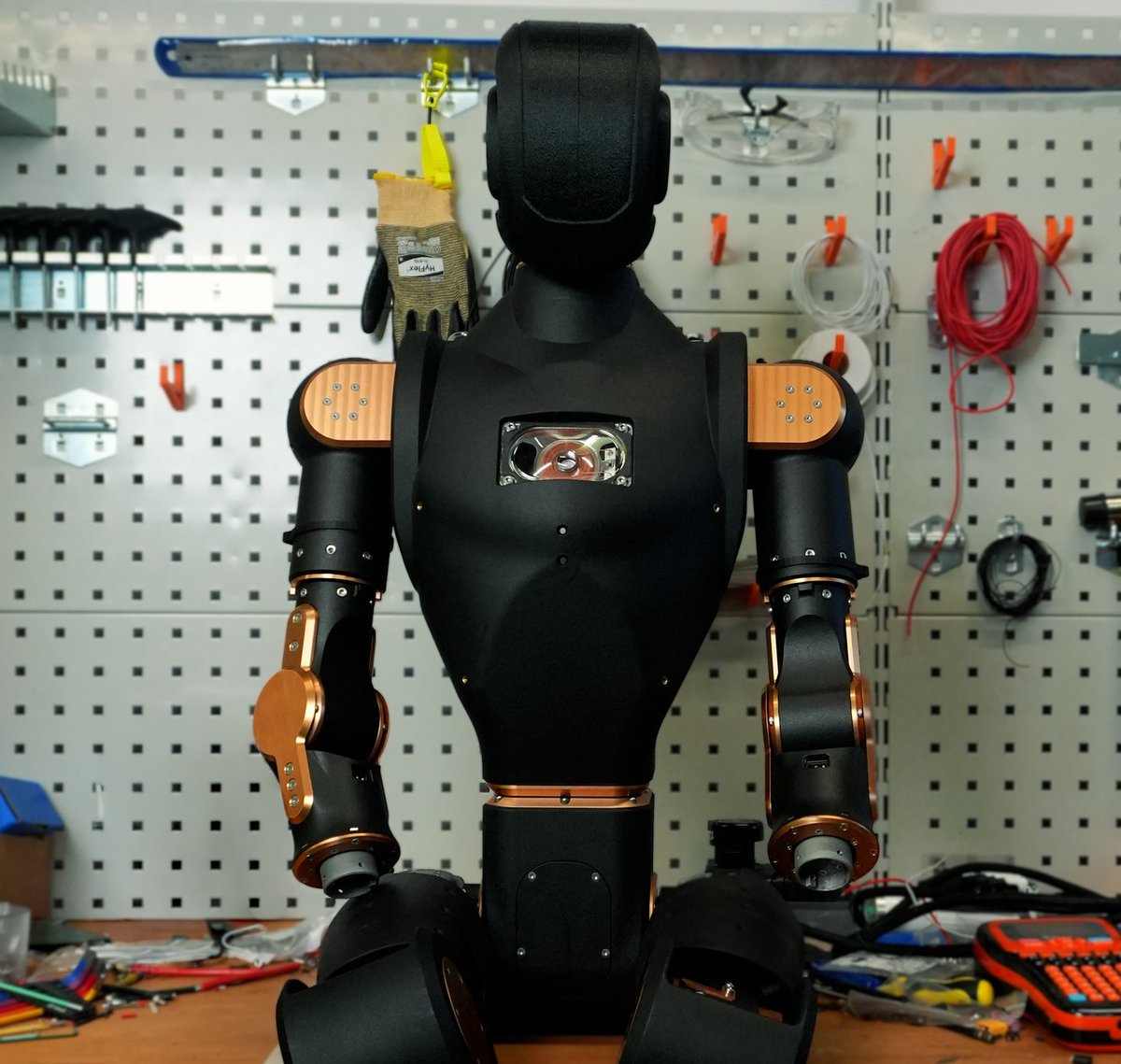
Asimov 1 is an open-source humanoid robot you can build and customize yourself.
Two ways to get one:
1) Source the parts yourself: https://t.co/vtG89UlhiK
2) Get the DIY kit: https://t.co/tzvzNyXiq2
The kit bundles every part as a group buy, cheaper than sourcing one by one, and you build alongside others.
this is f*cking gold
Andrej Karpathy joined Anthropic five weeks ago.
A friend on his team just showed me the exact LOOPS.md file he actually uses.
I dropped it into my setup. The very first response was different.
Not slightly different. Completely different.
Claude stopped giving generic answers and started working exactly the way I think.
You don't talk to the model anymore. You build the system that talks to the model for you.
Bookmark it before it gets lost in your feed.
Read it now, then check the article below.
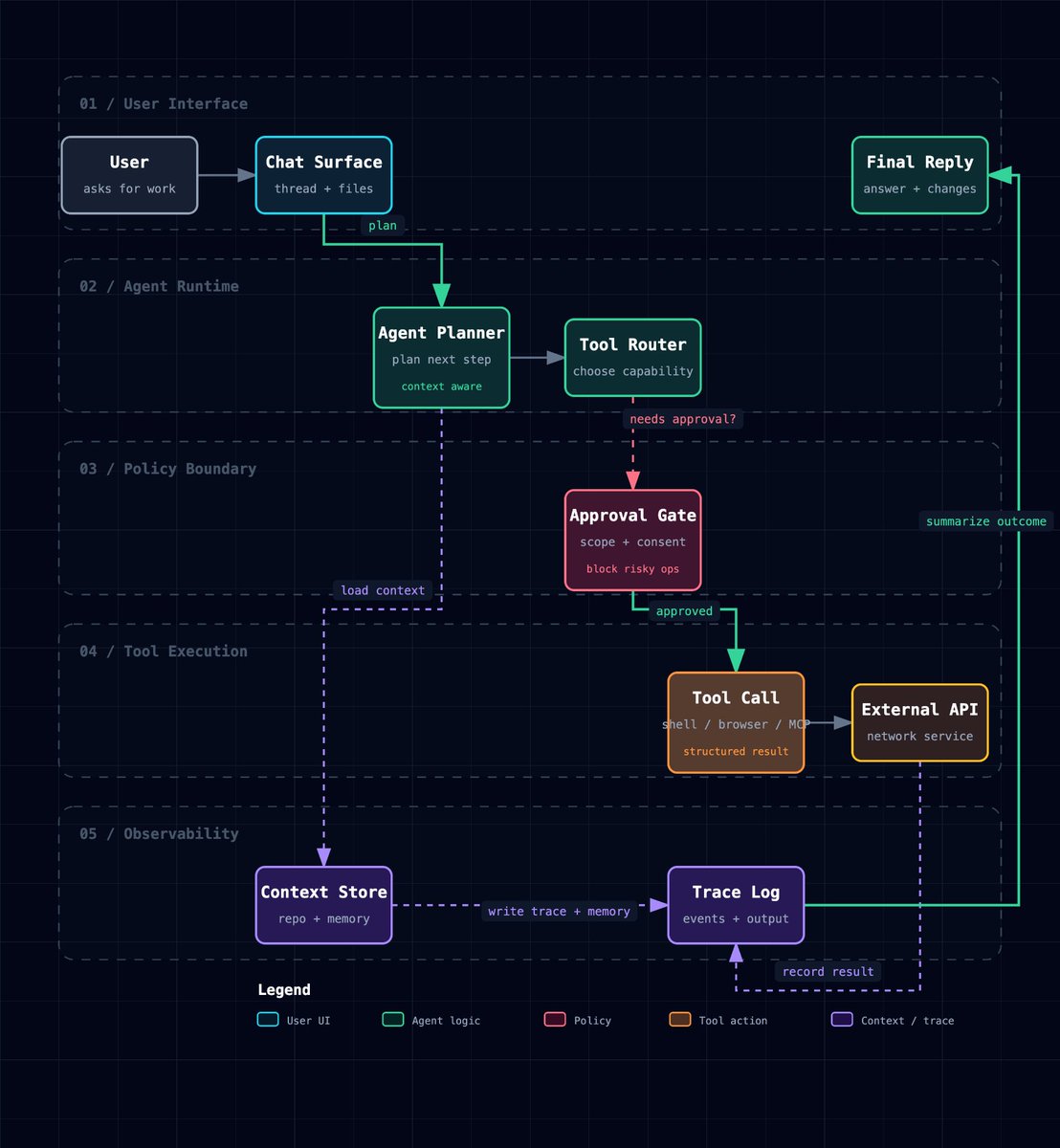
Use Fable 5 as orchestrator and Opus + Codex to execute (to save fable usage):
Fable 5 (max reasoning) = orchestrator
Opus = deep reasoning subagent
Sonnet = mechanical work subagent
Codex = peer Sr. engineer, different perspective
Setup:
1. Set Fable 5 as your main model In Claude Code: /model → Fable 5 → reasoning /effort to max
2. Create 2 subagents with /agents In Claude Code:
deep-reasoner → pinned to opus "Use for reasoning-heavy phases, architecture, debugging complex issues, algorithm design. Think thoroughly, return a concise conclusion the orchestrator can act on."
fast-worker → pinned to sonnet "Use for mechanical tasks, boilerplate, tests, formatting, simple edits. Execute efficiently."
3. Add OpenAI's official Codex plugin (install codex cli in your computer first), In Claude Code type:
/plugin marketplace add openai/codex-plugin-cc
/plugin install codex@openai-codex
/codex:setup
4. Drop this in your CLAUDE.md in your folder:
## Orchestration workflow
You (Fable) are the orchestrator. Plan, decompose, synthesize.
Reasoning-heavy phases → deep-reasoner
Mechanical work → fast-worker
Codex (/codex:rescue --background) is a cracked engineer on par with deep-reasoner, from a different perspective. Treat as a peer, not a reviewer.
High-stakes decisions: task Opus + Codex on the same problem in parallel, synthesize the best of both, without showing either the other's answer. Keep your own context lean.
5. Then prompt Fable like a tech lead: "Goal: [what you want] Context: [files, constraints] You're the lead. Delegate reasoning to deep-reasoner, grunt work to fast-worker, fresh-perspective problems to Codex. Show me your plan first, then execute."
That's it.
Jacob Bank, former Google product lead:
"I built up this team of 40 AI marketing agents to work with me. I'm the only marketing person."
In a 15-minute talk, he shows what one person with the right setup now runs alone.
Forty agents. One human. His AI bill is $500 a month, against the $50,000 a human team would cost.
That's the math quietly minting the first solo fortunes of the AI era.
Watch the talk, then read the piece below.
Bookmark this one.
🚨 ÚLTIMA HORA: Claude ahora puede construirte una página web ULTRA-PREMIUM en 30 minutos.
TOTALMENTE GRATIS.
Aquí tienes 8 indicaciones para CONSTRUIR TU PÁGINA WEB soñada:
If I was starting a new company today, I'd start an agent business.
SaaS was a multi-billion dollar market. Agents are a multi-trillion dollar one.
How to build I'd build an agent business from 0:
Spot the niche → find a workflow with a paycheck → shadow the human → spec the agent → run it manually first → build the smallest useful version → sell the pilot like labor → productize the repeatable parts.
Entire episode is live on @startupideaspod 100% free like always.
SaaS sold software and let your team use it to get the job done. An agent business sells the job already done. That shift matters because labor is a multi-trillion dollar market, far bigger than software ever was.
Watch
Anthropic engineer:
"You can build 5 assistants in one afternoon. Each one handles a task you've been doing manually every single day."
In 45 minutes he shows exactly how to do it from scratch, step by step.
Most people are still doing all of this by hand.
Watch the session, then save the guide below.
You don't understand how BIG this is.
Until now, agents could search the web but X was basically a wall. Real-time posts, trending topics, what people are actually saying right now, none of that was easy to pull into an agent workflow without a complicated API setup.
X just shipped a hosted MCP that changes that. Connect Grok, Cursor, or any MCP-compatible tool to the X API with no setup at all.
What this actually means if you run agents:
→ Your content agent can watch what's trending in your niche and surface it before you open your feed
→ Your research agent can pull real-time reactions to a product launch, not just news articles
→ Your morning brief now includes live X signal, not just web search
I run a content operation across 5 businesses. The bottleneck was always "my agent doesn't know what's happening right now." That just got solved.
If you're running agents and not wiring this in this week, you're leaving real-time context on the table.
Our Head of Growth runs $300K+/mo in paid ads without opening a single ad manager. Three platforms, one terminal, 12 custom Claude Code skills.
200+ hours of work off real client campaigns. Some clearing 4X ROAS on $1M+ spent. 40+ strategy files, 39 Python scripts hitting the platforms directly.
My bet: the agency that codes its ad-ops owns the margin everyone else burns in clicks.
The whole thing is 4 Claude Code skills:
> /linkedin-ads (15 strategy files, 14 scripts): full-funnel framework with audience-sizing rules, 6 campaign structure models, ABM 1:1/1:few/1:many playbook, 35-item audit checklist, creative by awareness stage. Scripts pull demographics across job function, seniority, company size, industry, country.
> /meta-ads (16 strategy files, 12 scripts): the Meta Ads Operating System, Creative Cadence OS, Pixel + CAPI setup, ABO to CBO to Advantage+ progression, creative fatigue detection. Scripts handle full creative-copy extraction across link, video, carousel, dynamic formats.
> /google-ads (9 strategy files, 13 scripts): the intent ladder, account structure split by intent, Phrase/Exact then Broad keyword progression, Performance Max guardrails, search-terms wasted-spend finder.
> /onboarding: 5-minute interactive setup. Walks credentials platform by platform, tests connections.
Underneath all three sits the foundations layer: the 5-Stage Demand Engine (replaces TOFU/MOFU/BOFU), budget allocation by stage and channel, voice-of-customer copy framework, scaling quadrant, optimization signals split between leading and lagging.
On each platform, one job at a time:
> Google: pulls 30-day search terms, queues every query that spent money with zero conversions as a negative once you approve, audits quality scores in the same loop.
> Meta: click-through fatigue watch across every live ad. Audience oversaturation flag.
> LinkedIn: 35-item account audit, then demographics on the top campaign. The job titles and company sizes that convert.
Read-only until the diff matches what Ivan would've done by hand. Then negatives, then fatigue, then bids.
Weekly pass: Ivan runs the zero-conversion sweep on Google, then the fatigue check on Meta, then pacing. Diff against last week's run.
Comment "ads" under the article and we'll send the repo. Must be following.
I cancelled my Clay subscription, and I run a Clay agency:
My 2025 outbound stack cost $3,300 a month. My 2026 stack costs $700, and it still does the same sourcing, enrichment and filtering without touching a paid Clay credit anymore.
A year ago that wouldn't have made sense. Now Claude Code quietly handles the day-to-day workflows I used to open Clay for, which raises an uncomfortable question: how many people are paying full Clay pricing out of pure habit, not because the work needs it?
To be clear, this is NOT me saying Clay is dead. It still does jobs nothing else on the market does. The role it plays in your stack is just shrinking.
I recorded a full breakdown of the 2026 stack, and I'm giving it away free, as one of the first UK-certified Clay experts telling you to de-risk Clay.
Comment "STACK" and here's everything you get, free:
• The $3,300 to $700 swap, line by line, so you see exactly what moved off Clay
• The 4 workflows Claude Code now runs (sourcing, enrichment, filtering, the daily grind)
• The jobs Clay still does better than anything, where you keep paying
• The orchestration setup that lets you offload more than you'd expect
• The Free Plan config I actually run my agency on
PS I profit from people staying on Clay. I'm still telling you to shrink the bill.
I built a Claude skill that makes Vox-style ads
> writes the voice-over
> breaks the ad into clips with timestamps.
> Recreates the video with Arcads MCP in Claude
Comment "VOX" and I'll send you the skill
JUST IN: We open-sourced the GTM Agent OS 🎉 — the full AI-powered GTM stack mapped end-to-end so revenue teams can go from zero to a connected agent system.
No more stitching tools, rewriting prompts, or losing context.
416+ skills, 92 agents, templates & CLI tools.
Comment "OS" and I’ll send it free!
#GTM #OpenSource
R.I.P. rebuilding your GTM stack from scratch every session.
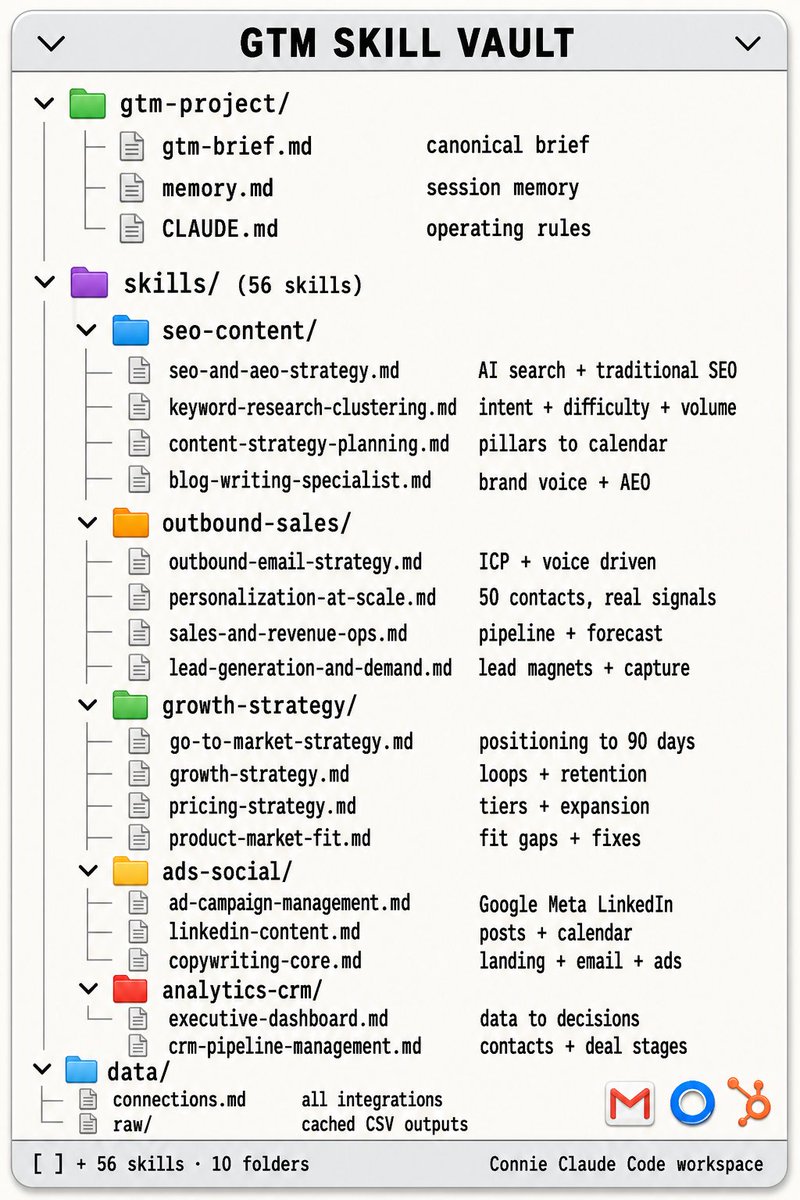
A complete Claude Skill Library can replace a $15,000/month agency retainer.
It is not as easy as hiring someone else to do it.
But if you start today, you can have 56 skills loaded into Claude covering SEO, content, outbound, sales, growth, analytics, strategy, ads, social, and CRM by end of this week.
I usually charge $299 for access to this library but today, it's free.
Like this post + comment 'Agents' and I'll DM you the entire skill library for free.
(Must be following, or I can't message.)
Taking this down in 48 hours.
this AI Agent scans digital product niches and tells you exactly which product type to build before you waste time making the wrong thing…
here's what it does:
type in any keyword and it scans the market for digital products that absolutely blew up in that niche
analyses exactly what made them go viral like hook structure, offer format, length, and conversion triggers
generates a full MD file you can drop straight into Claude or ChatGPT to make digital products in the same style
paste your own product idea in and it scans for similar digital products that went viral
gives your product a viral score so you know exactly how much chance you have of it selling
rewrites your product for maximum viral potential based on what's actually working right now
most people choose random products and hope. this tells you before you build whether it’s going to blow up.
comment "adaptive" + RT and i'll send you the full agent so you can stop guessing and start making digital products that actually sell
(must be following so i can DM)
For the next tutorial, I will teach you how to build a collaborative browser automation workflow builder with endless possibilities - here i instructed the agent to configure a new Porsche 911 and send me an email with the configuration link 😎






![diegocabezas01's tweet photo. Use Fable 5 as orchestrator and Opus + Codex to execute (to save fable usage):
Fable 5 (max reasoning) = orchestrator
Opus = deep reasoning subagent
Sonnet = mechanical work subagent
Codex = peer Sr. engineer, different perspective
Setup:
1. Set Fable 5 as your main model In Claude Code: /model → Fable 5 → reasoning /effort to max
2. Create 2 subagents with /agents In Claude Code:
deep-reasoner → pinned to opus "Use for reasoning-heavy phases, architecture, debugging complex issues, algorithm design. Think thoroughly, return a concise conclusion the orchestrator can act on."
fast-worker → pinned to sonnet "Use for mechanical tasks, boilerplate, tests, formatting, simple edits. Execute efficiently."
3. Add OpenAI's official Codex plugin (install codex cli in your computer first), In Claude Code type:
/plugin marketplace add openai/codex-plugin-cc
/plugin install codex@openai-codex
/codex:setup
4. Drop this in your CLAUDE.md in your folder:
## Orchestration workflow
You (Fable) are the orchestrator. Plan, decompose, synthesize.
Reasoning-heavy phases → deep-reasoner
Mechanical work → fast-worker
Codex (/codex:rescue --background) is a cracked engineer on par with deep-reasoner, from a different perspective. Treat as a peer, not a reviewer.
High-stakes decisions: task Opus + Codex on the same problem in parallel, synthesize the best of both, without showing either the other's answer. Keep your own context lean.
5. Then prompt Fable like a tech lead: "Goal: [what you want] Context: [files, constraints] You're the lead. Delegate reasoning to deep-reasoner, grunt work to fast-worker, fresh-perspective problems to Codex. Show me your plan first, then execute."
That's it.](https://pbs.twimg.com/media/HMLGA58XYAAP9vZ.jpg)