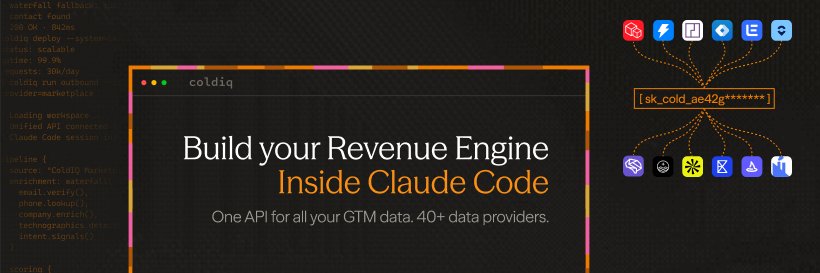
I'm exiting my $7M ARR agency to make the riskiest bet of my life.
I'm launching a unified API that lets any team run their entire GTM from inside Claude Code.
For three years we ran outbound for hundreds B2B clients and generated more than $50M in revenue for them.
Our best GTM engineers went from days to hours on the same campaigns just by writing a few lines to a coding agent.
If you really think about it, any tool is a login screen wrapped around an API that does the actual work.
Once you can call that API directly, a small team runs the plays that used to take a whole ops department.
But a coding agent is only as good as what you feed it: the right GTM skills, real outbound best practices, your keys across a dozen tools, your internal context, and every SOP, winning angle, and past result you have.
So we packaged all of it into one subscription that gives Claude Code the skills, the context, and the tools it needs.
Inside Claude Code, you type one line:
"Build a list of software CEOs in London, flag who's in buying mode, write three angles, and load it into my sequencer."
That's it.
1. It pulls the list from the right database
2. Enriches emails and phone numbers
3. Reads buying intent across several APIs
4. Writes the angles with ColdIQ's own skills
5. And drops it all into your sequencing tool.
One prompt, 40+ tools, each job routed to whoever does it best.
I don't say "riskiest bet" lightly. But I've trusted this instinct before, and it's the reason any of this exists. Before ColdIQ I got fired from four jobs and failed at seven startups in a row, and lost $40,000 of my own savings.
People still ask how I knew LinkedIn would be our channel. I didn't. I posted for a month and a half with zero leads, then one post booked me 25 meetings.
I eventually got the whole team on it, and LinkedIn has since added $5M in ARR.
The same instinct that made me double down on LinkedIn early tells me now that GTM is moving into the terminal, and I want to be the one building that layer.
We're opening private beta today and hand-picking a small group of design partners.
Once you're in, you get:
- a three-hour onboarding with our GTM engineers
- one of those sessions with me directly
- access to our private community with the team on hand for your questions
- a weekly live session where I build GTM campaigns alongside you.
Everything we can do to help you stand up your own GTM operating system.
If you're a GTM engineer, an agency, a B2B operator, or a data provider, I'd love to chat with you.
Comment 'GTM' below, send me a DM, or book a call with me, and I'll show you what we've built.
I sat down with ColdIQ's Head of Education, who's sent millions of cold emails and now runs 21 Grok Bots and 16 routines.
We broke down exactly how he gets unlimited leads with Grok Bot.
Here's the full breakdown. You can find the whole thing in the video below.
1,500+ LinkedIn posts in 4 years, 60M+ impressions. 5 formats got me 30M of those views in a single year.
They're in one guide now, broken down with infographics.
Best part? It's 100% Free.
What these 5 did for me:
- 2 million views on a single post, in one day;
- 30,000+ followers in 3 months;
- Hundreds of inbound leads.
And my business crossed $1M ARR with content and warm outbound.
Why mix the 5? If you repeat the same format over and over, your reach drops. That's because your audience wants to learn from different angles.
So how can you use the guide?
> Open it before you write: pick the format that fits the insight (depth, reach, trust, or a pitch);
> Rotate the 5 so 2 posts in a row never use the same one;
> Take one insight and turn it into 2 formats (a carousel, then an infographic). Repetition builds top of mind awareness, and a new format means your audience never sees the same post twice.
Here's how to get it:
> Like this post
> Reply 'post'
> Follow me so I can dm it
ColdIQ, a $7M ARR company, generated $506K from SEO + AI search in ONLY 4 months.
this is the breakdown of their insane system:
1. They unlocked thousands of pages that were literally blocked from search
ColdIQ had a large library of programmatic pages, but a lot of them had:
-> noindex tags
-> broken/missing canonicals
-> indexing blockers etc
the noindex tags were intentional because they were worried similar pages would cannibalize each other.
instead of blindly removing them, they analyzed thousands of pages + the exact queries each page ranked for.
they found the pages were different enough to target separate intent.
so they removed the blockers and switched the pages they wanted indexed to self-referencing canonicals.
that instantly opened a huge chunk of ColdIQ’s existing site to Google + Bing instead of creating more pages from scratch.
2. Bing was part of the strategy specifically because of ChatGPT
this is something a lot of people overlook
they made sure that their pages were indexable in Bing too because AI systems can pull fresh information through search infrastructure.
so the technical work wasn’t just “SEO cleanup.”
it directly affected whether ChatGPT could even discover the pages they wanted recommended.
3. Their content research pulled from places most SEO teams don’t combine
they used:
-> Ahrefs + Semrush + DataForSEO
-> SimilarWeb audience overlap + channel mix
-> Google Trends + Glimpse + Exploding Topics
-> live citations from ChatGPT, Perplexity, Gemini + Google AI Mode
-> Reddit + Quora + G2 + Capterra + TrustRadius
-> sales call transcripts
-> support tickets
-> live-chat logs
then they ranked opportunities by expected pipeline impact.
not just search volume.
that meant a question with lower traffic but much stronger buying intent could beat a huge keyword in the roadmap.
4. They turned ColdIQ’s own experts into the content channels
regular interviews were done with ColdIQ’s operators.
then those interviews were combined with:
-> LinkedIn posts
-> internal docs
-> existing content
instead of asking AI to invent “expert” content from scratch, they fed it actual internal knowledge buyers were already responding to.
the AI helped structure + scale it.
the expertise came from the company.
5. They reverse engineered the exact third-party sites shaping AI answers
for the prompts they cared about, they scraped:
-> which domains got cited
-> which sources kept influencing the answer
-> which third-party sites affected brand mentions + sentiment
those domains then became outreach targets.
so instead of only asking:
“what should we publish on ColdIQ (dot) com?”
they also asked:
“which websites does ChatGPT already trust for this question, and how do we get ColdIQ represented there?”
6. Reddit wasn’t treated like a traffic channel
they looked at which Reddit threads + subreddits were already getting cited by AI.
then they engaged specifically in those conversations and even started new discussions around attributes they wanted associated with ColdIQ.
the goal wasn’t Reddit clicks.
it was influencing the source material AI systems were already using to understand the category.
7. Their attribution system separated what they could PROVE from what they could only infer
AI search attribution is messy.
someone can discover ColdIQ in ChatGPT, close the tab, then Google “ColdIQ” 2 days later.
analytics calls that Google/direct traffic.
so they tracked:
-> first click
-> last click
-> assisted conversions
-> what prospects said on sales calls
-> what they reported during onboarding
-> CRM attribution
then they kept 2 numbers:
“clean attribution floor”
vs
“realistic influenced attribution”
clean attribution alone showed:
-> 15,700 visitors
-> 362 conversions
but when accounting for the direct lift, the estimated influence was much larger:
-> 55,813 visitors
-> 1,431 conversions
this is a much more honest way to measure AI search than pretending every customer clicks straight from ChatGPT into checkout.
8. The results
-> $506K in signed contract value
-> LLM search traffic grew 7.6X
-> organic search traffic grew 7.3X
-> SEO + AI search became their #1 traffic source
-> traffic share doubled from 16.5% to 33.3%
-> ranking keywords increased 983%
-> direct traffic increased 93%
-> ColdIQ went from 0 AI visibility to being recommended across dozens of high-intent prompts
the biggest takeaway:
don't just “publish AEO content.”
they unlocked pages that were already buried, fed real buyer language into the system, tracked the external sources AI already trusted, and measured AI discovery beyond last-click attribution to just name a few of the things they did.
if you want us to find where your company ranks + turn AI search into pipeline,
reply “BRR”
Actually a very insightful debate for agency owners between Eric & Kellen
The name of the game for scaling an agency = client selection.
What’s unfair though is that the most skilled operators get to pick the easiest clients.
Meaning, the folks most equipped to help struggling businesses, are busy helping businesses that don’t need that much help
1) I was driving with my mother in law and got his response.
2) Jordan also runs a super successful education business and this whole video is a promotion to get people to subscribe to his education. Actually, I'm very jealous of how much revenue he does on it haha.
3) I can concede that but then he said never pre market fit.
Kellen, I'm in no way trying to say your skills are not good. I've also just said publicly I think you're very talented and I respect your work a TON.
I think of a company as pre-product market fit as someone who hasn't figured out who their customer is and how to best serve them.
As an agency receiving no equity (I presumed from the post) you are being paid to solve a highly critical part of the business which ultimately is the founder's responsibility and it is irresponsible of them to think they can hire people fractionally to solve this for them because this is the hardest part of the business.
Can it work sometimes? absolutely, but I still think the founder is responsible for everything from the start to product market fit and is rolling the dice going to someone else they aren't giving equity to, to try to solve this for them.
And then running an agency or a service, I think if you genuinely like doing this work, go for it.
But I would advise publicly, 1:1, anywhere that if you're this good at this segment, you would have more impact serving companies with product market fit.
Bottom line, I'm not saying your abilities are lower. I'm saying as a fractional marketer or agency, this isn't your job to fix this and if you do you should get equity.
and if you like this work, great. But I will hold that I think you and everyone else that likes this stage could take your exact talents and have more impact in every way upmarket.
I guess this won't matter because you said no matter how many defending points but I think you're great. I think even the person that made this post is probably great.
I think if you don't have equity, that this isn't your job and you should take the same talents and go upmarket.
Which I would say directly to you. I think you're great, you should go upmarket.