My co-founder gave me 8 words of advice in January 2022.
They've fueled 3 companies since, including one I sold.
Here they are: "Pierre, you have things to say. Start posting."
At the time, I had 2,000 LinkedIn followers and an agency that needed clients. Here's what happened next:
My first job was at the Embassy of France in Thailand, as a communication advisor.
Then I went freelance, traveling across islands while running ads and funnels for clients 10 hours a day. Later, my co-founder and I turned that into an agency.
The first year of posting was slow. Some of my posts got 200 views. I posted again the next day.
Then a post about ChatGPT went viral (February 2023). I could have become "the AI guy". I said no and stayed on B2B marketing.
A few months later, I started drawing infographics. They became my unfair advantage (one of them reached 1.9M impressions).
The agency went from $0 to $1M in 14 months.
In September 2023, we sold it.
I went solo with 50,000 followers.
My first course came out of a single LinkedIn post. It made $270,000+.
(Forbes even featured the business.)
In 2025, I co-founded ContentPath.
It's now at $1M ARR.
Along the way: 40+ GTM and content systems installed, 500+ client posts published every month, and brands like lemlist and Semrush as clients.
I've posted every day since 2022. 4 years later:
>2,000 followers → 170,000
>35,000 newsletter subscribers
>60M+ impressions
>500+ marketing strategies audited
On X, I'm back where I was in January 2022.
So I'm taking my co-founder's advice again: start posting.
Follow along, and I'll teach you how to:
>Build a content strategy that books sales calls
>Position your brand so buyers stop comparing you on price
>Turn 1 insight into 20+ pieces of content (my 20/80 repurposing system)
>Design infographics people save and share
>Turn post engagement into warm conversations and clients
>Plan your marketing backward from a revenue target
>Get your whole team posting, the way we do it at ContentPath
Let’s go.
In the summer of 2023, I gained over 30,000 LinkedIn followers in 3 months.
It started when I began posting infographics.
I've made over 1,000 of them since, and we just used the same method to get a 2-month-old brand 167,000+ impressions and 817+ saves from a single post.
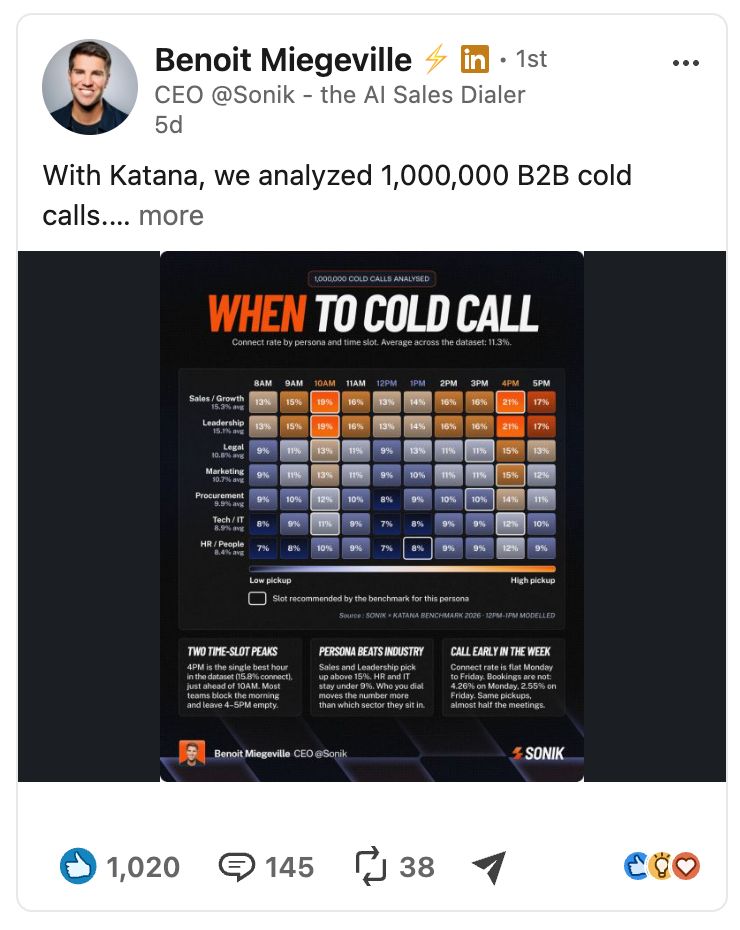
The brand is an AI dialer for sales teams that had just rebranded. We were helping their CEO launch the new name on LinkedIn.
They had studied 1,000,000 B2B cold calls with a data partner, so we turned part of that study into a heatmap showing when to call each role, hour by hour.
That's why it got so many saves. Sales teams come back to it before they pick up the phone.
Behind it is a simple formula of winning formats, unique insights and a signature visual identity. Here's how to run it for your own brand.
1. Start with your visual identity. Turn your brand's colors and fonts into a LinkedIn look people recognize. For this brand, that meant a strong black and orange palette, bold fonts and signature elements.
2. Build a knowledge center before you post. Collect your resources and interview your in-house experts, so every post idea comes from what only you know.
3. Pick 3 content pillars. Theirs were the CEO's sales and founder story, the cold call + AI playbook, and life behind the scenes.
4. Use formats that already outperform, and fill them with your own data. For this brand, that meant a 2020 vs 2026 table on how the BDR role changed, and the heatmap below.
5. Ship fast and keep publishing. Their first visuals were live within 2 weeks, and 14 posts went out in 7 weeks. You never know which post will take off.
Want signature content that stands out in the feed and converts? Book a call with us. The link is in the first reply.
How to actually find B2B clients:
I've grown 2 companies to $1M with content + social selling, including my current agency, ContentPath. Here's the playbook we now run for our B2B clients.
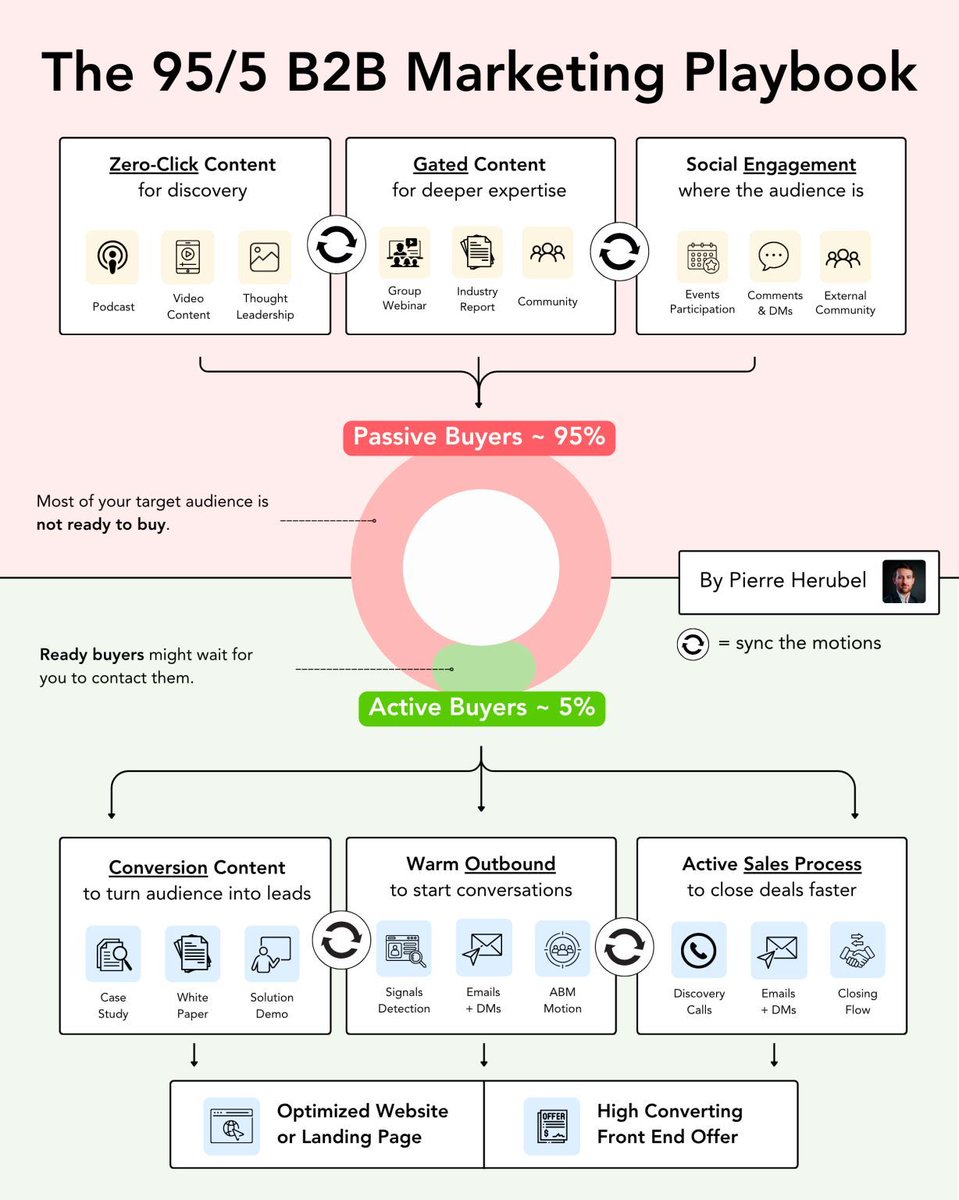
It's built on one split. About 95% of your market isn't ready to buy right now, and 5% is. You need a plan for both, running in sync:
1/ Passive buyers (95%): get known before they need you
They're keeping up with their industry and their job. So be the one they learn from:
- Open content for discovery: podcasts, video, and posts from your founder and team
- Gated content for deeper expertise: webinars, industry reports, a private community. Keep it to about 1% of what you publish, and make it excellent.
- Social engagement where they already are: events, comments and DMs, outside communities
2/ Active buyers (5%): reach them before a competitor does
Being ready to buy doesn't mean they'll reach out. So don't wait for them:
- Conversion content to turn your audience into leads: case studies, white papers, demos
- Warm outbound to start conversations: message anyone who downloads a report, signs up for a webinar or visits your pricing page, and run ABM on your larger accounts. The warmer the signal, the more direct the message.
- An active sales process to close deals faster: discovery calls, follow-ups by email and DM, a clear closing flow
3/ Both plans lead to 2 things
- A website or landing page that converts
- An entry offer that's easy to say yes to (build this one first)
B2B founders have paid me to teach them this playbook. Now it's free for everyone in the article below, including how to run it on LinkedIn.
(bookmark for later)
My co-founder gave me 8 words of advice in January 2022.
They've fueled 3 companies since, including one I sold.
Here they are: "Pierre, you have things to say. Start posting."
At the time, I had 2,000 LinkedIn followers and an agency that needed clients. Here's what happened next:
My first job was at the Embassy of France in Thailand, as a communication advisor.
Then I went freelance, traveling across islands while running ads and funnels for clients 10 hours a day. Later, my co-founder and I turned that into an agency.
The first year of posting was slow. Some of my posts got 200 views. I posted again the next day.
Then a post about ChatGPT went viral (February 2023). I could have become "the AI guy". I said no and stayed on B2B marketing.
A few months later, I started drawing infographics. They became my unfair advantage (one of them reached 1.9M impressions).
The agency went from $0 to $1M in 14 months.
In September 2023, we sold it.
I went solo with 50,000 followers.
My first course came out of a single LinkedIn post. It made $270,000+.
(Forbes even featured the business.)
In 2025, I co-founded ContentPath.
It's now at $1M ARR.
Along the way: 40+ GTM and content systems installed, 500+ client posts published every month, and brands like lemlist and Semrush as clients.
I've posted every day since 2022. 4 years later:
>2,000 followers → 170,000
>35,000 newsletter subscribers
>60M+ impressions
>500+ marketing strategies audited
On X, I'm back where I was in January 2022.
So I'm taking my co-founder's advice again: start posting.
Follow along, and I'll teach you how to:
>Build a content strategy that books sales calls
>Position your brand so buyers stop comparing you on price
>Turn 1 insight into 20+ pieces of content (my 20/80 repurposing system)
>Design infographics people save and share
>Turn post engagement into warm conversations and clients
>Plan your marketing backward from a revenue target
>Get your whole team posting, the way we do it at ContentPath
Let’s go.
Turn your revenue goal into a daily number your team can hit.
$100K from 1 channel → 5 deals at $20K → 25 calls at a 20% close rate → 500 conversations at a 5% booking rate → about 12 new conversations per working day for 2 months
Many founders confuse marketing strategy with tactics:
- They think "running ads" is a strategy;
- They think "posting daily" is a strategy;
- They think "doing webinars" is a strategy.
Because of this confusion, they don't have a high level plan.
- Who are we helping;
- For what problem;
- How we solve it differently;
- And what do we say.
As a result, they lack focus and direction.
- "Let's try this new channel!"
- "I read about a new automation hack!"
- "We don't want to miss this opportunity"
And it puts the business into a reactive posture:
No clear direction → Something external happens → We react to it → We try a new tactic → Intensify the lack of direction
To get out of this reactive marketing loop, you need to:
Distinguish strategy from tactics.
1. Strategy comes first: It's the high-level plan that guides how to achieve revenue goals.
2. Tactics come second: It's the specific actions and methods used to execute the strategy.
And don't forget the feedback loop between them.
Tactics' results always inform the strategic decisions.