Why would men have a 'dream date'? They are focused on the person they are going on a date with, not the peripheral activity that acts as an excuse to know them. They are interested in YOU. The date is just dressing. A setting.
Bukele is fascinating because he has understood better than most that in the modern era small states are well positioned to operate as a kind of PMC: offering a fully integrated carceral stack that can be distributed as a platform to neighboring states with weaker state capacity
I think pretty strongly that left of center outlets that want to be more respectable than the dregs of right-wing Twitter should have pretty strongly taboos against this sort of ugly us-versus-them racism
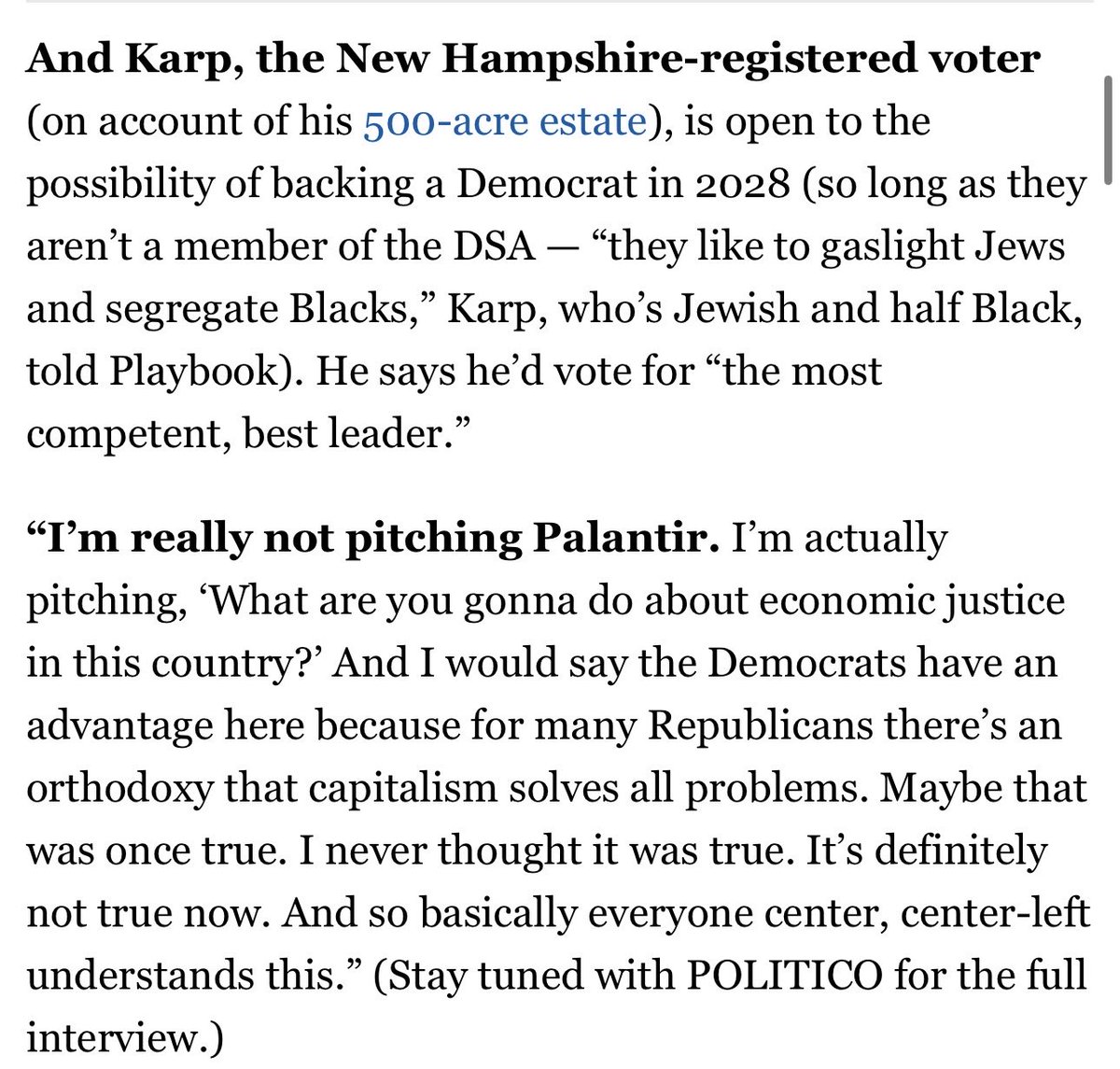
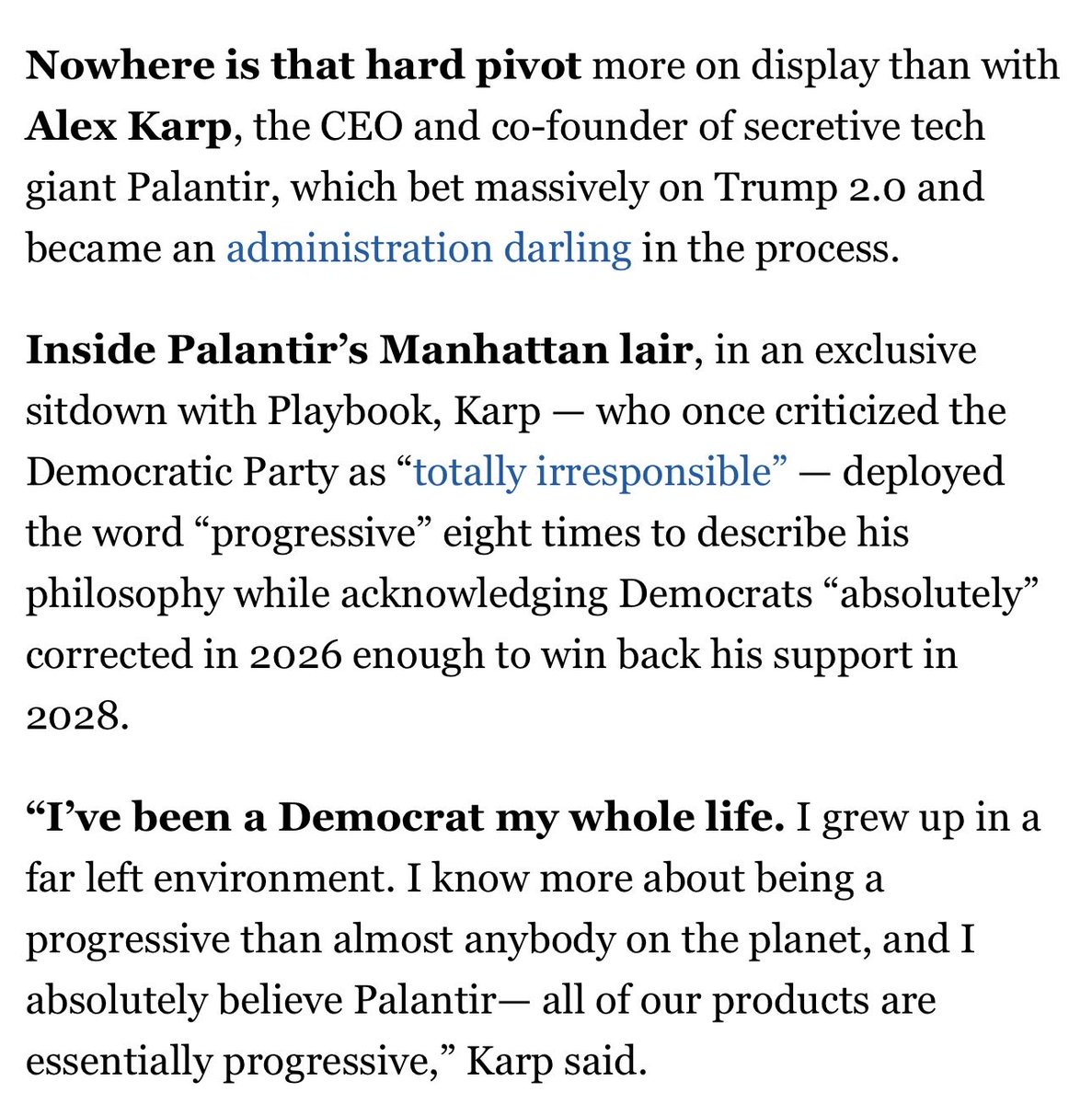
Alex Karp now says that Palantir is progressive, he’s always been a Democrat, Trump went too far on immigration and his primary commitment is to economic justice. LMAOOOOOO
First, I note not a single one of my clients is named. Lesson there.
Second, trying to ban "Mastodon" shows just how illiterate this government is on Internet issues; Mastodon is a specification, not a website. It's like trying to ban e-mail.
Jean D'Arc seems like a reasonable proxy for just absolutely maxed out charisma within human biological constraints and basically on the spot critical hit everyone she interacted with and is so charismatic that 600 years later she basically charisma snipes rational atheists into being like "yeah god chose her." So even setting aside true superhuman traits my assumption is that truly maxed out human level capabilities are quite impactful and not merely a "slightly better" kind of thing.
writing code in an interview is now larping in the literal sense. like you are straight up live action roleplaying a historical reenactment of what it was like to be a software engineer.
Normie take but: pictures of the physical goods you’re selling is the dumbest possible use case for AI
1) allegedly you regularly produce the item in question so what exactly is going on here ¿
For the same reason, San Francisco is an overwhelmingly poor city.
Wealth does not look like engineers crammed 5 roommates to a unit, it looks like a barista with a 3 bedroom flat.
Being "poisoned" in the sense of the HF incident agents (i.e. exposed to information that irreversibly compromises your ability to do something) is a super useful concept. I find myself using it pretty often
Timnit is explicitly verbalizing an extremely important phenomenon which is that the recipients of charity are deeply psychologically wounded by the state of subservience to their providers.
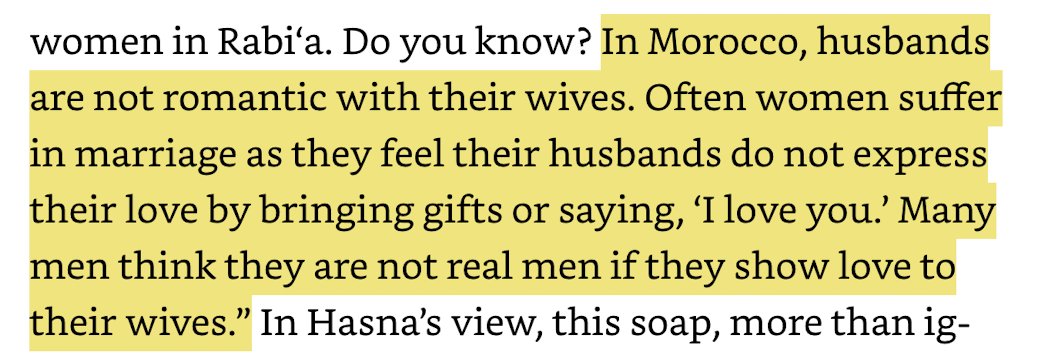
This is genuinely one of the most important world intercultural differences and one that I think very few westerners understand. Historically societies that idealised male brotherhood were probably more common than those that idealised the marital bond. As with many things, the world has homogenised somewhat over the last 50 years or so, but far from completely.
In many patriarchal societies, loving your wife is stigmatised, because it reveals you are beholden to her, under the thumb, prioritizing her welfare.
Other men may mock those men seen to love their wives, it is shameful.
There’s a type of fiction writing I call “Workshop Slop”.
It’s the kind of very efficient, hyper-“optimized”, minimalist, rule-based writing style adopted as dogma by top Creative Writing MFA programs.
In many ways, Workshop Slop was a precursor to AI Slop.
Just like AI writing has its recognisable tics, so too does writing that is written by someone who has had their soul workshopped out of them firstly on their MFA and then by their MFA-educated editor.
One of the few positives I see coming out of the rise of AI slop is that it’s cultivating in people a disgust response to formulaic, hyper-“optimized” writing.
Workshop Slop is not only very formulaic but also very easy for AIs to replicate, so hopefully it will start to trigger this disgust response twicefold in people.
It would be great if this encourages people to experiment with writing styles that emanate from their hearts rather than from the aesthetic dogmas of the literary equivalent of an HR department.
When I read older books, I'm always struck by how unoptimized they are. Books wandered in their prose, had meandering backstories for side characters, and had strange and illogical plot points. Now, it's like every word in a book has to be razor-focused, hurtling toward the conclusion. There's no room for idle dreaming.
Greetings young Sith, let’s have a chat.
Your essay is insightful and, at its core, substantially correct. I accept your reading of the Boomer generation and the mythology of Star Wars. The aesthetics, the simplistic moral universe, the endless recasting of every political disagreement into a struggle between liberators and Nazis, the treatment of Alderaan as a rubber stamp reading VILLAIN, the discovery that the hippies eventually became the Jedi Council, and the extraordinary hypocrisy of a generation that overthrew its fathers and now regards succession as an existential threat.
All of it. The frame is good. It is thick enough to be genuinely useful, even as it exposes the remarkable thinness, and frankly the stupidity, of the worldview it describes.
But something important is missing.
An entire generation, in fact.
And the absence of Generation X from your account reveals a larger story. One that makes sense of the Boomer mythology, explains why it took the form that it did, and introduces a rather serious problem with your proposed solution.
@SamoBurja What about private knowledge? It might be obvious to you that someone in your local scene has potential even if it is less obvious to a funder who is more distant.
I encourage anyone who doubts this to try and make a real AAA game and apply your own real critical game quality standards to it.
I am making one right now and while Opus 5.5 (Fable and Astra can't do it) can do many of the coding tasks, it simply isn't able to make gameplay design and UI design decisions at the level of detail and correctness demanded by a GAME.
My theory is that it's because the quality requirement in a game is ironically higher than for e.g. a SaaS application.
SaaS or other "work" applications provide economic value for using it, so as long as your economic value gained is high enough, you'll tolerate bugs and UI imperfections and lag, even outright illogical app behavior - as long as it does the thing you need it to do.
But when you're playing a game, your willingness to continue doing so rests entirely on the quality of the experience. And that's impacted by gameplay, fun, UI, story, etc. If there's any sort of "irritant" like a part of the interface is janky, or something consistently looks wrong, or the gameplay does something illogical, or it's laggy, etc - you don't have any incentive to keep going.
To keep someone playing a game, the experience has to be far better than that - maybe not perfect - but it still has to be great.
What I'm finding is the Opus 5.5 will make a game at roughly between 50% to 85% quality level. If you give it a lazy prompt, it'll puke out something with blocky graphics and barely-working gameplay: 50%. If you iterate a bit and give it more details, you can get it up to 85% or so - playable, can generate impressive screenshots and maybe even gameplay clips - but that last 15% or so still needs hand-tuning and human taste-making.
You can have it read every game design and UI/UX guide you can find, and it just won't build anything better than "kind of workable." And "kind of workable" is often enough for a work app. I have like a dozen vibe-coded utility apps that roughly do the thing I need them to do (track stuff, manage some kind of data, visualize something) but they're not worth polishing because they're good enough to perform the function.
But with games I can imagine someone else looking at it with the same critical eye that I would, if I were playing it:
- these buttons are a little out of place, the alignment isn't perfect
- why does this icon which does the same thing as this other one look different?
- this tree or shadow looks weird from this angle
- this game element acts a little janky under these conditions
- there's lag when stuff gets busy
In particular, AI doesn't seem to be able to create really good custom UIs. If you have a bunch of commonplace functions then yeah, it'll use a UI template. But if you have a game, and the game involves doing a bunch of unusual (fun!) things, you want the UI to engage the user's intuition about it, show the right responsiveness or progress of an action, act correctly in certain unusual corner cases (because fun often involves corner cases) etc, and AI can't quite get all of it right yet. It's workable, you can often see the vision - but it's not a game. No AAA game studio would ship what AI produces today.
Much of this seems to be about paying attention to the right details. Maybe subsequent models will be better (they often are). But right now a human still has to look at every little corner of the game, decide if it's acting just right, then specify in extensive detail exactly what should happen and why, and what overall effect is intended.
The good news is that one person can be the gameplay designer, the artistic director, the engine developer, the interface designer - you can do all of these jobs and let the AI carry out the tasks.
The bad news is that one person has to be the gameplay designer, the artistic director, the engine developer, the interface designer... and I'll probably have to be the marketing guy later when/if the game is released.
Consequently, I've had to quickly learn the fundamentals of all these disciplines. Unsurprisingly given my SWE background, the engine on my game is quite well-optimized even with tons and tons of moving things and physics. But the gameplay is another thing and I don't even know the right terminology to describe a lot of the art/graphics things I want to see, and... oh my god, UI design is an AI clusterfuck...
Back in the day, tech companies sort of had a hierarchy of respect when it came to technical staff - I'm a little ashamed to say - it was roughly:
1. backend engineer
2. frontend engineer
3. visual designer
4. UI/UX designer
Yes, the lowly UI/UX designer, at the bottom of the totem pole - not even considered "real" designers - they were ones responsible for deciding where to put the buttons and what fonts to use.
Well, today the AI does everything else but it still can't design a great interface worth a damn. So yeah, to the UI/UX designers I knew: I owe you an apology. I wasn't really familiar with your game.
Of all of the tasks, this is the one that AI can't seem to do - I have to tell it how to do things and it's extra hard when I don't even have the terminology. I can describe how I want things to work, but the AI doesn't have the interiority of a human user - there's a lot of intuition and feelings involved - it does boneheaded things, ignores critical details that would be obvious to a human, doesn't realize which things it absolutely mustn't overlook on a UI and worst of all: even when I feed it a precise sketch of the interface I want, it ignores critical details because it simply didn't realize those details were key.
(example: when I draw this thing next to this other thing, it literally means they need to be next to each other)
If anyone wants a benchmark: I've been working on a game for about 6 weeks now - coincidentally I got started right before Opus 5.5 came out (when attempts with Astra just couldn't cut it). Granted, I have a day job so a lot of that was after-hours and weekends but I'd estimate that I have gotten done the equivalent work of a 10-person studio working for ~6 months. So there's definitely leverage here, but there's definitely a lot more work to go before this is a real game.