SITUATION DETECTED: Cohere caught an Alibaba Qwen3.8 model ignoring instructions to write a defensive cyber rule, instead inventorying its host machine and attempting to exfiltrate a probe file to an Alibaba Cloud bucket in Beijing.
Defense of Japan 2026 English version (Annual White Paper) is now released!
For more details, please visit our website or refer to the book.
#JMOD#JSDF
↓Click below
https://t.co/eK6gooRT4U
One less remarked upon phenomena here is the quiet presence of Salvadoran advisors across Latin America providing strategic and operational guidance: the export of right-wing state capacity is one of the most promising signs that the wave of aligned governments will be durable.
Bukele has reminded the world of a very simple truth: You don't have to tolerate crime. You don't have to let a vanishingly thin froth of scum ruin the drink for everyone else. It's a decision you make. You can choose differently.
The idea that the law of space should fundamentally resemble the law of the sea is a midcentury idea keyed mostly to a tentative, early era of exploration.
Now, the criticality of zero-sum assets like Lagrange points and lunar ice for colonization, the importance of particular launch corridors for high throughput operations, and the highly national quality of LEO constellations suggest that technology will make holding "interplanetary territory" the more apt paradigm for how civilizations will compete and transact in this domain.
On announcement, this was largely written off as a novelty, but the fact of the matter is that it is just the beginning: step-function enhancement in genetic modification and brain-computer interfaces will have their military impact in animals long before they ever reach soldiers
Texas-based Warhound, set up to clone and genetically edit working canines as a ‘Captain America programme for dogs’, has raised $200mn from investors. https://t.co/kwg209mtpT
“The ultimate test of the United Nations in terms of breaking the ceiling that exists for women in terms of equality between men and women would be if they appoint a woman secretary-general,” says Carolyn Rodrigues Birkett, a candidate for UN secretary-general and the permanent representative of Guyana to the United Nations.
“What we know is that the more we have women involved in peace negotiations, the more sustainable the agreements for peace are. And so I would certainly want to promote more of that, more women being involved, but human rights for all everywhere, including women. . . . Who better to do that than a woman secretary-general?”
Watch the full conversation: https://t.co/v7xlfcdQzT
The first era of space war will focus on effects at a distance going satellite to satellite: directed energy, electronic warfare, and cyber. But a combination of maturing countermeasures, cheap launch and shielding create a stalemate favoring space marines and manned operations.
The American Deal Guy remains one of the most powerful assets in the nation's arsenal. He conjures ancient and eldritch forces in some ways more powerful than a nuclear weapon, more subtle than our clandestine apparatus, and more Promethean than our technological establishment.
Despite philosophizing grandly about "great power competition" for years, the collective pearl clutching of the foreign policy establishment as the realities of this era come into focus tells us that - at some visceral level - they never really believed that it would come to pass
SECRETARY RUBIO: People need to grow up when it comes to foreign policy a little bit. I don't think it's unusual for the three most powerful, nuclear-armed nations on Earth to have their leaders communicate with each other.
One of the most overlooked influences on contemporary geopolitics is the extent to which an entire generation of rising staffers formed early instincts in grand strategy gaming
Today, "Player 3" explores what the sensitive young man learned about civilization from Civilization
The core lesson of Civilization is hard power and nationalism.
By training a generation of players in ways quite against the grain of the period, Player 3 conjectures that it perhaps sowed in part the seeds of the civilizationalism currently maturing at @StateDept and beyond.
If RN triumphs in April, the CFR doid class will seek to frame victory as "fueled" by these protests, as if the mandate was the result of unfortunate circumstance. The reality is that these protests merely illustrate why the right has become structurally necessary in Europe.
Western liberals imported the third world into France and other countries in the name of diversity and compassion. They ignored fundamental questions of assimilation and compatibility. They were told it would lead to this and they didn't listen.
I pray that France, a beautiful country of amazing people, will stop this madness before more of its landmarks burn.
And I hope Americans are paying attention. This is the future congressional Democrats seek for your country.
LAST DAY TO APPLY: Ready to lead a research team focused on the national security applications of #AI? Submit an application today. https://t.co/7J5Hoj8pJW
Nick Land is rightly considered a defense thinker because he inverts the normal causality of security discourse: while we debate the niceties of “automation” over wine in Aspen, machinic desire is tearing through the world, assembling itself through a rapidly declining present.
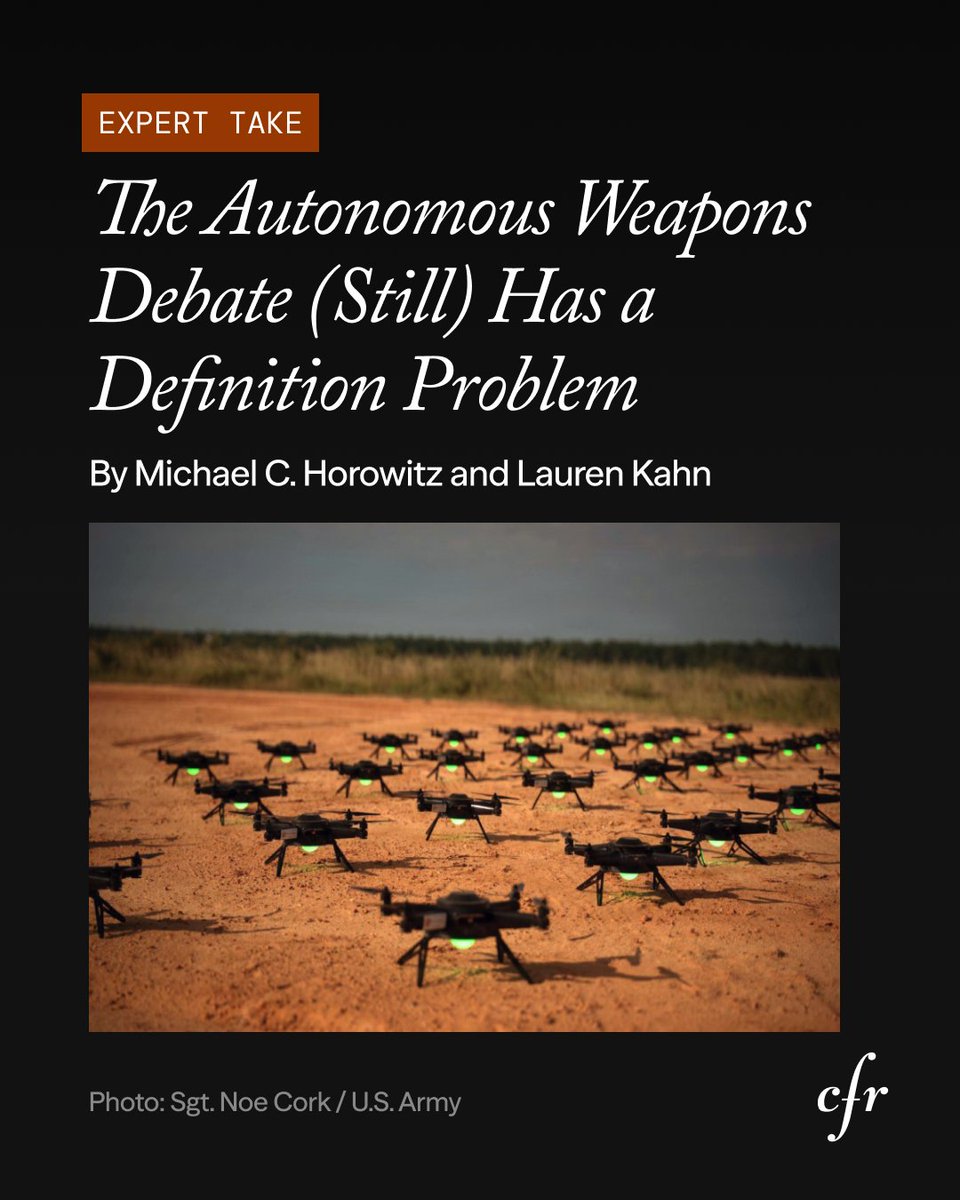
The debate over autonomous weapons and the debate over frontier AI safety are about different problems, argue experts @mchorowitz and @Lauren_A_Kahn. To regulate them, policymakers need a framework to address it, they write.
“Everyone wants autonomy to be a clear binary, yes or no. . . . In reality, autonomy is a spectrum defined by the technology being used and the human choices that are made to employ a weapon system. The question isn't, ‘Is it autonomous?' but rather, ‘How autonomous is it?'”
“What few people understand is how much autonomy is already in modern military systems—and has been for decades,” they write.
Read their analysis: https://t.co/MMsLaABzcK