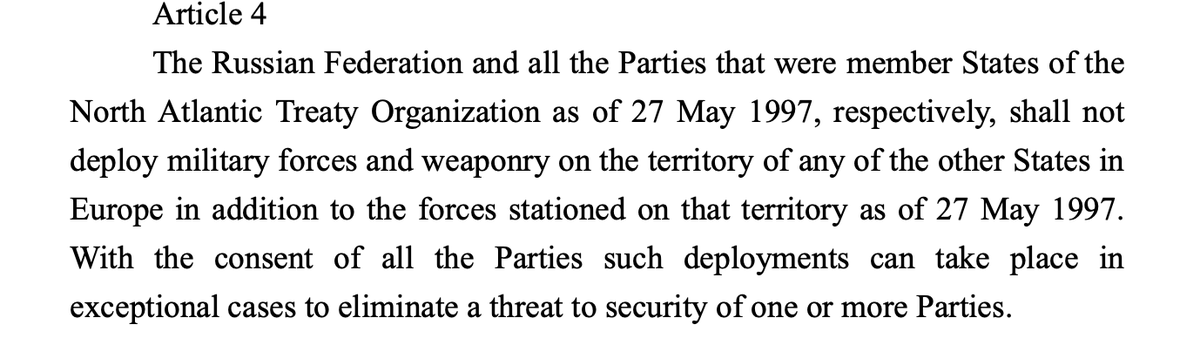
@itsdaniryan The difficult thing about this kind of argument is it's purely psychotheraputic. "Sure, NATO won't invade Russia, but how can we expect Russia to know that!" Maybe the entire history of the alliance? All its behavior since 1989?
@itsdaniryan Plus if we actually accept the RU argument, what's the point of opposing NATO? US/UK don't want anyone invading Russia, in fact they want the opposite! No NATO = a non-Anglophone Euro bloc comprised of countries with real historical grievances or prior threats!
@itsdaniryan But instead the psychology of Russia's position trumps any concrete evidence. Why must we accept Russian psychological paranoia compared to, say, Baltic, Nordic, Polish, or Ukrainian "paranoia," when Russia has invaded all these countries/regions in the past century?
@scharap “There is a pattern here of asking Ukraine for proposals and not liking the result. It happened in 2014, arguably 2022, and again in 2025 and today.”
@WeaponScientist While you're certainly right in some respect, we can also see the replication of military tasks for less cost in other contexts. The "combined" element of combined arms is what really matters (a point that Wilf Owen hammered home in British Army Review 10 years ago).
@Volod_Ishchenko Both you and Alex are wrong. Operationally speaking you can't have NATO command structures without "foreign troop deployments." And RU's not exactly signaled openness to massive CEE force buildouts (cf every demand for UA force limits).
@MarcusMStanley@Volod_Ishchenko I would have sympathy for this argument if any RU behavior since, well, 1991 indicated Moscow wanted to engage in security consultations with Europe in good faith. Instead it wants a privileged position. Maybe it takes that by force, but it has no right to it.
@MarcusMStanley@Volod_Ishchenko And on verification: RU routinely and flagrantly lied about exercises under pre-2021 notification norms. Why wouldn't that continue? What about a postwar architecture would change this?
@MarcusMStanley@Volod_Ishchenko The verification elements are equally disingenuous. RU wouldn't actually accept a demilitarized/verified zone well into the (former) Western and Southern Mil Districts. But they'd insist on verification across the frmr WP.
@MarcusMStanley@Volod_Ishchenko You're playing w/legal semantics here. The point is obviously "remove core mechanisms of NATO protection from the states, so that in a future crisis they are vulnerable, justifying either a great power deal or, perhaps, a special military op!"
@kirlant We both know they are reconciled only when the costs of continued intransigence are dramatically increased. Otherwise negotiations are just attrition.
@Volod_Ishchenko The Russians lost their contest for power. They may well win this one. Neither aspect legitimates their demands. Nor does it compel their neighbors to abide by them if geopolitical alternatives exist. Realpolitik cuts both ways.
@Volod_Ishchenko Sure, Russia didn't say "roll back." It just said "don't deploy military force in these countries." Gosh, I wonder why? The spectre of NATO invasion, yeah?
@Volod_Ishchenko The thing I'll never understand about this perspective is what taking Russia seriously means. The Russian demand was, and remains, "we know the Cold War didn't go our way, but give us back everything but Germany!" Apart from capitulation, what would have been a serious response?