To end the fighting in Ukraine, U.S. negotiators should abandon their narrow land-for-guarantees formula and instead structure a deal around the parties’ core security concerns, argue @scharap and @jekavanagh.
https://t.co/yTlrFi6xis
To end the fighting in Ukraine, U.S. negotiators should abandon their narrow land-for-guarantees formula and instead structure a deal around the parties’ core security concerns, argue @scharap and @jekavanagh.
https://t.co/yTlrFi6xis
Instead of pursuing a land-for-guarantees deal in Ukraine, U.S. negotiators should “seek a more comprehensive arrangement, one that addresses the credible commitment problem,” argue @scharap and @jekavanagh.
https://t.co/yTlrFi6xis
“If U.S. officials want to end the long, bloody war between Russia and Ukraine, they must stop anchoring the process on a narrow land-for-guarantees formula,” argue @scharap and @jekavanagh.
https://t.co/yTlrFi6xis
“If U.S. officials want to end the long, bloody war between Russia and Ukraine, they must stop anchoring the process on a narrow land-for-guarantees formula,” argue @scharap and @jekavanagh.
https://t.co/yTlrFi6xis
The Trump administration is determined to end the war in Ukraine, but “structuring a peace agreement around land for security guarantees has not worked yet and is unlikely to work in the future,” write @scharap and @jekavanagh.
https://t.co/yTlrFi6xis
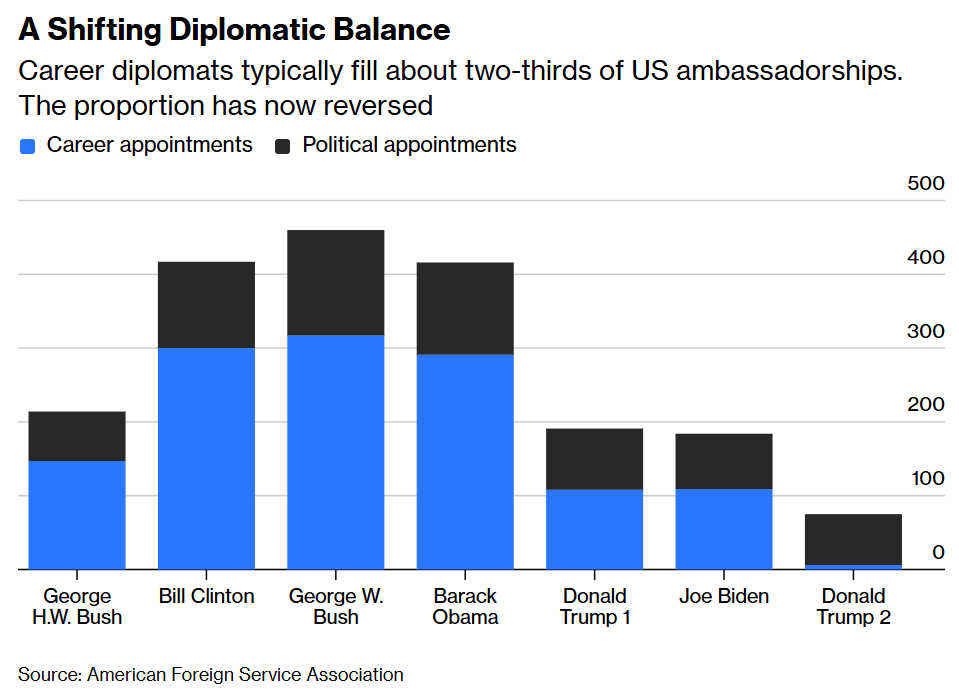
US diplomatic corps are but a shadow of their former self "Out of 195 ambassadorial postings around the world, more than 110 sat empty as of early March-including in countries as vital to US interests as Germany and South Korea" @business
https://t.co/5e31jUQYx2
In Ukraine, U.S. negotiators should start treating talks “not as a barter of land for security guarantees but as the foundation for stable—if hostile—relations between Russia and Ukraine and, eventually, Russia and NATO,” argue @scharap and @jekavanagh. https://t.co/tuzw2SH4IA
.@scharap and @jekavanagh argue that trading territory for security guarantees is unlikely to achieve a lasting peace in Ukraine:
https://t.co/yTlrFi6xis
“If U.S. officials want to end the long, bloody war between Russia and Ukraine, they must stop anchoring the process on a narrow land-for-guarantees formula,” argue @scharap and @jekavanagh.
https://t.co/yTlrFi6xis
.@HiskiHaukkala, langjähriger Berater des finnischen Präsidenten, hat in "Foreign Affairs" mit @scharap einen ausführlichen Text zur Frage geschrieben, wie das Verhältnis der Europäer zu Russland nach dem Krieg aussehen sollte. Ein "back to normal" wird es nicht geben, aber auch ein simples Aufstellen von Panzersperren und Geschützen an der Grenze birgt Risiken der ungewollten Eskalation. Kurzum: Wie lässt sich trotz Gegnerschaft das Risiko eines Kriegs durch selbsterfüllende Prophezeiung verhindern? Hiski Haukkala hat da im Interview mit dem @sternde als Finne nicht nur ein besonderes Interesse, sondern einige gute Ideen. (€)
https://t.co/7WF8LpHz2n
I spoke with RAND's top Russia expert @SCharap about Ukraine and avoiding NATO-Russia conflict turning into open war.
Things I learned:
1. Russia has accepted Ukraine joining the EU (in 2022).
2. Finland joining NATO has made defending the Baltic states much easier.
3. Ukraine has options to build 'porcupine defences' during a ceasefire, making a Russian re-invasion very painful.
4. Ukraine would accept an unconditional ceasefire right now. Russia won't as they believe they're winning.
5. Research suggests China's calculus on Taiwan is shaped more by US behaviour in Asia than by what happens in Ukraine.
6. Russia sees itself as weaker than NATO, such that the biggest escalation risk comes not from a land grab, but from Belarus disintegrating.
7. Deploying UK/French troops to Ukraine probably does more to prevent a ceasefire than to deter Russian invasion.
8. The "snapback" mechanism in ceasefire negotiations would flip the burden of proof and reimpose sanctions and deep-strike weapons automatically and immediately should Russia violate it.
9. Parts of the Russian military probably knew the 2022 invasion plan was insane but couldn't stop it.
And plenty more. On the 80,000 Hours Podcast, enjoy! Links below.
• Could peace in Ukraine lead to Europe’s next war? (00:00:47)
• Do Russia’s motives for war still matter? (00:11:58)
• What does a good ceasefire deal look like? (00:18:16)
• What’s still holding back a ceasefire? (00:40:15)
• Why Russia might accept Ukraine’s EU membership (00:47:51)
• How to prevent a spiralling conflict with NATO (00:49:58)
• What’s next for nuclear arms control (00:51:56)
• Finland and Sweden strengthened NATO — but also raised the stakes for conflict (00:55:36)
• Putin isn’t Hitler: How to negotiate with autocrats (00:58:53)
• Why Russia still takes NATO seriously (01:04:33)
• Neither side wants to fight this war again (01:14:04)
“The resolution of the conflict in Ukraine, whatever its contours, will not put an end to the forces it has unleashed,” write @scharap and @HiskiHaukkala. “Indeed, a cease-fire could mark the start of an even more dangerous era.”
https://t.co/YNURvmfVYA
Read @scharap and @HiskiHaukkala on how the United States and Europe should prepare to handle an adversarial relationship with Russia after the war in Ukraine:
https://t.co/YNURvmfVYA
For now, it is safe to conclude that the unstable environment in Europe today will persist after the war in Ukraine ends, write @scharap and @HiskiHaukkala.
https://t.co/YNURvmfVYA