If you are leaving Twitter for Mastodon/the Fediverse you can find me here: https://t.co/IsDVmYBD8d
(And I highly recommend joining https://t.co/LhwrdRRs27 if you’re looking for a server. It’s cooperatively owned and operated! ❤️)
⭐ New talk! https://t.co/dhDLxakvrC
Coding agents might help us finally break out of two cages: the app model, which traps computing in one-size-fits-all silos; and programming as a specialization, which has crowded out cultures of imagination and domain insight.
This post made me realize I don't actually understand how terminal UIs work. I asked Claude to make an explainer with interactive examples.
https://t.co/uFM00fIcqt
It still feels like black magic, but now it's slightly less magic.
2023 was the year of the chatbot.
2024 was the year of RAG and finetuning.
2025 has been the year of MCP and tool use.
2026 will be the year of the computer environment and filesystem.
A lot of people say AI will make us all "managers" or "editors"...but I think this is a dangerously incomplete view!
Personally, I'm trying to code like a surgeon.
A surgeon isn't a manager, they do the actual work! But their skills and time are highly leveraged with a support team that handles prep, secondary tasks, admin. The surgeon focuses on the important stuff they are uniquely good at.
My current goal with AI coding tools is to spend ~100% of my time doing stuff that matters. (As a UI prototyper, that mostly means tinkering with design concepts.)
It turns out there are a LOT of secondary tasks which AI agents are now good enough to help out with. Some things I'm finding useful to hand off these days:
- Before attempting a big task, write a guide to relevant areas of the codebase
- Spike out an attempt at a big change. Often I won't use the result but I'll review it as a sketch of where to go
- Fix typescript errors or bugs which have a clear specification
- Write documentation about what I'm building
I often find it useful to run these secondary tasks async in the background -- while I'm eating lunch, or even literally overnight!
When I sit down for a work session, I want to feel like a surgeon walking into a prepped operating room. Everything is ready for me to do what I'm good at.
---
Notably, there is a HUGE difference between how I use AI for secondary vs primary tasks.
For the core design prototyping work, I still do a lot of coding by hand, and when I do use AI, I'm more careful and in the details. I need fast feedback loops and good visibility. (eg, I like Cursor tab-complete here)
Whereas for secondary tasks, I'm much much looser with it, happy to let an agent churn for hours in the background. The ability to get the job done eventually is the most important thing; speed and visibility matter less. Claude Code has been my go-to for long unsupervised sessions but Codex CLI is becoming a strong contender there too, possibly my new favorite.
These are *very* different work patterns! Reminds me of @karpathy's "autonomy slider" concept. It's dangerous to conflate different parts of the autonomy spectrum -- the tools and mindset that are needed vary quite a lot.
---
The "software surgeon" concept is a very old idea -- Fred Brooks attributes it to Harlan Mills in his 1975 classic "The Mythical Man-Month". He talks about a "chief programmer" who is supported by various staff including a "copilot" and various administrators.
OK, so there is a super obvious angle here, that "AI has now made this approach economically viable where it wasn't before", yes yes...
But I am also noticing a more subtle thing at play, something to do with status hierarchies.
A lot of the "secondary" tasks are "grunt work", not the most intellectually fulfilling or creative part of the work. I have a strong preference for teams where everyone shares the grunt work; I hate the idea of giving all the grunt work to some lower-status members of the team. Yes, junior members will often have more grunt work, but they should also be given many interesting tasks to help them grow.
With AI this concern completely disappears! Now I can happily delegate pure grunt work. And the 24/7 availability is a big deal.
I would never call a human intern at 11pm and tell them to have a research report on some code ready by 7am... but here I am, commanding my agent to do just that!
---
Finally I'll mention a couple thoughts on how this approach to work intersects with my employer, @NotionHQ
First, as an employee, I find it incredibly valuable right now to work at a place that is bullish on AI coding tools. Having support for heavy use of AI coding tools, and a codebase that's well setup for it, is enabling serious productivity gains for me -- *especially* as a newcomer to a big codebase.
Secondly, as a product -- in a sense I would say we are trying to bring this way of working to a broader group of knowledge workers beyond programmers. When I think about how that will play out, I like the mental model of enabling everyone to "work like a surgeon".
The goal isn't to delegate your core work, it's to identify and delegate the secondary grunt work tasks, so you can focus on the main thing that matters.
Obsidian 1.10.0 (early access) is now available to Catalyst members with tons of improvements for Bases!
- New List view
- New Map view an official open source plugin
- Bases API for views
- Group results by property
Many new table view features:
- Keyboard navigation
- Select cells
- Copy/paste
- Summarize results (sum, average, etc)
- Undo/redo changes
In good hands
There is a feeling I search for: being in good hands. It is the feeling I look to give and the feeling I look to receive.
I know I am in good hands when I sense a cohesive point of view expressed with attention to detail.
I can feel it almost instantly. In any medium. Music, film, fashion, architecture, writing, software. At a Japanese restaurant it's what omakase aims to be. I leave it up to you, chef.
When I am in good hands I open myself to a state of curiosity and appreciation. I allow myself to suspend preconceived notions. I give you freedom to take me where you want to go. I immerse myself in your worldview and pause judgement.
I want to be convinced of something new. I want my mind to be changed. Later I may disagree, but for now I am letting the experience soak in.
That trust doesn't come easily. As an audience member it's about feeling cared for from the moment I interact with your work. It's about feeling a well-defined point of view permeate what you make.
If my mind was changed, I must have been in good hands.
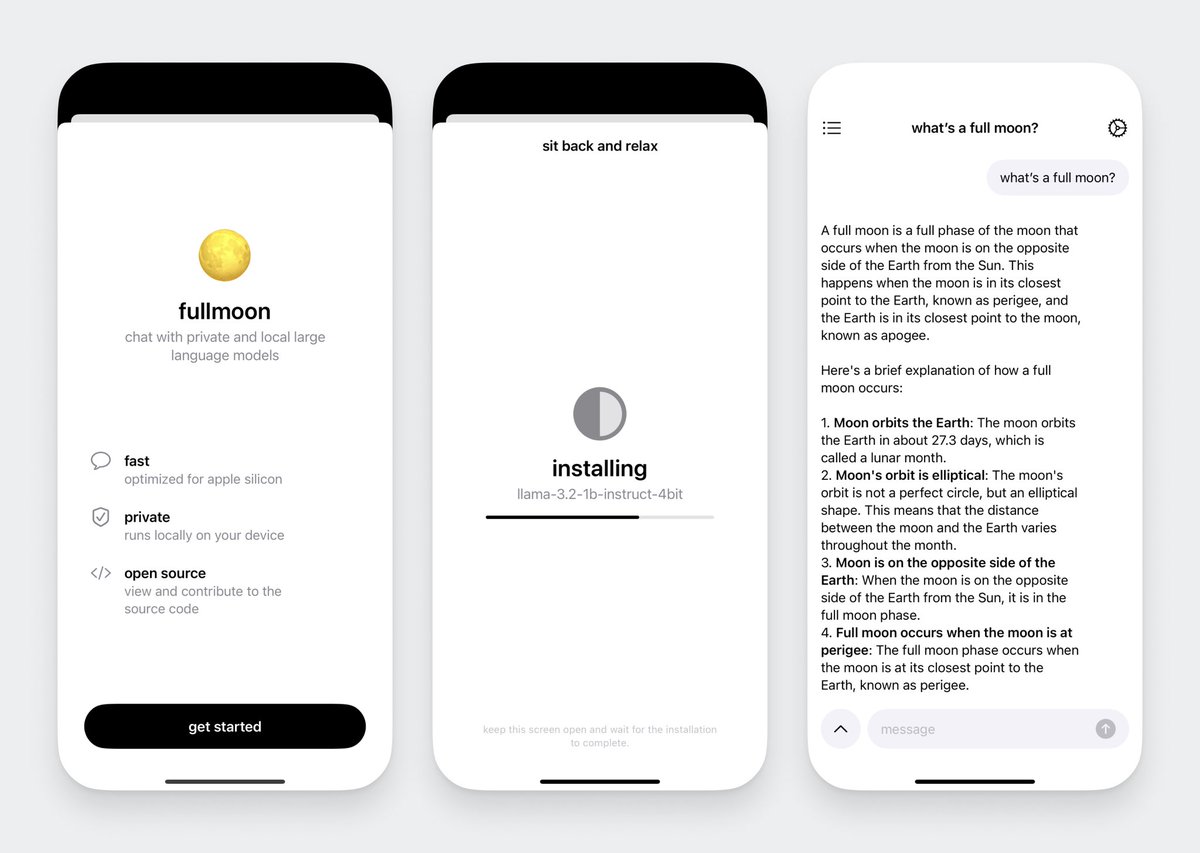
today @mainframe is open-sourcing and releasing a testflight beta of fullmoon
an experimental app to chat with private and local large language models like llama
Laurie's first new album since 2018, 'Amelia,' about Amelia Earhart’s tragic last flight, is out now on @NonesuchRecords. You can get it and hear it at https://t.co/y5t3IoHqkZ
why do we keep doing superfluous rework instead of pushing the boundaries of knowledge
this is from 1972
they chose a tactile standard because they understood you wouldn’t always be able to look at your controls and should be able to tell what you were doing without looking
@geoffreylitt I’ve gotten some VERY WEIRD hallucinated recommendations this way. Movies that _sound like_ I will be into them …but 30m in it turns out they have absolutely nothing to do with the generated description. 🤣 (Have also gotten some good recs tho.)