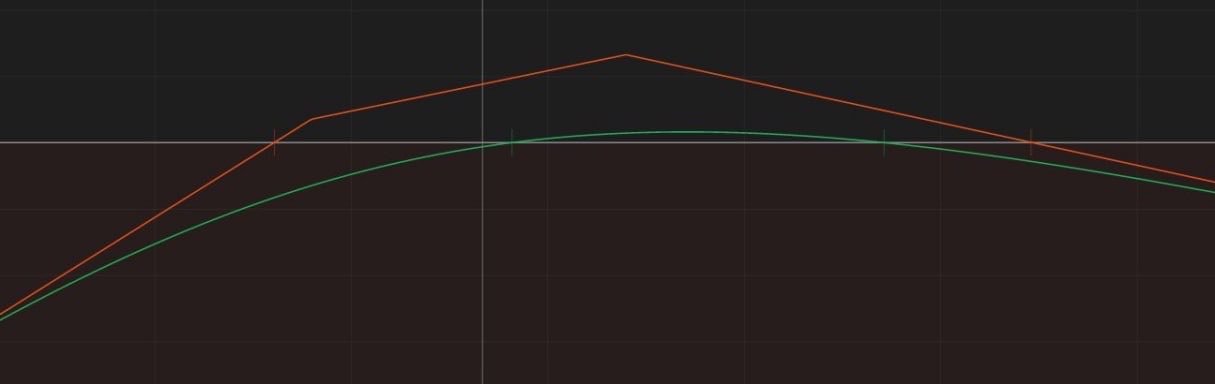
The more "crash insurance" is purchased, the less likely it becomes that a crash will happen. Sharp corrections yes, but not a crash. Fear & panic expressed through puts add liquidity when it is needed most. Long puts (when itm) compel dealers to buy the underlying as iv rises.
This is still the case, especially now that a lot of the “bad news” data is in the rear view mirror. Don’t get shaken out. You have a couple of months that the current narrative won’t be able to understand.
I’m currently using derive but paradex is looking interesting, paradigm is the standard for deribit RFQ so wouldn’t be surprised if paradex becomes the standard for on chain options.
we’re all in on RFQ 🔥
it is 100x easier to navigate vs a strike grid
searching for strikes is not intuitive
the wall of numbers is overwhelming
you came here to express a view
and suddenly you’re learning greeks… WTAF?
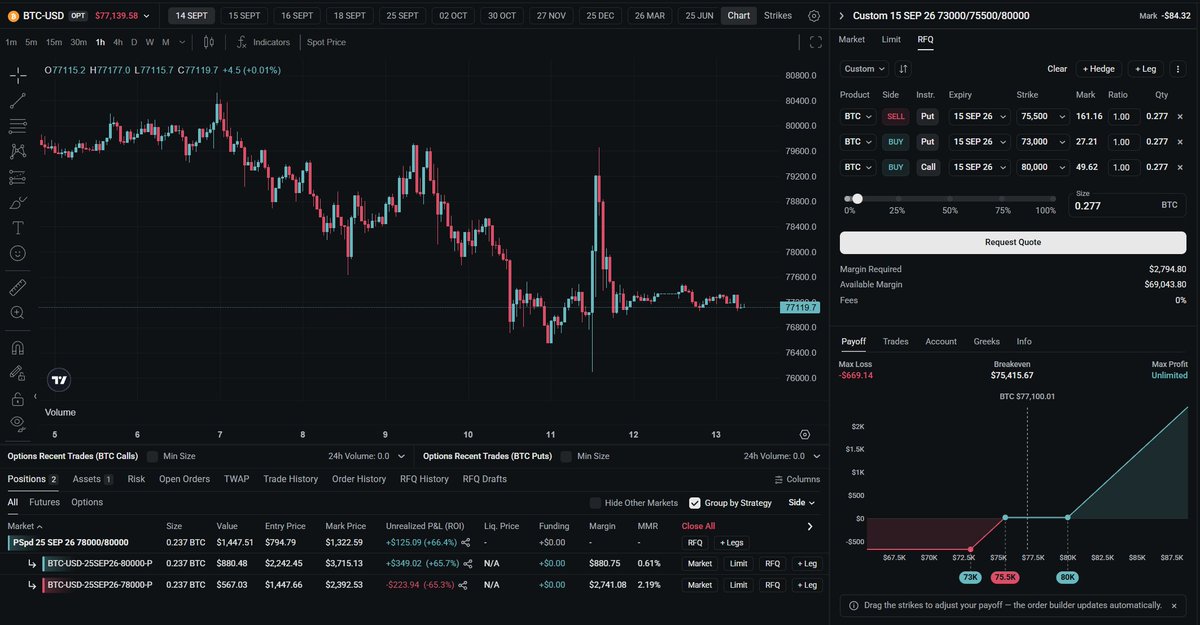
so we moved the strike grid out of the way
and made the chart a main character
1️⃣ stare at chart
2️⃣ drag strikes to configure payout
3️⃣ trade via RFQ
because i support autism
This is still the case, especially now that a lot of the “bad news” data is in the rear view mirror. Don’t get shaken out. You have a couple of months that the current narrative won’t be able to understand.
Used to need a subscription to be able to see charts like this now there are whole terminals that cost nothing to use and are just as good as/better than the paid versions.
One of the biggest misconceptions I hear retail traders make about systematic trading:
“Context is king — but context can’t be programmed.”
This is unequivocally false.
A huge amount of what discretionary traders call “context” is simply information that hasn’t been converted into features yet.
Take a discretionary NQ trader who says:
“We’re trading near the overnight low, well below VWAP, after sweeping a prior structural low. The market is rotational, sellers are becoming less effective, and aggressive selling isn’t producing much additional downside.”
That sounds highly discretionary.
Now decompose it:
• Distance from overnight low → measurable
• Distance from VWAP → measurable
• VWAP deviation normalized by ATR/volatility → measurable
• Sweep of a prior low → definable
• Trend vs rotational regime → classifiable
• Realized volatility → measurable
• Selling aggression/delta → measurable
• Price response to aggressive selling → measurable
• Time of day → measurable
• First/second/third test of a level → measurable
Suddenly “context” starts looking a lot like a feature vector.
The mistake is assuming systematic trading has to look like:
IF order flow > X → BUY.
That’s not sophisticated systematic trading.
That’s just a rule.
A contextual system can incorporate:
Location + Regime + Volatility + Auction Structure + Price Action + Order Flow + Time
Then ask:
Given this particular market state, what is the conditional probability of continuation or reversal?
Even something seemingly discretionary like “acceptance above the Initial Balance” can potentially be decomposed:
How long has price remained above IBH?
How much volume has traded above it?
Is VWAP moving higher?
Is developing POC migrating higher?
Are pullbacks holding IBH?
How does price respond when aggressive sellers appear?
You don’t necessarily need AI to do this.
Start by translating discretionary observations into measurable hypotheses and testing them historically.
Some context will undoubtedly be difficult to quantify.
But:
“Difficult to quantify” ≠ “impossible to systematize.”
A discretionary trader sees a story.
A systematic trader asks:
What variables describe that story — and does the data show that they actually change the distribution of future returns?
Context isn’t the enemy of systematic trading.
Context may be one of its richest sources of features.
There is a narrative forming that the recent move in crypto and other risk assets is due to lower dollar hedge ratios. A weaker dollar is a known tailwind for risk but the move also lines up with ETF inflows, treasury buybacks and liquidity/positioning effects.
@Bettingonalpha@ExitLiqCapital It isn’t directly determined by the fed you’re correct but the rate does influence yields especially with short term bonds.
@ExitLiqCapital They can’t hike rates, the interest on the debt will be too much. There’s only one way out and it’s the same route they always choose in the end. The printer will be turned back on sooner or later.
When I first started trading I was looking at candlesticks and drawing lines like everyone else but I never really enjoyed doing this and felt like I was missing something. It wasn’t until I found out about auction market theory when things started to make more sense to me.
Think about positioning, not just opinion. Ask which side is crowded, leveraged and who would be forced to act if price moved against them.
That is the “pain” trade. It matters most at extremes but it is not a permanent rule.
Consensus can be a useful input but it isn’t an automatic fade. Crowds can be right for a long time. The real question is whether the position is one-sided enough that a move against it would force covering, liquidation, or a scramble for liquidity.
Social media can help gauge retail sentiment in markets where retail can actually move the price (crypto, meme stocks, some small caps) but it is noisy, extreme and a poor proxy for institutional or derivative positioning.
COT data, options positioning, fund flows and sentiment surveys are more useful when they exist.
Do not treat this way of thinking as a complete trading system.
It can tell you how a move may travel but not whether the thesis is correct.
Betting that yields must keep rising against sovereign nations that control the currencies and the rulebook is often expensive in the short to medium term but they can still lose later if inflation, the currency, or credibility become the release valve.
You can also gain an “edge” as a retail trader by operating in markets the big fish don’t touch or by finding errors in order books etc but this kind of “edge” doesn’t usually last very long.
I have seen some discourse recently regarding “edge” and the fact that the majority of retail traders simply have none. As someone who has worked on the corporate side of finance I can tell you that a lot of “edge” is access to information and indifference to intra day PA.