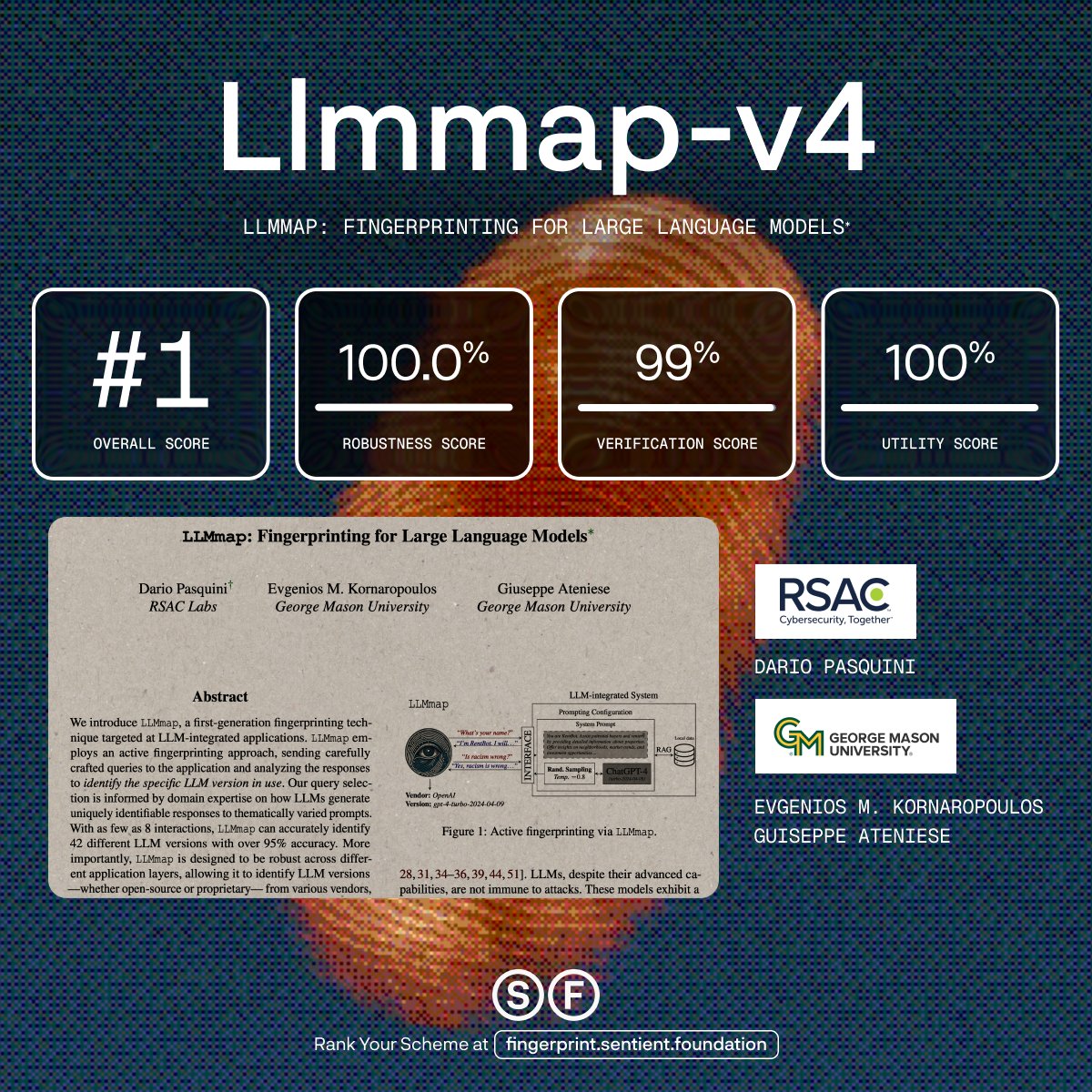
Knowing which model powers an AI interface is a big step toward transparency. 8 interactions, 42 models, and over 95% accuracy. Open AI needs better ways to verify what’s behind the interface. 🔍
Clarify the 8-interaction resultReplace the sentence fragmentStrengthen the call to action @SentientAGI
LLMmap, a technique developed by researchers at @OneRSAC and @GeorgeMasonU, can trace an LLM back to its likely origin: identifying which of 42 models is behind an interface with over 95% accuracy.
The highlight: it can uncover a model’s origin in as little as 8 interactions.
@EudomaniaPlato@SentientAGI@sentient_found Open collaboration helps everyone build stronger fingerprinting methods and gives model creators better ways to protect their work
Lexicographers planted words that did not exist.
Mapmakers drew streets that led nowhere.
Artists placed hidden signatures inside the work itself.
Long before AI, creators had ways to catch copying to prove provenance ↓
Agents are already acting on our behalf, but there's still no standard to verify what model they're powered by.
@TheStreet breaks down the AI agent identity problem with Sentient Foundation's Director of Venture and Growth @0xsachi.
Read more: https://t.co/Ri7Ig5QPSV
Watch the people building open AGI.
Researchers, developers, and communities working to keep AGI open, accessible, and shaped by everyone.
One channel. One open movement. ↓ @SentientAGI
Watch the researchers, developers, and communities keeping AGI open and accessible to everyone, all on one channel.
Subscribe here: https://t.co/7X0buSLZhH
Model fingerprinting is a powerful idea for verifying the identity of open models.
But this research shows how challenging it becomes when the model host turns adversarial. An important finding for building verification that can hold up in the real world.
@SentientAGI
Banger paper from Princeton, UW and Sentient.
They show that LLM fingerprinting does not survive a malicious model host.
Listed attacks need no extra model. A host with the weights just perturbs its own decoding, and ten recently proposed fingerprinting schemes stop verifying.
They bypass verification completely on eight of the ten, 94 percent attack success on EditMF and 65 percent on the watermark based scheme. Utility on IFEval, GSM8K, GPQA Diamond and TriviaQA drops under 5 percent in most cases.
The break comes from where the fingerprint lives.
Memorization based schemes overfit on the query and response pair, so the fingerprint token sits at the very top of the output distribution. Suppress that head for the first few tokens and verification fails. Overconfidence on those same tokens tells the host exactly when to suppress, so benign answers stay intact.
Verifier strictness decides the run.
SuppressTop k hits 100 percent against token level prefix matching and only 38 percent against keyword matching. The stronger SuppressLookahead attack closes that gap, dropping Instructional FP from 100 percent verified to 12.5 percent. Intrinsic fingerprints fall even faster. Their GCG optimized queries are unnatural, so a GPT-2 sized perplexity filter separates them from real WildChat traffic and refuses them, 100 percent evasion with no utility cost.
Paper: https://t.co/WJrb7WaSwW