Assistant professor in cognitive neuropsychology studying aging, cognitive decline, and neurodegeneration @Carleton_U @CU_Psychol
Tweets reflect personal views.
We are excited to launch The Data Quartet Challenge, recognizing student contributions to projects that integrate data from at least 2 of 4 FRQ supported Quebec Alzheimer’s and Aging cohorts (PREVENT-AD, CIMA-Q, NuAge, TRIAD), with 3 prizes of 5000$
https://t.co/jUYizVxi2u
Exciting new research shows the power of combining MRI and clinical data with machine learning to predict AD pathology up to 14 years before death with ~90% accuracy! MRI features are crucial for early prediction. @DadarMahsa@farooqkamal_1 https://t.co/XnTbK1ZrFe
Racial and ethnic differences in white matter hypointensities: The role of vascular risk factors - Alzheimer's & Dementia - Wiley Online Library https://t.co/k56raXQZix @farooqkamal_1@CassMorrison01@roqmoqadam
According to https://t.co/6NralMwOdM, dementia costs $40B/y (15B direct + 25B indirect) in Canada. Delaying onset by 1, 5 or 10y could save 10% ($4B), 42% ($16B) or 70% ($28B), respectively.
Surely @CIHR_IRSC can increase research funding a bit to make this happen! @TheNeuro_MNI
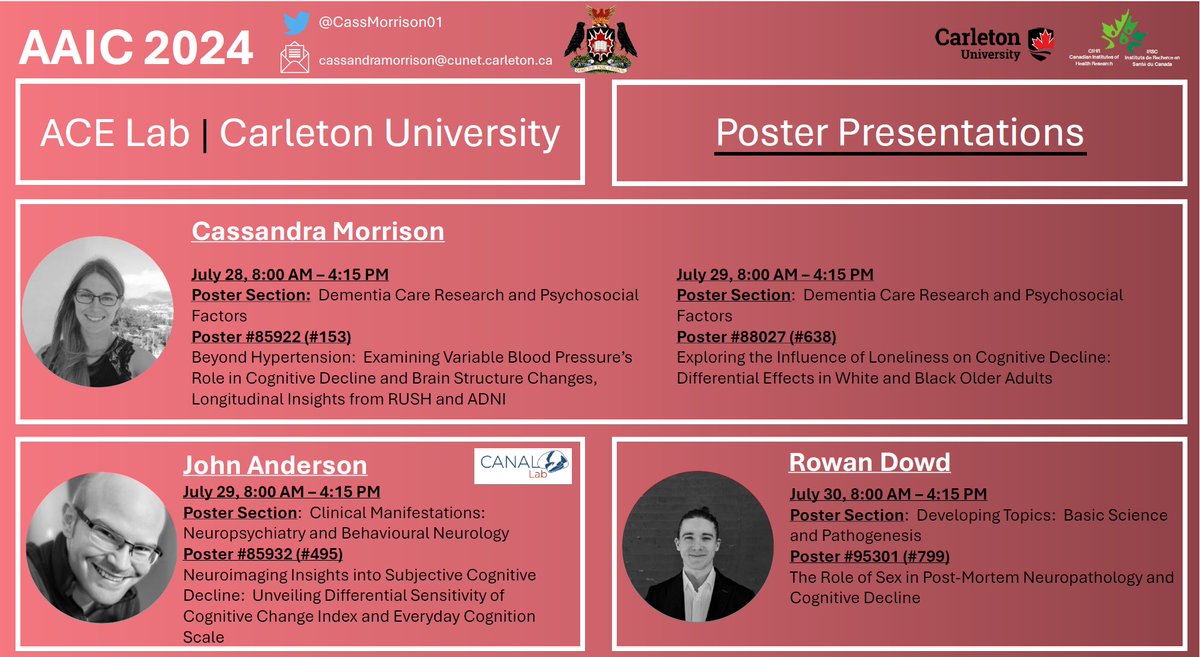
Excited to attend my first conference as an assistant prof from @CU_Psychology showcasing my students work and new collaborations with @janderz. Be sure to check out our posters Sunday 28 -Tuesday 30 #AAIC2024
🔍Exciting opportunity!🧠With CIHR funding, we're seeking a postdoc to delve into Alzheimer's disease in diverse populations like in this paper https://t.co/msnzLQq9cC Join us in uncovering fascinating insights! #Alzheimers@DadarMahsa@DouglasResearch@mcgillu@CU_Psychology
Most research has examined how blood pressure impacts cognitive and brain changes, while ignoring variable BP. Our study found that variable BP results in more cognitive decline and structural brain changes than both normal and high BP! @DadarMahsa
https://t.co/fSC1fMeANG
Job Alert! Together with @CassMorrison01 we are looking for a postdoctoral fellow interested in studying Alzheimer's disease in diverse populations using neuroimaging. @DouglasResearch@mcgillu
Please RT!
https://t.co/uOjlT90Tmn
As my postdoc ends and I begin my career as an assistant professor, I want to send a huge thanks to my incredible supervisor for his guidance and support throughout this journey @dlouiscollins 🙌
My final publication as a postdoc examined the fascinating world of #WMH and #sexdifferences🧠🚺🚹! We observed that even with the same amount of WMHs, females showed more cognitive decline than males https://t.co/BgtTs99YPN
Special thanks to @DadarMahsa for all her support
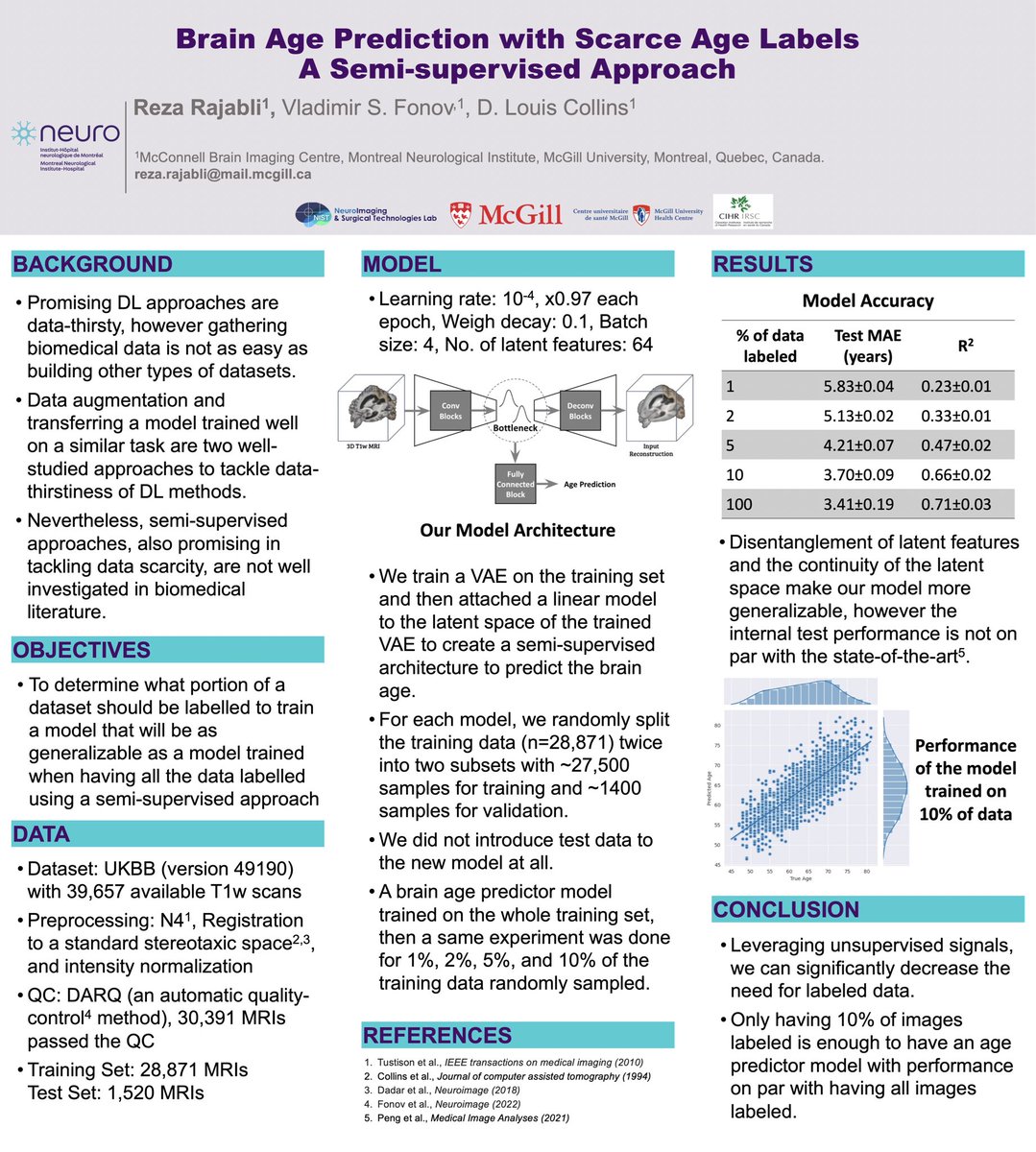
Are you attending @OHBM and wondering how to apply deep learning to your small yet valuable MRI dataset to make a generalizable model? Let's have a talk! You can find me at poster 273.
#OHBM2023
(link to my abstract: https://t.co/jhcNguGkIb)
Interested in #tau and #AD? See Vlad FONOV’s imaging session poster (July 15) AIC-P-329 (and July 17 P4-397) In vivo data-driven patterns of Tau accumulation associated with AD progression using 18F-MK-6240 PET @vfonov@pedrorosaneto#AAIC23@nistlab@theneuro_mni@bbme_mcgill
Have questions about #WMH & #APOE in #AD? Come see Cassandra Morrison’s poster P2-019 (July 17) Differences in pathology, brain atrophy, and WMHs across APOE subtypes #AAIC23@nistlab @ theneuro_mni @bbme_mcgill
how does the #NbM change in early #AD? Come see Neda Shafiee’s poster (July 19) P4-360 Nucleus basalis of Meynert degeneration starts in the earliest stages of Alzheimer's disease: A deformation-based morphometry analysis @shafieeneda#AAIC23@nistlab@theneuro_mni@bbme_mcgill
APOE status is a main risk factor for AD. However, a number of limitations in our understanding of how APOE influences cognitive and brain changes still exists. We completed two studies examining how APOE influences cognition and the brain! @DadarMahsa@dlouiscollins @KamFaro
Study 2: people with SCD with at least one E4 exhibited increased cognitive decline than those with MCI! Adults with MCI and SCD and at least one E2 have similar rates of change compared to healthy older adults with an E3 and less change than a healthy older with at least one E4