Le recteur @PhiAgresti et le président de la Région @fbonneau se sont rendus au lycée A.Fournier de Bourges.
Au programme: échanges avec le proviseur et les élèves, découverte d’un nouvel espace d’apaisement sensoriel et visite d’une exposition d’art en résidence au sein du lycée
👩🚀👌 La seconde sortie extravéhiculaire de Sophie Adenot s’achève avec succès après 6h30 dans le vide spatial aux côtés d’Anil Menon. Se rend-on vraiment compte de la prouesse que représente le fait de passer autant de temps dans une combinaison aussi rigide et imposante ?
🔴 LIVE - Sophie Adenot s'aventure une deuxième fois à l'extérieur de la Station spatiale internationale pour remplacer une antenne de communications et ainsi compléter sa mission commencée la semaine dernière ⤵️
https://t.co/I02QYEuvk4
The New York Times once described hippo meat as “lake cow bacon” while supporting a 1910 House bill that proposed introducing hippos to the bayous of Louisiana.
In 1910, Congress seriously considered an extraordinary solution to Louisiana’s environmental and food problems: importing hippopotamuses into the state’s bayous.
Supporters argued that hippos could eat invasive water hyacinths choking Southern waterways while providing Americans with a cheap new source of meat. The proposal, known as the American Hippo Bill, was championed by explorer and congressman Robert F. Broussard and supported by former President Theodore Roosevelt.
During congressional hearings, USDA researcher William Newton Irwin claimed the plan could add up to one million tons of meat to America’s annual food supply. He even suggested importing other exotic animals, including rhinoceroses, African buffalo, Tibetan yaks, dik-diks, and Manchurian pigs.
The bizarre proposal attracted national attention but ultimately went nowhere. Congress never approved the bill, and the Louisiana bayous remained hippo-free.
The bar tab from George Washington’s 1787 farewell celebration still survives today, revealing just how heavily the Founding Fathers partied. Among only 55 guests, they reportedly consumed 54 bottles of Madeira, 60 bottles of claret, 8 bottles of whiskey, 22 bottles of porter, 8 bottles of hard cider, 12 bottles of beer, and 7 large bowls of alcoholic punch.
Né un 8 mai ce bon vieux Fernandel que l'on oublie de plus en plus...
Mais en 1953 c'était le roi du pétrole au box-office avec 3 films aux 3 premières places (et des chiffres d'entrées vertigineux).
#BOTD#Fernandel
Avant la tour Eiffel, il y a eu Garabit. Et c'est techniquement plus audacieux.
Le viaduc de Garabit, dans le Cantal. 565 mètres de long. 122 mètres au-dessus de la Truyère. Une arche de 165 mètres de portée, parabolique, en fer. Quand il est achevé, en 1884, c'est le viaduc le plus haut du monde. Et son arche, jusqu'en 1886, la plus grande jamais construite.
Le projet est signé Léon Boyer, jeune ingénieur des Ponts et Chaussées, mort à 35 ans avant de voir l'ouvrage fini. Pour la réalisation, il s'adresse à un industriel parisien spécialisé dans les structures métalliques rivetées : Gustave Eiffel.
Eiffel a 47 ans. Il vient de perdre son ingénieur calcul. Il embauche un Alsacien de 23 ans, sorti de Zurich, qui va faire les plans : Maurice Koechlin.
Quatre cents ouvriers, 800 mètres d'altitude, à 5 kilomètres du premier bourg. Toutes les pièces fabriquées à Levallois-Perret, acheminées par train, puis tirées sur 30 km par des chariots à huit chevaux. Plus d'un million de rivets posés à la main.
Quand les deux moitiés de l'arc se rejoignent au-dessus du vide, en avril 1884, l'écart est de quelques millimètres. Eiffel parlera d'une jonction "presque mathématique".
Trois ans plus tard, le même Eiffel et le même Koechlin commencent un autre chantier à Paris.
Garabit aura été le brouillon grandeur nature de la tour Eiffel.
On July 31, 1968, a young, black man was reading the newspaper when he saw something that he'd never seen before. With tears in his eyes, he started running and screaming throughout the house, calling for his mom...
He would show his mom, and, she would gasp, seeing something she thought she would never see in her lifetime.
Throughout the nation, there were similar reactions.
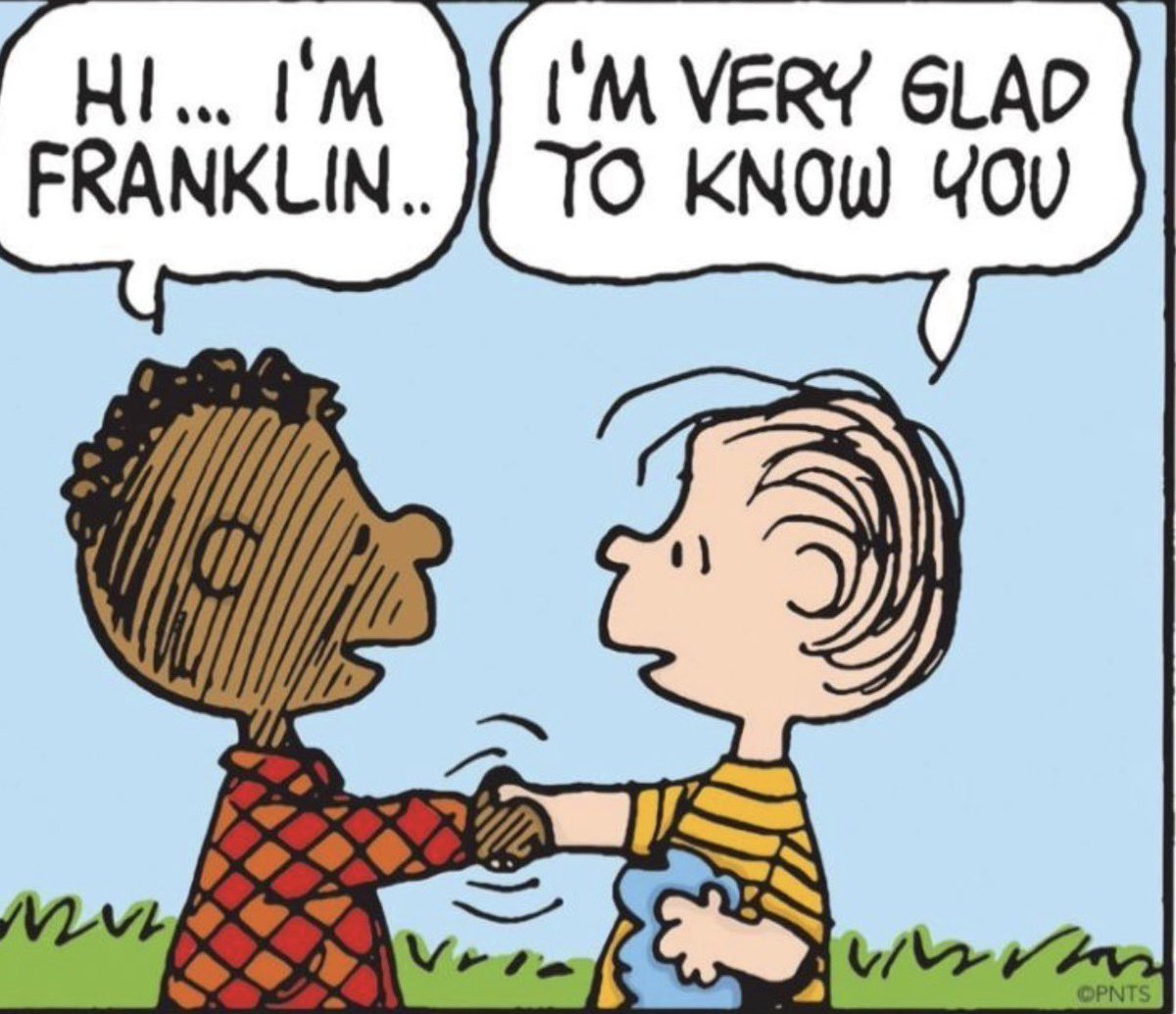
What they saw was Franklin Armstrong's first appearance on the iconic comic strip "Peanuts."
Franklin was "born" after a school teacher, Harriet Glickman, had written a letter to creator Charles M. Schulz after Dr. Martin Luther King, Jr. was shot to death outside his Memphis hotel room.
Glickman, who had kids of her own and having worked with kids, was especially aware of the power of comics among the young.
“And my feeling at the time was that I realized that black kids and white kids never saw themselves [depicted] together in the classroom,” she would say.
She would write, “Since the death of Martin Luther King, 'I’ve been asking myself what I can do to help change those conditions in our society which led to the assassination and which contribute to the vast sea of misunderstanding, hate, fear and violence.'”
Glickman asked Schulz if he could consider adding a black character to his popular comic strip, which she hoped would bring the country together and show people of color that they are not excluded from American society.
She had written to others as well, but the others feared it was too soon, that it may be costly to their careers, that the syndicate would drop them if they dared do something like that.
Charles Schulz did not have to respond to her letter, he could have just completely ignored it, and everyone would have forgotten about it.
But, Schulz did take the time to respond, saying he was intrigued with the idea, but wasn't sure whether it would be right, coming from him, he didn't want to make matters worse, he felt that it may sound condescending to people of color.
Glickman did not give up, and continued communicating with Schulz, with Schulz surprisingly responding each time.
She would even have black friends write to Schulz and explain to him what it would mean to them and gave him some suggestions on how to introduce such a character without offending anyone.
This conversation would continue until one day, Schulz would tell Glickman to check her newspaper on July 31, 1968.
On that date, the cartoon, as created by Schulz, shows Charlie Brown meeting a new character, named Franklin.
Other than his color, Franklin was just an ordinary kid who befriends and helps Charlie Brown.
Franklin also mentions that his father was "over at Vietnam."
At the end of the series, which lasted three strips, Charlie invites Franklin to spend the night one day so they can continue their friendship.
don't like how the algo is overly reactive. i've spent years liking animal-related content on here, but if you like one tweet about potatoes or whatever, it's like potatoes all the way down until another animal tweet appears and you have to treat it like a life preserver