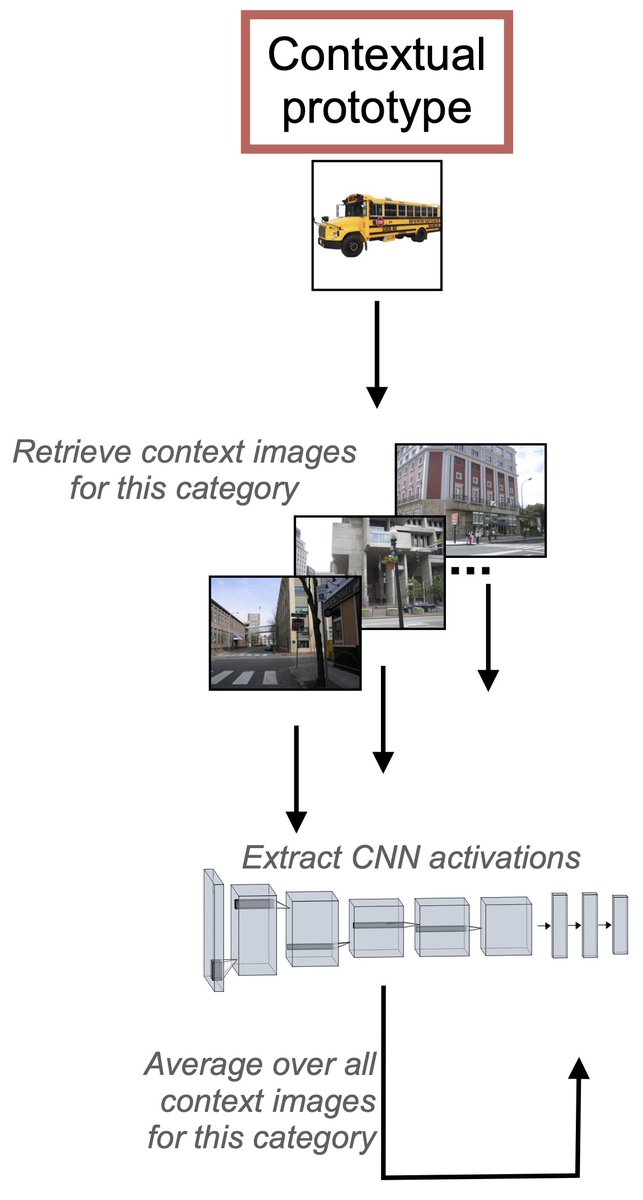
Context is all you need. A new computational model predicts intuitive judgments of object similarity without seeing the objects themselves—it only sees the contexts in which the objects are typically encountered @ELSpsychology
https://t.co/SbBjb7L1T6
Context is all you need! We found that object similarity judgments can be predicted from CNN responses to objects’ typical scene contexts—the CNN doesn’t need to see the objects themselves. With @catmag29 & @EricElmoznino. https://t.co/DuuonyIkf5
@profcikara I also get them! Started in late 20s, to both eyes. I’m more prone to them after exercising and/or when I’m tired/dehydrated. It’s usually in the periphery but if I look at something bright like a screen it fills my whole field of vision !
Excited to announce a new paper: “Automated detections reveal the social information in the changing infant view” with Alessandro Sanchez, Allison M. Kraus, @_ketan0 and @mcfrank at Child Development, https://t.co/tp9pAs9WeP https://t.co/r1uHf8k7e3 ($) (1/15) 🧵
I'm hiring an intern at Google brain team 2022! Email me if you are 1) Graduating in 2022 (preferred) or early 2023 2) Interested in interpretability, representation learning or studying fundamental principles of how NN perceives the world. Pleas read the whole thread--> 1/n
Just out in the New Yorker: An article about Men Reading Minds with fMRI!
The author mentions 9 male and 0 female neuroscience professors, a feat made possible by impressive contortions like attributing a study from Ev Fedorenko’s lab to one of its male middle authors.
New preprint with Mira Bajaj and Sharon Thompson-Schill! This was Mira's honors thesis & joint first author paper--incredible work. https://t.co/hFUo1NjQgn
What do tool-selective responses in lateral temporo-occipital cortex (tool-LOTC) reflect? 1/n
New preprint shows how tuning for mid-level features gives rise to selectivity across multiple levels of complexity: from categories, such as scenes and landmarks, to surprisingly simplistic stimuli, such as oriented edges and boxy shapes. w/ @shipui2005 https://t.co/oEPqPtLRPo
Staff scientist position open at NIH. It’s a permanent position to do neuroscience, to mentor trainees, plan, conduct, and disseminate original neurophysiological, neuroanatomical, and behavioral in vision. Great resources and colleagues! DM me. Pls RT
https://t.co/0bZtlT4n7v
Hasson Lab is looking to hire a postdoctoral researcher at the intersection of machine learning and cognitive science for a multidisciplinary project centered on *very* big, naturalistic audiovisual data acquired during the first years of life! Apply here: https://t.co/8Bgn4uWddl
Objects don’t just move, fall, and bounce—they also transform, as when logs burn or ice cubes melt. In a new paper @PsychScience, we (@talboger & @chazfirestone) explore mental representation of state-changes—and find that your mind 'melts ice' in memory! https://t.co/Gv8FirlSNq
We're hiring a social psychologist for the @NatRevPsych editorial team! I'm more than happy to answer questions about qualifications, the role, and what I love about this job--just DM me. Please RT! https://t.co/uDDQcYHoxE
Humans: Adversarial examples show how brittle machine recognition is! Human visual processing would never be led astray by small image perturbations or anomalous patches.
Also humans:
@criticalneuro I think not enough emphasis is sometimes given to the “reading” part. how much time to allocate when reading? In what sequence? i think giving a demo for how papers should be read may really help in improving comprehension
In three pre-registered TMS studies we reveal feedforward and feedback processes supporting the recognition of objects based on local features and based on scene context.
With @MilesWischnews1@DondersInst
https://t.co/HacaiZYsVy
Thread 👇