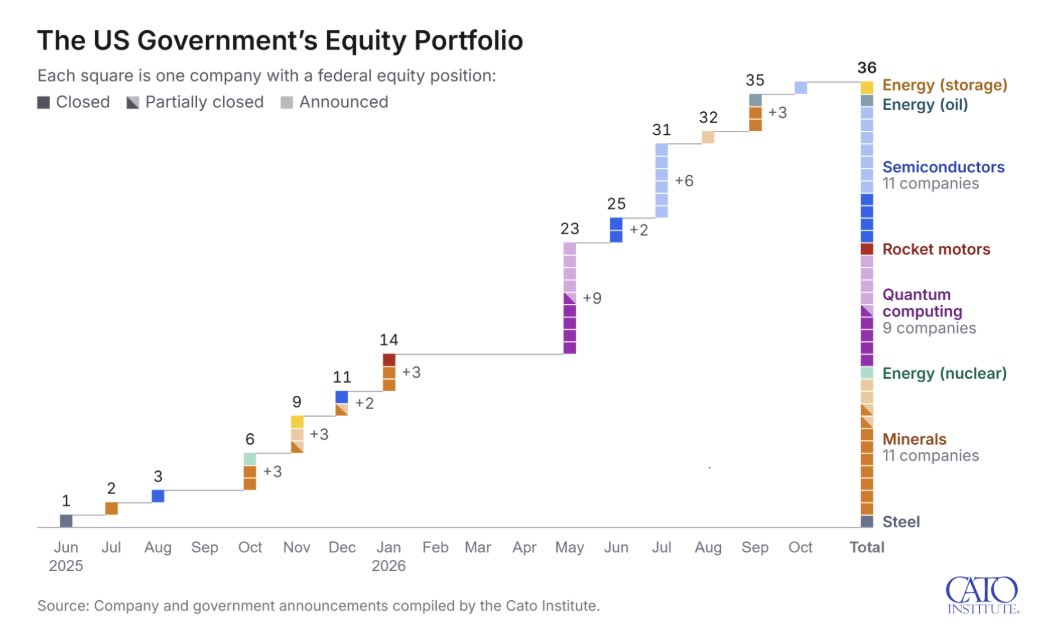
The Department of Commerce has announced four more deals involving federal ownership stakes in private companies.
These firms, each in the semiconductor industry, increase the US Government's Equity Portfolio to 40 firms.
See the details on our dashboard: https://t.co/xemv0mkJeu
“Whether it’s President Trump or somebody else like Bernie Sanders... I don’t trust the federal government being a long-term investor in American companies.”
Sen. Jon Husted’s bill to gradually unwind federal ownership stakes has no cosponsors yet, @semafor reports. #CatoRFE
Two years ago, what share of GOP voters would agree with government ownership of companies?
Now 29% of GOP voters do. More than Democrats.
This must be reversed. Those who pushed for this may come to regret it if America becomes a socialist country.
And right on cue, the Trump admin announces 4 more equity stake deals (via the CHIPS Act, which doesn't expressly authorize equity deals), thus bringing the grand total to 40 (FORTY).
https://t.co/ReSTx8Jesv
"The executive branch is attempting to monetize trade agreements, merger approvals, subsidy awards, and immigration, turning delegated powers into potential streams of payments or equity."
https://t.co/Ln80MwTvNK
"Federal officials are using government power to steer capital toward politically favored firms and industries."
@adamnmichel and @santiagoforster explore the monetization of executive discretion in their new essay in the #CatoRFE library. Link below.
Memo to the Trump administration: Stop buying companies.
A government $40 trillion in debt should be SELLING assets, not buying ownership stakes in 36 companies.
We thought government control of the means of production was what we were fighting against.
Of course, of course: "Trump turned the government into an investor. Democrats have shopping plans, too." https://t.co/uhjGXvUSGj
"We’re through the looking glass"
"The sky’s the limit"
"The Trump administration has opened up Pandora’s box"
Former Biden officials already have ideas for Trump’s equity stakes: reining in AI, boxing out China, and pressuring gun and oil companies.
As Cato’s @DeHavenTad told @semafor: “The sky’s the limit, because the pattern’s been set.” #CatoRFE
https://t.co/h93B9SM011
The government's equity portfolio of 36 companies has a distressingly weak legal foundation, says Cato’s @scottlincicome.
None of the cited laws expressly authorize federal ownership stakes in private companies. #CatoRFE
https://t.co/qWz68qGyVk
Very interesting.
Many countries have a functional mortgage system and high homeownership without their own Fannie Mae and Freddie Mac.
So what social function is being done here?
What has $7.8 trillion in federally backed mortgages actually accomplished?
• US homeownership sits at ~65% – virtually what it was in the late 1960s.
• Home price and construction volatility remain among the highest in the developed world.
Federal intervention has boosted home mortgage debt, not homeownership.
Full report: https://t.co/lRtbswwTBc
Supporters of South Korea’s industrial policy point to the firms that thrived.
@APanagariya points to everyone else: unfavored firms, consumers, and the economy as a whole.
What that means for Washington's equity stakes:
https://t.co/aGsVjovH0W #CatoRFE
South Korea’s heavy-industry push, Sweden’s state ownership, America’s “friendfunding” with allies, and more coming soon.
New #CatoRFE international essays offer lessons from abroad to warn Washington about its current ownership spree:
https://t.co/QYNxKFluIf
Amtrak was supposed to become self-sufficient within a few years. Fifty-six years later, it has never earned a profit, and it lost $1.9 billion on operations in 2025.
@CatoEdwards on what government ownership did to passenger rail: https://t.co/xLqgNwzXdx #CatoRFE
Before U.S. Steel and Intel, there was Amtrak. And Fannie and Freddie. And TARP.
Cato’s new case studies show what happens when Washington owns businesses, and why it’s so hard to get out: https://t.co/kmvSQCCZK6 #CatoRFE
@reason on #CatoRFE
"When the government gets involved in any industry, it complicates matters for the companies in which shares are held, for competitors who must worry that regulators will put their thumbs on the scale to help favored firms, and for the market in general."
October 2026: The CHIPS Act, along with other legal authorities pointed to by the administration, does not explicitly authorize the government to take ownership stakes in private US firms.
https://t.co/AZ1YYIGqz1
Since 2022, @scottlincicome has argued that CHIPS Act subsidies would come with political strings and risky bets.
As of October 2026, the government has taken ownership stakes in 22 firms using CHIPS subsidies for authorization.
A quick review of Scott's work on CHIPS🧵 #CatoRFE