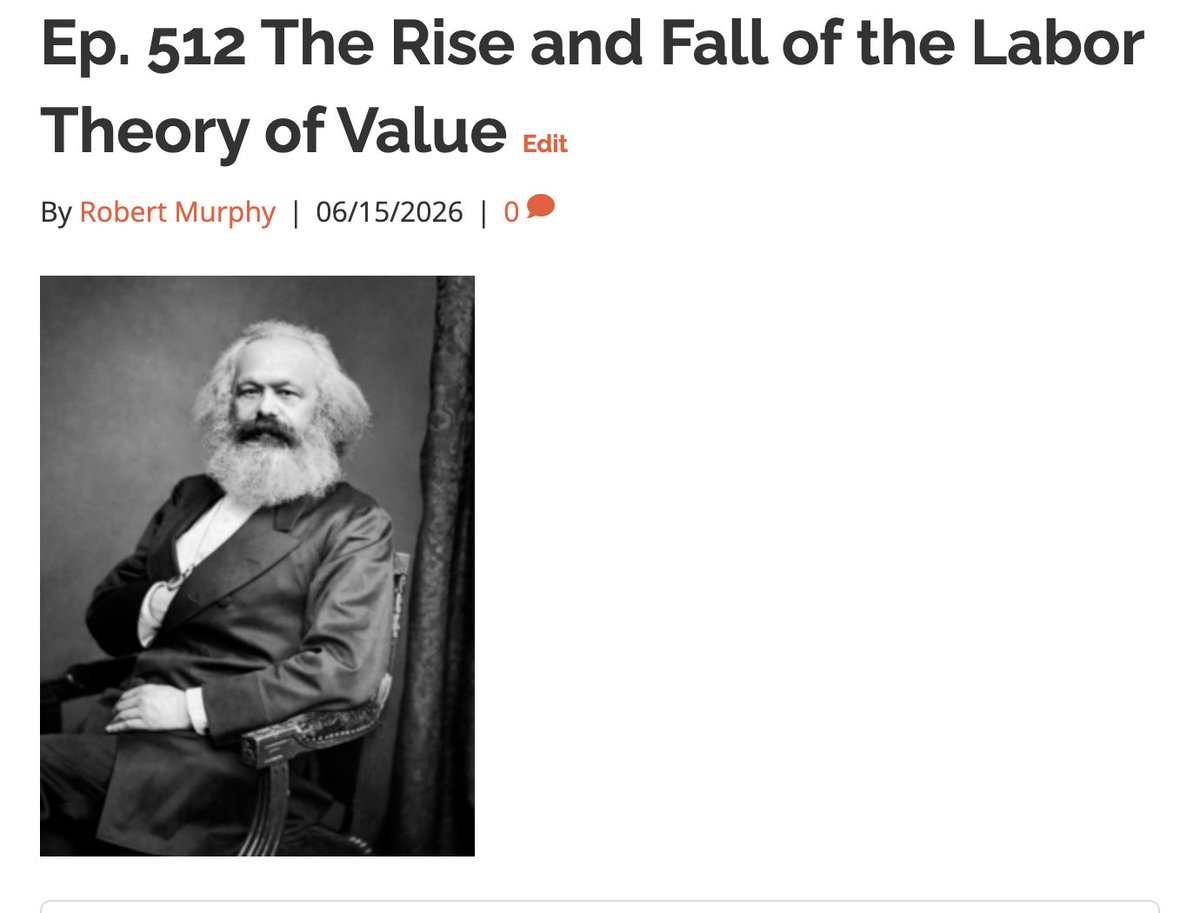
The photo is clickbait: All of the great classical economists (Smith, Ricardo, even French ones to lesser extent) held a cost/labor theory of value. I explain why it was so popular then, and why the profession abandoned it for subjective marginal utility approach. (Link next.)
Speaking of Jesus and mustard seeds; He mentioned that “faith that can move mountains” need only be the size of a mustard seed.
That doesn’t sound like a lot of faith.
It isn’t the quantity of your faith, nor the quality, that matters, but the Object, which, of course, is Jesus
@cavalier973 That is an interpretation of the chain mail rules.
It comes with its own house, rulings and what I would consider to be either misunderstandings of the original rule set or perhaps deliberate changes. I prefer the original.
@CastleGrief It does seem rather truncated.
How does Chainmail compare to Swords and Spells, as a set of rules for adjudication g mass combat in a D&D game?
@MattisRedacted It’s amateur hour with regard to finding “contradictions” in the Bible.
All this stuff has been thoroughly processed, and answered, for centuries, now.
@SandyofCthulhu I thought the idea was that the thrown oil flask broke onto the monster’s head and dripped down, and while the monster was wiping oil from its eyes, it briefly glimpses the torch that was hurled at it.
The year is 1949.
The Nobel Prize in Medicine has just gone to the man who invented the lobotomy. Your doctor suggests one for your sister, who has not been herself since the baby came. It is the most celebrated advance in psychiatry of the age, and he is simply current. By the time the prize curdles into an embarrassment, close to twenty thousand Americans have had the operation, and proportionally more here in Britain.
The year is 1956.
Lay the baby down on his front, the doctor says. So does the most trusted childcare book ever written, the one on every new mother's shelf. On his back he might choke, the reasoning goes. Millions obey. The advice holds for nearly thirty years, long after the evidence has quietly turned, and a generation of cot deaths is counted before anyone thinks to roll the babies over.
The year is 1966.
A bestselling book informs your wife that menopause is a disease, that she is, in the author's word, a castrate, and that a small daily pill will keep her youthful and tolerable to live with. Her doctor agrees. The drug becomes one of the most prescribed in the country. Nobody mentions that the author sat on the payroll of the company that made it. That detail surfaces decades later, in the same year the landmark trial is halted early for raising rates of breast cancer, stroke and clots.
The year is 1979.
Your ulcer is caused by stress and sharp food, the doctor explains. Calm down, drink milk, take the antacid that happens to be the best-selling medicine on earth. Two Australians are about to prove that most ulcers are caused by a bacterium and cured by a fortnight of antibiotics. The profession laughs. One of them eventually drinks a beaker of the stuff to settle the matter. The establishment takes the better part of twenty years to stop laughing. The Nobel lands in 2005.
The year is 1985.
Butter is dangerous, the doctor says. Switch to margarine, it is modern, it is heart-healthy, the experts are united. The spread he nudges you toward is loaded with trans fats, which the next decade will identify as the genuinely dangerous one, and which will eventually be banned outright. The butter goes quietly back in the fridge. No correction is ever printed at the volume of the original warning.
The year is 1992.
There is a pyramid on the surgery wall, and the very same one in your grandchild's classroom. Bread, cereal, rice and pasta form the broad virtuous base, up to eleven servings a day. Fat is exiled to the tiny tip. The chart was reportedly held back a year while the relevant industries had their say. It is wrong at the bottom and wrong at the top.
Now it is today.
Your doctor has new guidelines, new studies, a fresh consensus, delivered with precisely the steady confidence of every guideline above. He believes it, and he has good reason to. So did every doctor in this thread. None of them were villains. Each was sincere, most were kind, and all were certain, reading from a map that somebody else had drawn and handed them. That is the part worth sitting with.
So when the man in the white coat tells you what to eat, what to fear, and what to swallow every morning for the rest of your life, you are allowed to ask. Who paid for the study. What the evidence says beneath the headline. What he was just as certain about thirty years ago, and where that advice sits now.
Then make up your own mind. Call it scepticism, or call it whatever your grandmother called it when she ignored the advert, kept the butter where it was, and lived to ninety-one.
It has outlasted every consensus on this list. It will outlast this one too.
@BobMurphyEcon@bourscheid How long could he keep up the payments, I wonder.
Also, how soon until he realizes that most people will still treat him like garbage, take his charity for granted, and continually demand more from him until he is bankrupt?