🚨 BREAKING:
🇮🇷🇮🇱 Reports of Israeli aircrafts have entered Western Iranian airspace.
Source: Middle_East_Spectator (Telegram) / Writers: Mhedi, Samuel
PD: Photo for illustrative purposes only (NOT CURRENT)
Iran fired ballistic missiles at northern Israel on Sunday after Israel carried out a strike in Beirut earlier on the day. Tehran described the attack as a warning.
🔴 IRGC: In response to the widespread crime of the usurping Zionist regime in southern Lebanon and the massacre and widespread displacement of the oppressed people of the Tyre and Nabatieh regions and other areas including the Dahieh of Beirut, the Ramat David airbase, the origin of these aggressions, was targeted by ballistic missiles of the IRGC Aerospace Force.
via @FarsNews_Agency
Scottish soccer fans was banned from entering America 🤷
The same happened to several Norwegian journalists and fans the other day 🤷 America should never again host any kind of global sporting event 🤬😤
BOYCOTT AMERICA ✊✊✊✊✊
In a new New York Times @nytimes piece, I argue that the war in Syria forged an unlikely partnership between Turkey and Russia a decade ago. That partnership is now unraveling, and Turkey is helping Ukraine expand its presence in a part of the Middle East where Vladimir Putin once enjoyed considerable influence. https://t.co/PXMOECPG3M
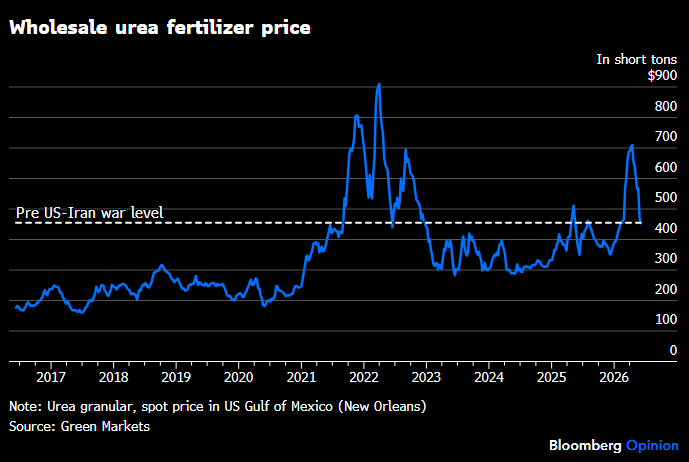
CHART OF THE DAY: The cost of the most important nitrogen fertilizer is back to pre-war levels in the US, benefiting from ample natural gas supply in America. Urea prices are sharply down too in Europe and Latin America, but remain elevated in most of Asia.
The Iran Campaign Was an Operational Success but a Strategic Failure
In recent days, a growing number of commentators have argued that the campaign against Iran was a major success. Their argument is straightforward: Iran's economy suffered, its conventional military capabilities were degraded, and continued pressure will eventually weaken the regime further and perhaps even bring about its collapse.
Many of the same people making this argument, however, supported the campaign from the outset. More importantly, they are evaluating the outcome through the lens of operational achievements rather than strategic objectives.
To be clear, Iran suffered real damage. Significant military assets were destroyed, parts of its conventional force structure were degraded, and the country's already fragile economy absorbed additional blows. These are genuine accomplishments and should not be dismissed.
The question is whether those accomplishments translated into strategic success. The campaign was not presented to the public as an effort merely to weaken Iran's military or economy. It was framed as a historic opportunity to fundamentally alter the trajectory of the Islamic Republic and remove the threat it poses to the region. By that standard, the results are far less impressive.
Indeed, there is a strong argument that the campaign produced effects opposite to those intended. Rather than accelerating internal pressure on the regime, it provided Tehran with a political lifeline. External military pressure strengthened nationalist sentiment, allowed the government to portray itself as the defender of Iranian sovereignty, and narrowed the political space available to domestic actors who sought change from within.
The nuclear issue presents an even greater concern. Despite the damage inflicted on elements of Iran's nuclear infrastructure, Tehran's fundamental position has not changed. Iran still refuses to accept meaningful restrictions on its strategic capabilities, its missile forces, or its regional proxy network. More importantly, there is little evidence that the regime has abandoned its ability to move toward a nuclear weapon if it eventually decides to do so.
The death of Ali Khamenei may complicate matters further. Whatever his many faults, Khamenei often demonstrated caution when approaching the nuclear threshold. There is no guarantee that future leaders will share the same restraint. Nor is the problem limited to the nuclear file.
The post-war Iranian leadership appears more radical, more decentralized, and potentially more willing to challenge American interests directly. Rather than producing a more cautious Tehran, the conflict may have helped create a leadership culture increasingly defined by revenge, ideological commitment, and a desire to restore deterrence.
The Strait of Hormuz illustrates the broader strategic dilemma.
Supporters of the campaign often argue that patience is required, that sanctions and economic pressure should continue, and that Iran will eventually be forced to compromise. The notion that the current situation can simply be maintained indefinitely is perhaps the most dangerous assumption in the entire debate. There is no stable status quo to preserve. The global economy cannot absorb prolonged uncertainty in the Gulf without consequences. Shipping costs, insurance premiums, energy prices, and investment decisions are all affected by the persistent threat of disruption in the Straits.
And for the nuclear... nearly a year later the 12 days war, international monitoring mechanisms remain weakened, transparency regarding Iran's nuclear activities is significantly reduced, and questions remain about the country's ability to reconstitute parts of its nuclear program.
This is not a minor detail. It is a strategic reality. In fact, perhaps the strongest evidence that the campaign failed strategically is that Washington now finds itself with no attractive options.
Many of the same analysts who describe the campaign as a success are simultaneously advocating negotiations with Tehran in order to reopen the Strait of Hormuz and stabilize global energy markets. In doing so, they implicitly acknowledge that military action did not create a path toward regime change. Instead, it produced a situation in which the United States may ultimately need to reach an accommodation with the very regime it sought to weaken or replace.
That contradiction is difficult to ignore. If the end result of a military campaign is a negotiated settlement that restores economic breathing room to the targeted regime, then one must ask whether the campaign fundamentally changed the strategic balance at all.
Washington now faces an uncomfortable choice. It can pursue an agreement that reduces tensions and secures energy flows, but such an agreement would inevitably strengthen the regime economically and politically. Alternatively, it can maintain indefinite pressure, accepting the growing risk of escalation while hoping that Iran eventually changes course.
Neither outcome resembles the objectives that were originally promised.
The situation becomes even more troubling when viewed through a long-term lens. If negotiations fail and Iran's nuclear program continues advancing, the United States and its regional partners could ultimately find themselves in a worse position than before the conflict. A campaign launched to solve the Iran problem may have merely postponed it while creating new challenges.
There is also a political reality that many advocates of the campaign prefer not to discuss. Even if another military operation remains technically feasible, will a future American president be willing to undertake it? After the costs, risks, and uncertainties associated with this conflict, that assumption should not be taken for granted. Strategic plans that rely on repeated military interventions are often far less sustainable than their supporters imagine.
This is why the distinction between operational success and strategic success matters. Air superiority is not a strategy. Destroying military targets is not a political outcome. A large number of sorties, precision strikes, and tactical victories do not automatically produce lasting strategic gains. History is filled with examples of impressive battlefield performance that failed to achieve the political objectives that justified the war.
Iran was weakened. But weakening an adversary is not the same thing as changing its behavior, collapsing its regime, or eliminating the long-term threat it poses.
The central lesson is therefore straightforward: significant operational achievements did not produce a corresponding strategic outcome. The campaign left Iran damaged but still defiant, left its core positions largely unchanged, and left the United States with fewer attractive policy options than many anticipated.
That is why the campaign should be understood not as a strategic success, but as a strategic failure, one whose consequences policymakers must honestly confront if they hope to develop a more effective long-term approach toward Iran.
#IranWar
This is why central bank credibility matters.
If the Fed cuts rates because politicians want it to, people may start expecting more inflation. And inflation is a lot harder to beat once those expectations become entrenched.
82 years ago, 14,000 Canadians landed on Juno Beach, many of whom would never come home.
On the anniversary of D-Day, we pause to honour those who served and sacrificed. We remember that our rights, our freedoms, and our way of life were fought for and were won by those who answered the call.
Today is the 82nd anniversary of D-Day – the Allied landings in Normandy, which significantly hastened the countdown to the Nazis' collapse in World War II. It is one of the most important moments of unity among the defenders of life in human history, and it was less than a year until the peoples’ aspiration for freedom and the hope of peace prevailed in May 1945. It happened then. We are working to make it happen again today.
And although yesterday in Petersburg another cynical order to continue killing was issued for the army trying to destroy our freedom, history has seen this before. The Nazis also had their own hopes after D-Day. But freedom still wins. And even in the darkest circumstances, people find ways to come together to protect life.
I thank all those who are now helping to protect the values that prevailed in World War II. I thank everyone who is defending life. Glory to Ukraine!
Why Ukraine is doing the right thing buying Gripen JAS 39:
1. About half the cost of a F-35 ($60-85 mn vs $144 mn).
2. Adjusted to war with Russia & not for all purposes.
3. Easier & cheaper maintenance.
4. Reliable & faster delivered.
Avoid F-35!
If leading AI companies are indeed approaching the point of recursive self-improvement, a coordinated, verifiable, and universally applied pause is probably the only responsible solution to mitigate several major AI risks; at least until safety guarantees are developed and demonstrated. Ensuring that such a moratorium is respected would require sincere collaboration between various countries and companies, but I definitely believe it is achievable if others follow in @AnthropicAI's footsteps.
For two decades, Vladimir Putin managed to trick the world into believing he was a master geopolitical chess player.
The catastrophic invasion of Ukraine has permanently shattered that illusion, exposing him as one of the most wildly overestimated strategists in modern history.
Putin's long streak of international ”successes” was never a product of strategic brilliance. Instead, his ”victories” happened simply because he was willing to break international rules and push further than his targets expected. Many of his opponents mistakenly believed that appeasement would preserve stability, which only encouraged his aggressive behavior for years.
The moment someone finally stood up to him, the entire facade came crashing down. Ukraine refused to capitulate, and the Kremlin's supposedly unstoppable military machine failed pathetically. Putin completely miscalculated the resolve of Ukrainian people and the unity of the West, proving that his earlier triumphs were just the result of bullying weak and hesitant adversaries.
By overstretching his forces in this reckless war, he has effectively ruined the economic potential and future of Russia. His legacy is now defined by a bleeding military, crippling sanctions, and absolute isolation from the developed world. It is a pathetic end for a ruler who genuinely believed his own propaganda