Leadership is hard. This will help.
I've launched the Wednesday Win weekly newsletter with just the boost you need to have a great week. Every week.
Join here: https://t.co/8zAbcQFbB2
Let go of this idea that you have to find this one great thing...
Find fascination.
Fascination is way better than passion. It's not so sweaty.
– Jerry Seinfeld
Reaching high goals requires building consistent habits, but that same dependence on consistency can make you vulnerable to collapse and failure if you aren't prepared for interruptions.
While surprises can happen any time, most disruptions are easy to spot on the calendar ahead if you are paying attention.
Instead of letting your upcoming travel blow up your good habits, recognize the disruption is coming and make conscious decisions about how you will handle that different time.
And then be ruthless about returning to your productive groove when the trip is over.
Prepare in advance so you can adjust with intent instead of being blown off course never to return.
Learning should be exciting and engaging. Not a burden and drudgery.
Especially once you've learned the basics, find something that interests you or confuses you or makes you want to dig deeper and start exploring.
This is the way kids learn on their own. It's as much about play and pretend as it is about learning.
They sure seem to be enjoying the adventure.
You should, too.
If you only agree with everything you are reading, you aren't really learning.
Expand your world. Be challenged in idea and thought.
Find room to deepen your understanding of others.
Always seek new knowledge.
Be ready for new insights from the world around you. And always seek greater understanding.
Your future will be massively improved by the effort.
Reading comes first as the most efficient, most direct, and most rewarding way to gain knowledge, but use audio books, training classes and full courses, instructional videos, hands on projects, meet-ups, conferences, mastermind groups, or community gatherings, too.
And, be sure to pursue knowledge outside of your established areas of experience.
Remind yourself what it means to be a beginner in some new subject especially when you are already an expert in others.
Pick up a camera, a paint brush, or a gardening shovel.
Choose a few biographies or a new how-to guide book.
Or plan a new trip.
The goal isn't transactional.
Learning activates something in us that helps us stay innovative in all parts of our lives.
But beyond that, you may find you have a whole new set of skills and interests that expand your life.
How you choose to optimize will have a big impact on your experience of the world.
Economist, author, and Econtalker podcaster Russ Roberts finds the essence of this in his insightful exploration in Adam Smith’s observations about life and human behavior.
Optimizing for life and not just pure ambition enables much richer journeys than ambition alone affords.
In a fast moving environment, it's easy to feel behind the curve or out of touch with all that's new.
But that fast pace offers a great benefit to the novice: even a little learning can place you at the front of that pack.
The number one task: just get started.
One irony that keeps too many from pursuing grand opportunities:
• For anything big, good outcomes are usually much more within reach than they appear before any action is taken (so fear keeps most from even starting...)
• But those same good outcomes are usually much farther than they appear after starting work to achieve them (and the disappointment leads most of the few who started to quit before realizing their potential...)
@emollick Pre-order is in. Co-Intelligence has been my most recommended book to colleagues since it came out Looking forward to your evolving perspective.
What's amazing about personal growth is that the task you most dread and desire to avoid is almost always the most important challenge to overcome in order to move forward.
As author Steven Pressfield so aptly wrote: fear tells us what we have to do.
Why is that the way the world works? I don't know, but I've lived long enough to see it proven true.
The work we most want to avoid is like a giant neon arrow pointing directly at our biggest opportunity for growth and fulfillment.
"A good movie has memorable scenes and so does a good life."
That line jumped out at me from Donald Miller's memoir, A Million Miles in a Thousand Years.
His point: experiences are clearly better than things, but even beyond that, experiences need something extra to really become memorable scenes in our lives.
Turning experiences into those memorable scenes feels like a good goal to me for most trips.
I will never forget the first time I saw the Grand Canyon in person the morning after my friends and I drove into the park in the dark, having never been there before. It wasn’t just that the sight was awesome (and it is), but it was the shared experience of all of us simultaneously seeing something powerfully unique by surprise after a tough cross-country drive together.
Funny exchanges. Surprise encounters. Unique experiences. Extra effort applied. All can elevate moments from pleasant to exceptional and worthwhile to memorable.
It's a good goal to pursue.
Have you heard the one about the Centaur and the Cyborg?
Chess Grandmaster Gary Kasparov coined the use of Centaurs vs. Cyborgs to describe two modes of working with AI. Warton professor Ethan Mollick has brought this idea back again to describe the ongoing evolution of AI.
Centaurs, the half human/half horse creatures of mythology, represent interacting with AI with firm boundaries. You ask a question and get a response. It’s all about working with AI as a tool that does atomic, or standalone, actions. Work is clearly separate between the human and the machine.
Cyborgs, on the other hand, represent complete operators that work through multistep processes or more complex reasoning while interacting with the human. Cyborgs represent the blend of human and machine and describe a more natural and complete mix of the participants involved in the work.
The transition from exclusively Centaur mode which is where many business leaders have started with AI to Cyborg-style interactions will drive the kind of business value that AI proponents have been boosting and doubters have been questioning.
To stay in front of this wave, you need to move beyond one-shot prompting and single use AI queries. Think about how you can interact with a knowledgeable colleague with access to a great deal of depth on many subjects you know nothing about.
Ask for suggestions, redirect responses, set tones and expectations, and shape the results over time to expand your thinking beyond your usual boundaries.
Yes, agents and agentic AI are coming fast to take over tasks, but the real power for business leaders, personally, is to partner with AIs to accelerate your learning, your creativity, and your pace of innovation.
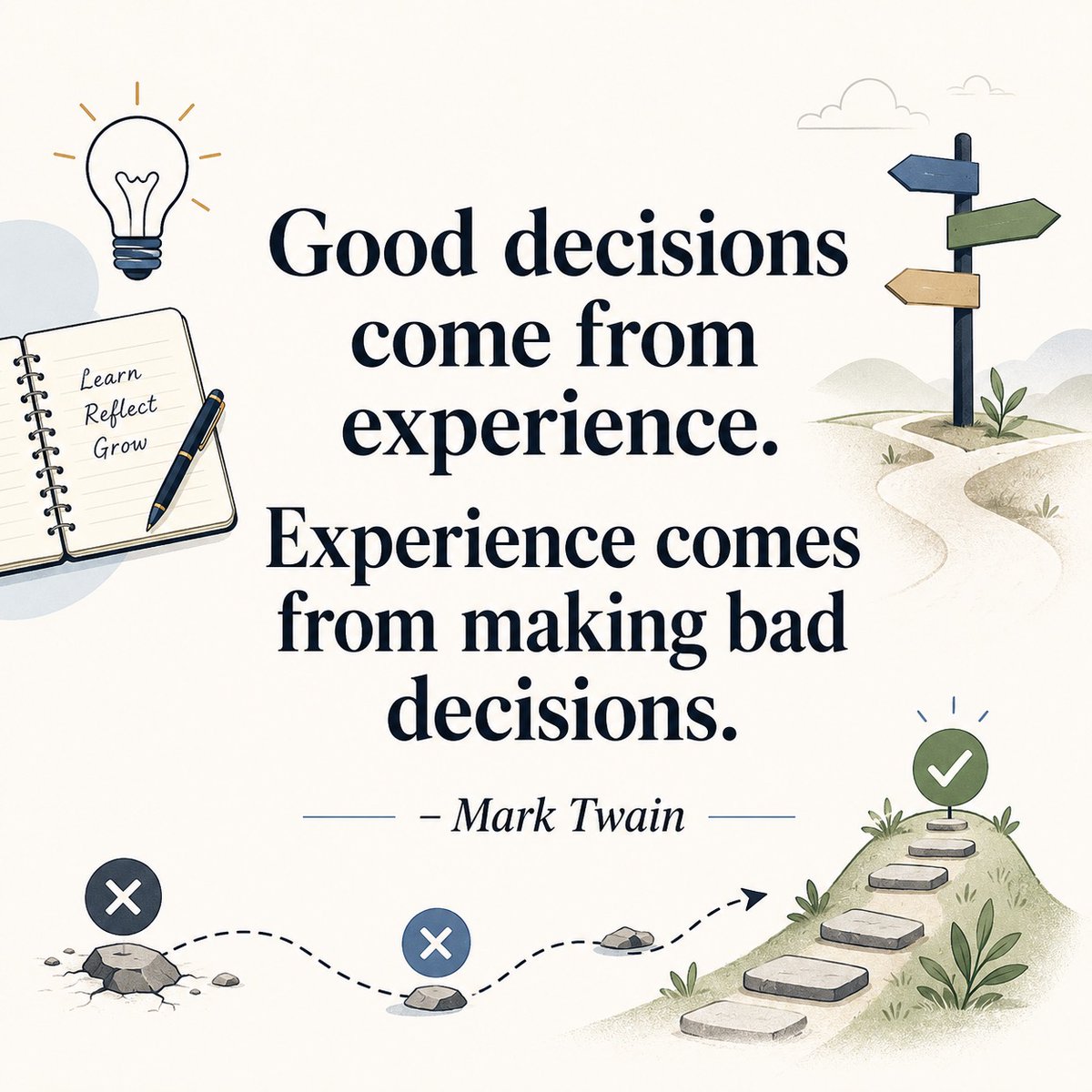
It's easy to embrace the idea that (relevant) experience improves the quality of decisions. But what really accelerates good decision making?
Making bad decisions.
So how do we use this?
Get in the game. Try things. Push your limits. Take the kind of action that will expand knowledge and understanding.
Action is always more useful than indecision. Action leads to more data, more insight, and more experience.
It's easy to get disrupted when schedules change or are interrupted by travel or time off, but recognizing it's happened is the essential first step for getting back on track.
No need to beat yourself up, but it's essential to reclaim focus and recapture those good habits.
Great business operations are like a wheel rolling down a road:
ideas leading to execution,
execution leading to evaluation,
evaluation leading to insights,
and insights leading to fresh ideas driving the wheel around again.
Skip evaluation and you'll miss essential lessons.
The power of changing your environment to refresh thinking is unmatched.
Even a simple walk at a time you aren't usually outside can be enough.
Try it.