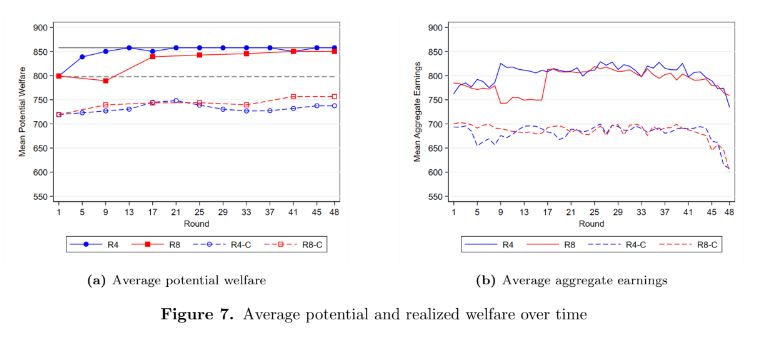
Network dynamics suggest that groups use network revision opportunities to pursue higher payoffs (and, in some cases, they are successful at capitalizing on this increase in potential welfare).
I am on the job market. You can find my JMP here: https://t.co/EvGhhkrz5U
🧵In this thread, I describe some of the main theoretical and experimental results.
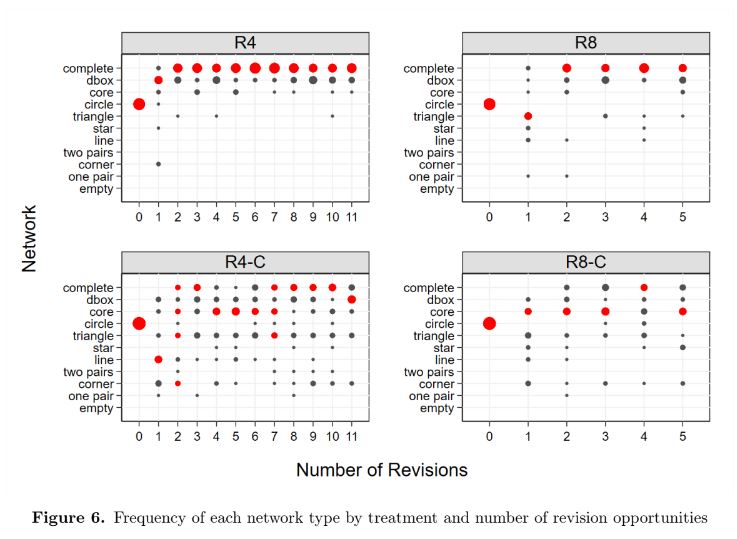
Networks tend to become more connected over time, with many groups quickly forming complete networks (where all possible links are established).
*The frequency of each network type is represented by the marker size; red markers indicate the modal network(s) at each time.
@JordiPaps@JostRossel@alyssa_holden_ @MayaGosztyla More costly option, but solves the color/graphics issue while keeping the convenience of a pen + paper feel on a tablet. iPad + @paperlike screen protector.
@HannaGHoover I managed to get to Dallas, but now @AmericanAir keeps delaying my second flight. Seems likely that it will get cancelled, but I guess they’re going to making us stand here for a few hours before they confirm that.
All packed up and ready for my flight to #ESATucson in the morning. This will be my first in-person conference in nearly two years—excited to catch up with some people I haven’t seen in a while and to meet a bunch of new @EcScienceAssoc folks.
@aboutJoy In general, I think I’d agree that I don’t believe it will have much effect. Though, I am curious about the relationship between risk preferences and selection into in-person experiments (i.e., are more risk averse individuals less likely to sign up to participate?)
@pauljhealy Is the ‘treatment’ in this case passing BOTH in first round? What about looking specifically at the exam that corresponds to the individuals’ research area? Compare individuals that passed 1/2 on first round and see if there’s a difference based on which exam they passed?