This week in Astar's governance, dApp Staking cleanup was initiated, Tokenomics 3.0 moved to referendum, Comet Swap joined the program, and new ACC members were confirmed.
Here’s what changed and why it matters. 🧵
.@aave continues to prove this is the biggest DeFi protocol this week:
🔹 Aave crossed $4.6 billion all-time liquidations.
🔹 @chainlink SVR processed $675m across 3,900 liquidations, capturing $16 m.
🔹 @capapp has grown to $500m and over 80% of Cap's cUSD reserves( $360m) , are currently deployed on Ethereum core market.
🔹 @maplefinance 's assets on @aave have reached over $750 million.
🔹 Aave will be deployed on Megaeth with the requirement of $2m in revenue within first 5 years.
🔹 Aave users can now borrow and earn yield directly through @Rabby_io Mobile.
🔹@acier has posted a new proposal to close weak Layer 2 markets
Our teams have been building with a 2.5x-faster version of Claude Opus 4.6.
We’re now making it available as an early experiment via Claude Code and our API.
Maple assets on @aave scaled to over $750M in less than 6 months.
The new generation of financial apps and neobanks needs sustainable yields, deep liquidity, and resilient infrastructure. This is precisely what these deployments unlock.
Our latest case study highlights the success.
It’s been a remarkably resilient week for the Aave Protocol and DeFi as a whole.
Over the past seven days alone, the protocol liquidated more than $450M worth of collateral across multiple networks.
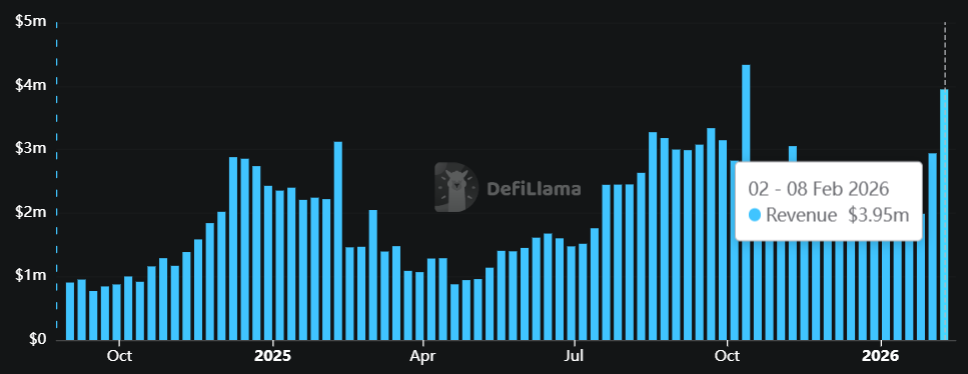
For a $50B+ lending protocol, this represents roughly 0.9% of total deposits at the time. At the same time, Aave has continued to accumulate additional revenue, helping offset risk while rewarding participants.
What’s truly fascinating is the scale Aave has reached. No other system is able to manage resiliency at this level today.
That said, lending is never a free lunch. Bad debt can occur as part of the process, and Aave has built-in mechanisms designed to handle exactly that.
The system is backed by overcollateralized, liquid assets with pre-vetted risk parameters, a critical factor in any lending context. Aave’s resiliency doesn’t rely solely on its technical design, but also on the rigorous risk frameworks established by its risk service providers. This combination of engineering and risk discipline is what sets Aave apart.
Pre-vetting risk parameters, performing accurate due diligence, and maintaining robust modeling are key reasons Aave has earned trust over the past five years.
This resiliency is further reinforced by a broad, autonomous liquidation network that actively competes for liquidation opportunities, ensuring efficiency even during periods of stress.
On rare occasions when excess debt is not fully covered by liquidations, it can be automatically absorbed by Umbrella pools, Aave’s native protection mechanism. Aave remains the only protocol with dedicated, built-in user protection of this kind that users can partake.
Learn more about Umbrella here: https://t.co/CfgMo3HkYp
All of this together defines Aave’s resiliency. The protocol has weathered multiple market cycles, from the FTX collapse and centralized lender failures to Black Monday, Thursday, and Friday.
The takeaway is clear.
DeFi wins through resiliency, transparency, and a superior cost structure.
We’re also releasing a new liquidation engine for Aave V4, bringing even more flexibility and performance to the protocol. More details here: https://t.co/ebUlEptZVa
If Aave and DeFi can withstand the most volatile asset class in the world, crypto, we should apply these systems to all assets, across both crypto and TradFi.
Aave will win.
After yesterday, Aave crossed $4.6 billion all-time liquidations.
While undesirable for borrowers, they serve as a critical safety mechanism for lenders and the Aave protocol.
Crypto prices will keep swinging — that’s the easy part. 📉📈
The real question is: do you still remember why you entered Web3?
Not for the pumps.
Not for the panic.
But for decentralization, a future where people own their data, communities control value, and power isn’t locked in the hands of a few.
Markets fluctuate. Missions don’t.
Stay here for the revolution, not the rollercoaster. 🌍⚡
Onboarding is broken because we treat every user the same.
AI changes that.
It adapts flows, timing, rewards, and nudges based on who the user is and where they’re stuck.
The next wave of onboarding isn’t louder.
It’s smarter. 🚀
Monday reminder ☕
Web3 is quietly shifting from “what token?” to “what problem?”
AI-native apps, real users, real revenue — the next cycle isn’t loud, it’s useful.
Build > Hype. Ship > Speculate. 🚀