I’m happy to share that I got hired as a postdoc researcher at RTWH Aachen University!!
Under the supervision of Prof. Hector Geffner, I will research how to integrate the data-driven and model-driven paradigms, in order to achieve "deep understanding" and robust generalization.
At the LM4Plan Workshop, we will present a preliminary version of our proposal, leaving the actual implementation for future work.
Here's a meme for making it to the end!!
In a few days, at the LM4Plan Workshop during #AAAI25, we will present Search Transformers — an enhancement to transformers for learning to reason end-to-end https://t.co/FhwBXn6Ix9 #AI#Transformers#LLMs#planning (1/6)
Given the input task, Search Transformers learn to obtain a sequence of search nodes containing useful information to solve it. Then, these nodes are appended to the context window, providing extra info for predicting the output tokens (5/6)
💻 Crean un generador autónomo de problemas de #IA capaz de mejorar las aplicaciones de mapas o el diseño de videojuegos
📈 Investigadores #UGR@DaSCI_es están detrás de este avance
📝 Noticia completa ⤵️
https://t.co/nrX1gswLPL
Just read GSM-symbolic https://t.co/QeyjfIEmph?, an interesting paper testing the abilities of LLMs on maths tasks. It seems like most LLMs (not o1) struggle with variations in question prompts and difficulty, and all of them (including o1) are bad at discerning relevant info
The University of Granada @CanalUGR just wrote a news article about NeSIG, our planning problem generator presented at @ecai2024 !
https://t.co/ygXNr0STzU
Curious whether video generation models (like #SORA) qualify as world models?
We conduct a systematic study to answer this question by investigating whether a video gen model is able to learn physical laws.
Three are three key messages to take home:
1⃣The model generalises perfectly for in-distribution data, but fails to do out-of-distribution generalization. For combinatorial scenarios, scaling law is observed.
2⃣The models fail to abstract general rules and instead tries to mimic the closest training example.
3⃣The model prioritizes different attributes when referencing training data: color > size > velocity > shape.
This work is a joint effort with our outstanding intern @YangYue_THU.
Paper: https://t.co/4opSJcPXI7
Webpage: https://t.co/cANYiThjoD
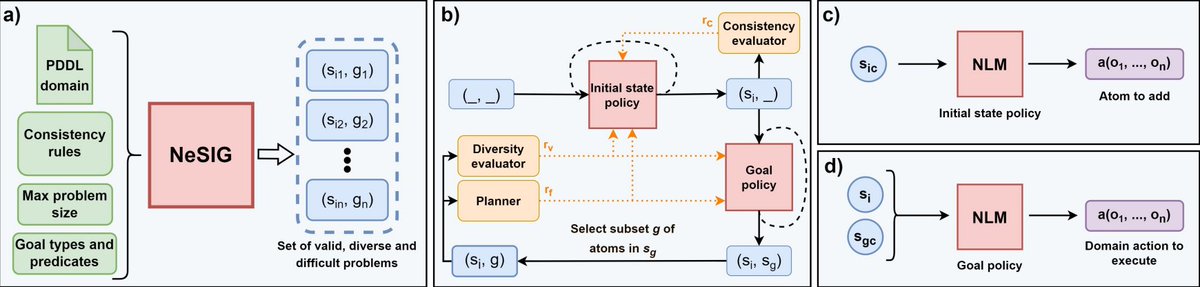
Next week I will be presenting at #ECAI 24 our work “NeSIG: A Neuro-Symbolic Method for Learning to Generate Planning Problems”, a SOTA generative model for automated planning tasks. Feel free to reach out if interested! #AI#planning#RL#Games#NeuroSymbolic#GenAI
More info ⬇️
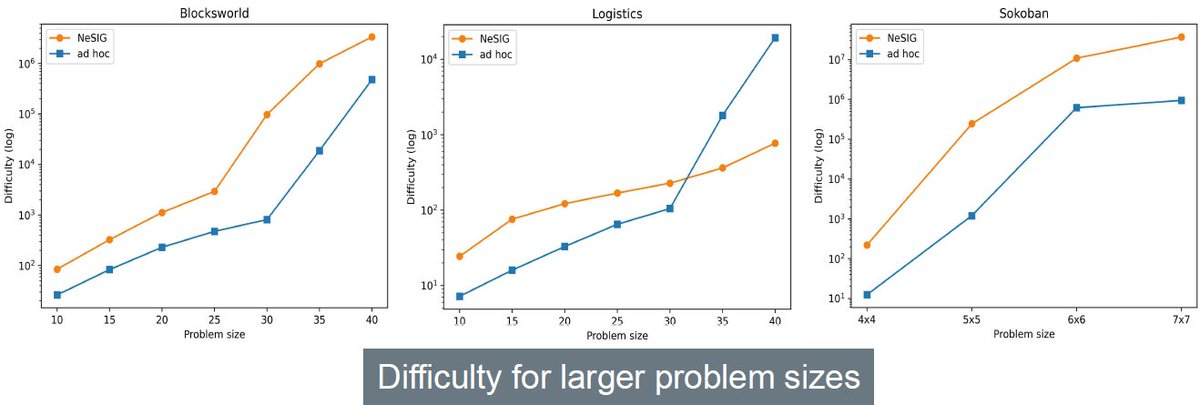
We compare NeSIG against handcrafted, domain-specific generators and ablations. Results show NeSIG obtains valid and diverse problems of much greater difficulty than ad hoc generators, generalizes to larger problems and requires much less human effort! — The End