I’m very excited to finally share the results of a passion project that has been on my mind for nearly a decade. You can find the pre-print below, but what follows is the saga of how this project came to be:
Key take home messages:
1. High-quality genome of SPB
2. Stevens elements conservation in Dendroctonus
3. Widespread gene losses and gains in SPB
4. Lower gene content in Dendroctonus due to gene losses, fewer new gene families
5. Lots of misannotated genes in other beetles.
9/
But the most surprising finding came from non-Dendroctonus beetles. Many of these genomes contain thousands of genes encoding proteins with transposable element domains (TEs). Further analyses show that these are likely annotation artifacts rather than domesticated TE genes.
8/
Instead, we found that widespread gene loss and a low rate of novel gene families formation could explain the diminished gene content in Dendroctonus.
7/
We found a range of gene gains and losses both in SPB and in Dendroctonus that may be involved in specific adaptations and possibly in its aggressive behavior. Many conserved genes have been lost in this genus (lots more details are in the paper).
5/
Intriguingly, SPB and other Dendroctonus species seemed to have fewer genes than most other sequenced beetles. We ruled out annotation errors in Dendroctonus due to artifacts and biases.
6/
Second, we wanted to know what the SPB genome can tell us about its tree-killing habit, given that SPB is the most destructive forest pest in the southeastern US with outbreaks that have greatly impacted loblolly pine commercial and natural forests.
4/
First, Dendroctonus shows extreme karyotypic variation and multiple lineages that evolved neo-XY chromosomes.
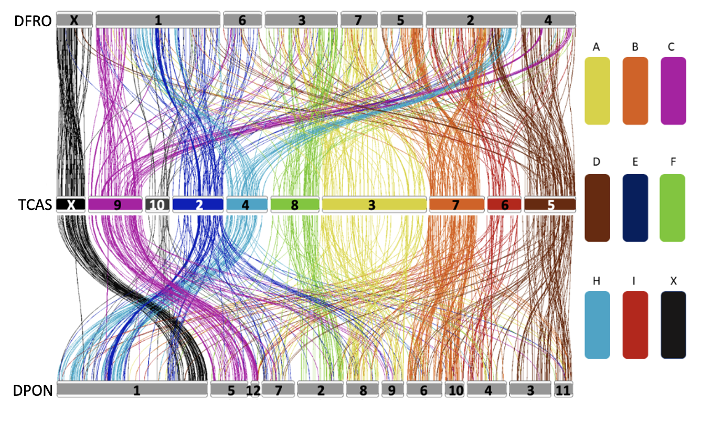
Despite this variation, we confirmed that the core coleopteran Stevens elements are conserved in SPB, and we identified the bona fide SPB X chromosome.
3/
Happy to see our work on the assembly and genome analysis of the southern pine beetle (SPB) Dendroctonus frontalis out in RS Open Science!
So why SPB, and what did we learn? (and bonus surprise at the end..)
https://t.co/gVKt9kZRby
1/
SPB is one of about 6,500 species of so-called bark beetles, subfamily Scolytinae. Most bark beetles are non-aggressive, but the genus Dendroctonus, which literally means ‘tree killer’, contains a number of species that can generate devastating outbreaks (hence the name..)
2/
Very pleased to see this work out that identifies a code in C3 rice co-opted to allow C4 photosynthesis. https://t.co/CNuFLMr13J
Thanks to all involved but in particular @l_luginbuehl@JoeEcker@_joseph_swift Great transatlantic partnership.
@plantsci