Janet Yellen called Powell's stewardship of the Fed's independence "close to exemplary" at a retrospective hosted at the Brookings Institution on Tuesday.
Resisting recent pressure "required a kind of steadiness that good monetary policy judgment alone does not provide, and Jay Powell had that steadiness in abundance."
She outlined why she doesn't think it's enough to say the central bank's independence is up to the central bank.
"The Fed cannot defend itself alone."
She said the past several years have been "alarming and ultimately somewhat reassuring" that a broader coalition, "slow and imperfect as it is, exists, and can be rallied."
Video: https://t.co/DmOFJiWClX
Email is one of the most important skills that isn't, you know, actually taught anywhere, except maybe by apprenticeship in sales and consulting organizations.
This seems like a missed opportunity for every organization which sits downstream of email.
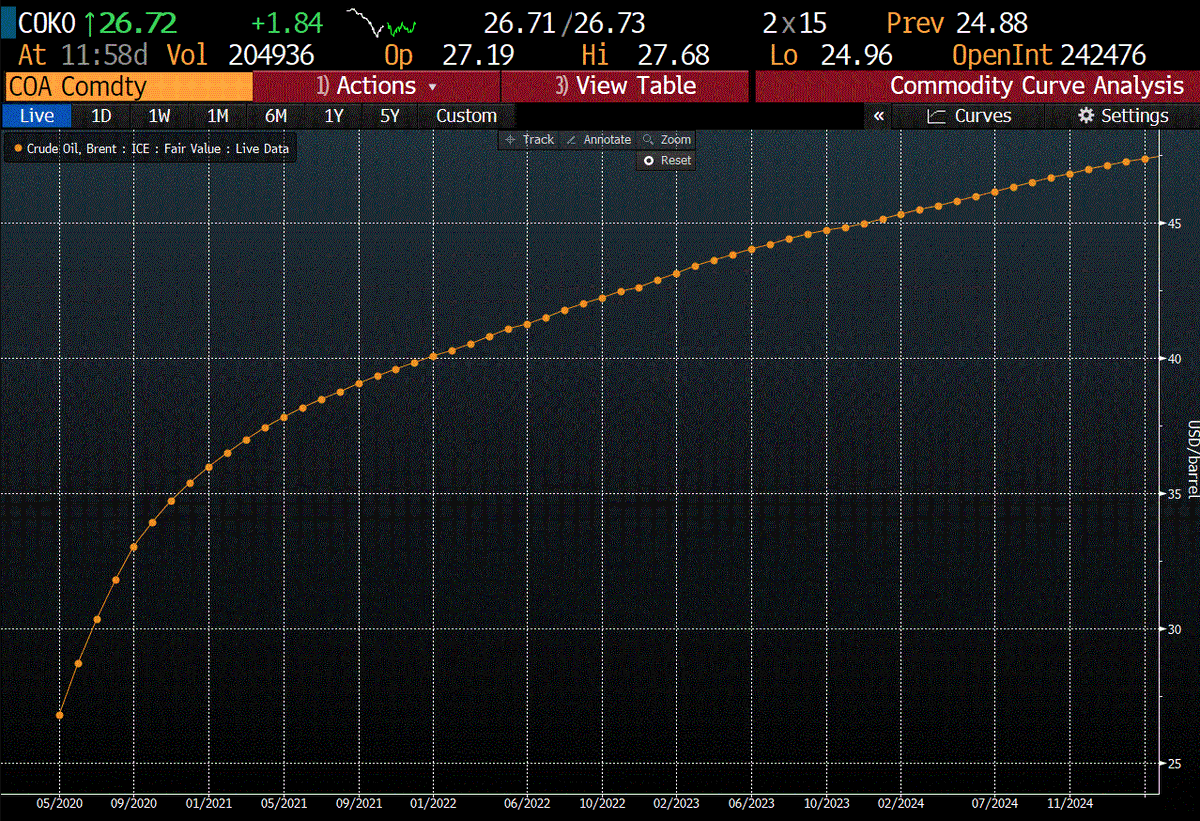
"You can buy physical Brent Crude today, lock in the price 12 months into the future, and guarantee yourself an $11 per barrel profit. It’s a great return, except you have to pay someone to store it. Here’s where my tankers come in."
https://t.co/ROYEU7WWCx
Ok so people did get this directionally right. There are several smaller effects that were pointed out (loss of convexity on the straddle as spot moves, etc) but the first-order effect here is “smile delta”. In this example, you will lose money on the rally.
@TheStalwart@tracyalloway@bennpeifert@Brad_Setser Also if the note is triggered (one index falls more than 30%) but then it does rally back to being higher than entry level - you get the worst performer of the 3 indices, subject to maximum you get 100% of principle back
The high coupon (say 10%) is paid through the tenor (3-5y)
1) Go into the field because you think the subject matter is interesting and fits your skill set. The heyday of public markets finance as a growing field is over. You will not get rich quick; you will advance slower in seniority; you will envy the $ in private equity and tech.
We have a winner! Hong Kong is the best place for quant analysis of racing because *it only has one racecourse*, on which a consistent population of horses regularly race each other. "Horses for courses" isn't just a proverb, it's a fundamental fact about racing...
One of the best podcasts I listened to this year.
Single biggest insight is that companies have complicated capital structures, that this is value-creating by assigning risk to people who want it, and that other things can now have complicated capital structures due to tech.