Goldman Sachs expects monthly token processing to rise from 1.7Q in 2025 to 120Q by 2030 - a 70X increase - with agentic AI driving more than 80% of demand.
My analysis hitting inboxes Friday reveals why the 70X increase may still be too low. Link in bio.
$NVDA $GOOG $MSFT
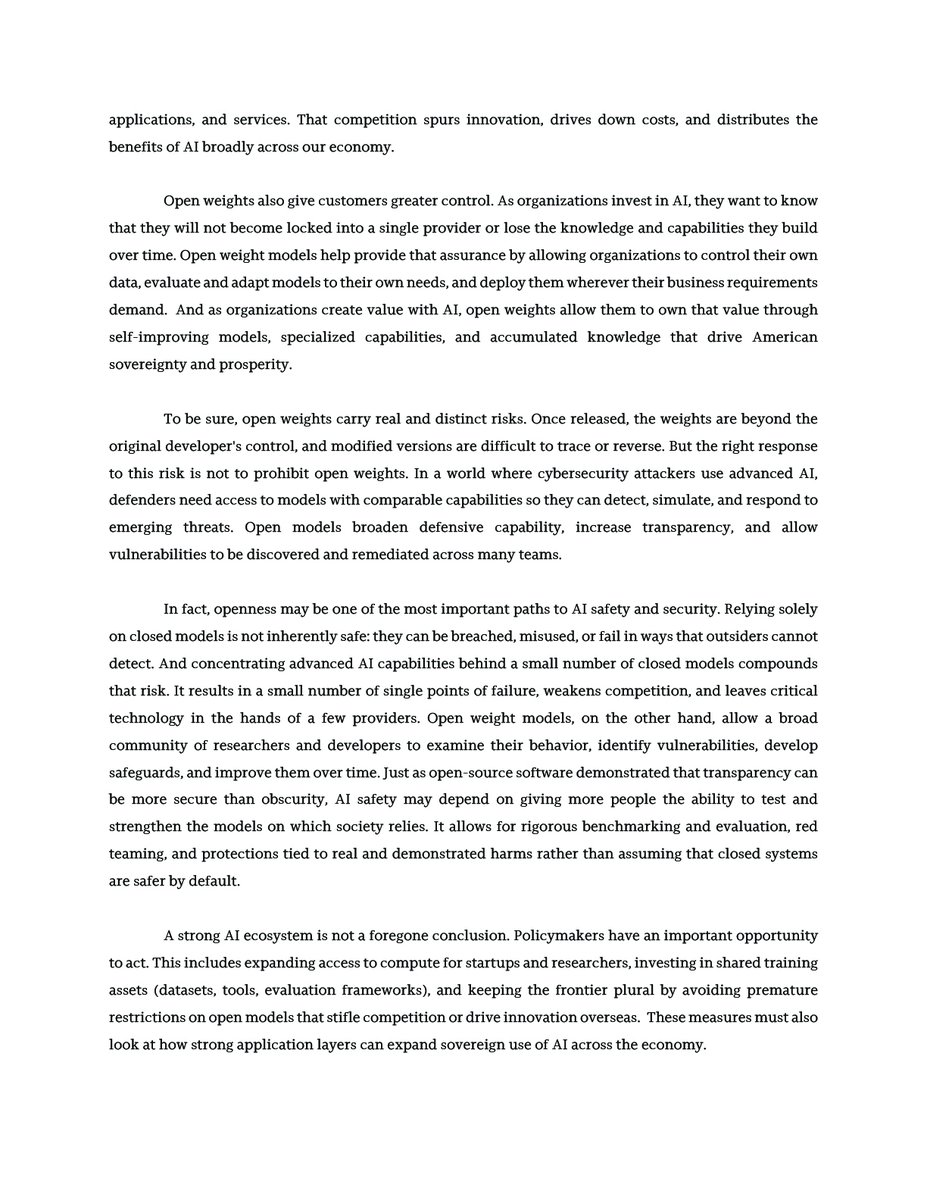
For my first post, I’m sharing a letter @NVIDIA signed on why open models matter.
AI will transform every industry, power every company, and be built by every country.
Open models strengthen safety and cybersecurity, accelerate innovation and diffusion, and enable sovereignty.
The world needs both frontier closed models and frontier open models.
https://t.co/AUKzoQ5Ikb
$VERU
$36 million market cap, late stage pharmaceutical company, with a very promising muscle sparring drug, enobosarm, that is being paired with GLP drugs, resulting in up to 99% muscle preservation in their initial results. 2-10 Billion buyout opportunity for $NVO.
Open-weight models are essential to a healthy AI ecosystem. Together with others across our industry, we are outlining a path for open-weight models to strengthen American competitiveness and expand economic opportunity, while protecting national security. https://t.co/Tr0sAzAxTD
AMD AND ANTHROPIC JUST SIGNED A HUGE DEAL FOR TENS OF BILLIONS OF DOLLARS WORTH OF AI SERVERS
Anthropic will purchase up to 2 gigawatts of AMD's $AMD next-generation Instinct MI450 chips starting in the first half of 2027
AMD will separately invest up to $5 billion into Anthropic, its first check into the company, as certain deployment milestones are met.
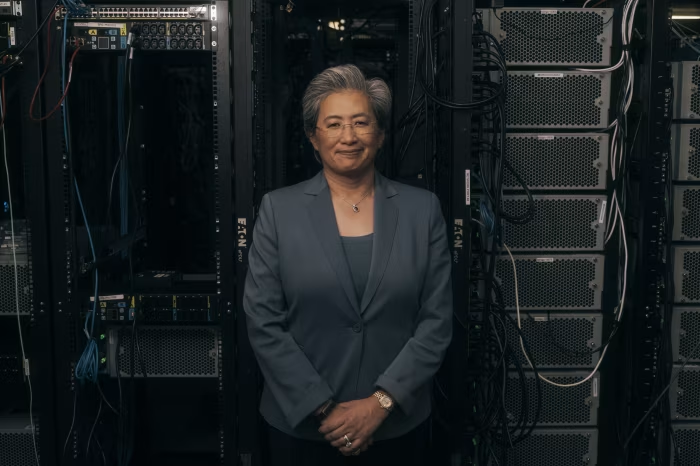
AMD CEO Lisa Su: "We have very much wanted to be a major part of their infrastructure."
AMD is also reportedly in talks to provide a financial backstop for Anthropic's future data-center leases
AMD will use Anthropic's Claude models to help improve its own chip technology.
(Source WSJ)
Microsoft $MSFT expands Mistral partnership with a multibillion-dollar European AI infrastructure deal
Microsoft will use Mistral’s Europe-based GPU capacity, powered by thousands of Nvidia Vera Rubin GPUs, to support its cloud and AI services.
Mistral Medium 3.5 and OCR 4 are also joining Microsoft Foundry, with Medium 3.5 added to Copilot Studio for enterprise and regulated-industry deployments.
THE EMPIRE STRIKE BACK (AT CLAUDE)
In the coming months, we will see a release from $MSFT that is just like Claude Cowork.
Except it runs faster, and natively on your AI powered Dell laptop.
And, we're going to see $GOOG launch a version of Claude CoWork in the cloud.
This isn't too different from how Microsoft responded to Netscape Navigator.
The incumbents are slower to adapt. But, they do have plenty of cashflow to fund capex.
And, they do have the engineering resources to "fast follow".
If you're Anthropic, you should be seeking to go public as fast as humanly possible.
THE EMPIRE STRIKE BACK (AT CLAUDE)
In the coming months, we will see a release from $MSFT that is just like Claude Cowork.
Except it runs faster, and natively on your AI powered Dell laptop.
And, we're going to see $GOOG launch a version of Claude CoWork in the cloud.
This isn't too different from how Microsoft responded to Netscape Navigator.
The incumbents are slower to adapt. But, they do have plenty of cashflow to fund capex.
And, they do have the engineering resources to "fast follow".
If you're Anthropic, you should be seeking to go public as fast as humanly possible.
The mega bull case for AI infrastructure would be *if* market share shifted away from certain frontier labs with 90%+ inference margins toward cheaper models, whether open-source or closed.
It would increase the ROI on AI spend for end customers by increasing intelligence per dollar, which would drive incremental token demand. Margin dollars would effectively get redistributed from the frontier labs to AI infrastructure providers. The infra winners would be those with the lowest per token cost and the winners at the model layer would be those with the highest token efficiency.
There are many reasons Jensen is so focused on open source, but this is likely the most important one as I think he is probably less worried about a monopsony these days. Lower margin % at the model layer = more margin $ at the infra layer all else equal.
With SpaceX and Meta being vertically integrated and possessing the #3 and #4 models respectively it is more possible than ever. Note that Grok 4.5 is ahead of Fable for some useful tasks at a much lower cost, so ranking them #3 is conservative.
This is not happening yet. Cheap, mostly open source tokens are likely the majority of volume today but the majority of economic value is still accruing to the most intelligent models. Might change though.
We will see.
Meta’s chip push explodes with help from TSMC, MediaTek, Qualcomm, Arm, Broadcom, DigiTimes reports:
-Meta also working with Qualcomm, MediaTek on new ASIC projects
-Will use Qualcomm CPUs, working with Arm on CPU project
-Broadcom readied ‘Iris’ chip in just 6-months (testing, validation) for September production, shows Meta revving up chip ops
-Key reason for Meta chip moves: Reduce computing costs $META $QCOM $AVGO $ARM $TSM #Mediatek #semiconductors https://t.co/CUSQZbSPwj
BofA says $META's 2026 buildout math may be far better than expected: 6.5 GW of added capacity on $145B of capex implies about $22B per GW, versus BofA’s prior $45B estimate. If accurate, sub-$30B/GW costs could materially improve AI infrastructure returns.
BofA says $META may be building its AI empire at roughly half the cost the market expected.
Its math shows 6.5GW of added capacity on $145B of capex implying ~$22B per GW versus its prior $45B estimate.
Thats huge because lower cost per GW makes external monetization far more powerful so if Meta sells 50% of capacity at $15B of revenue per GW then BofA’s framework points to up to $150B of incremental revenue potential.