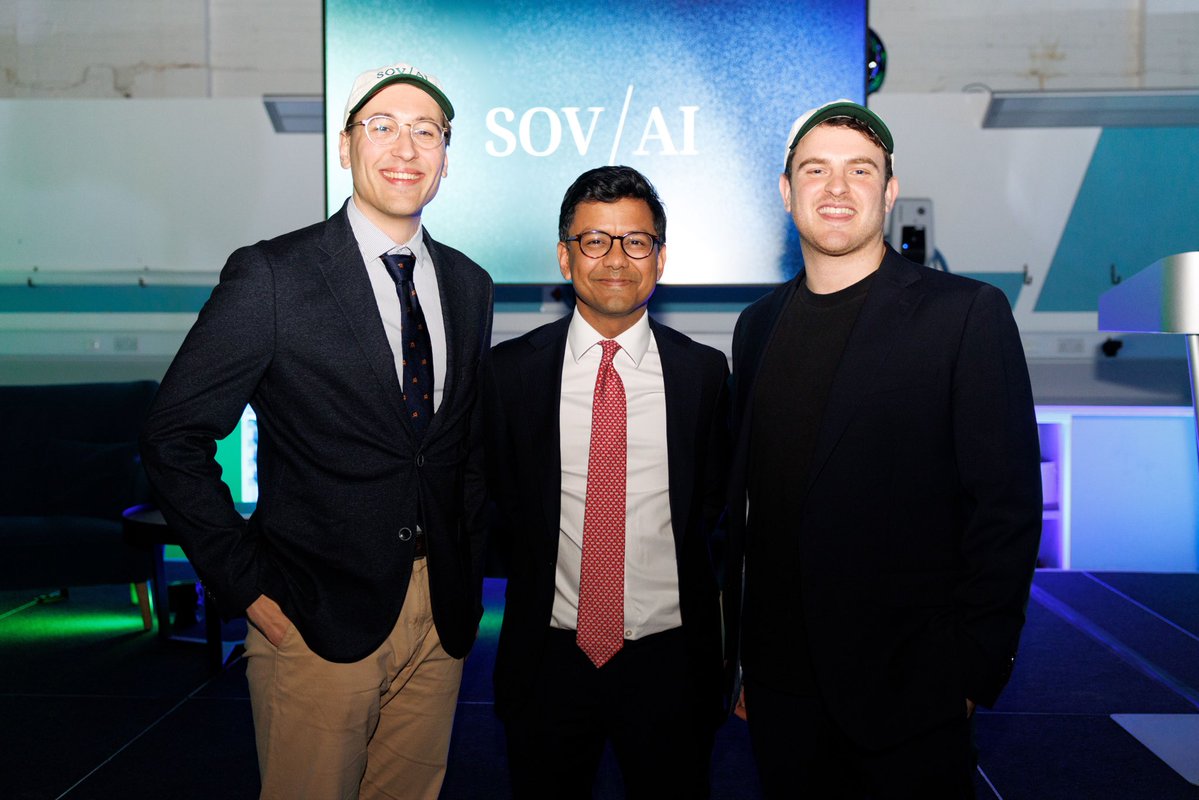
I just took a look at @CallosumAI's posts and announcements and it looks super impressive. Need to get the download from @achterbrain.
They're attacking cost, accuracy, and/or speed of whatever workload you have by breaking it down into modular components and running those pieces on whatever hardware or model meets your specs.
But I honestly think one of the coolest things that Callosum could do is serve as basically the OpenRouter for chips. Think about it—they don't need to be a chip company, which means they have no ultra-concentrated bet on some particular hardware that may not work out. At the same time, they could offer an invaluable resource to any hardware startup: an immediate sales channel. If it's as simple as changing an API call and pointing my workload at some new hyped chip, of course I'm going to give it a try. And the best part is that hardware designers can provide their specs, interface, etc., Callosum can plug the chip in and make it available, and coding agents will be able to help you get the most out of this new hardware, easing the adoption burden of new hardware.
These guys are so well positioned for the Cambrian explosion of hardware heterogeneity we're about to witness over the next few years.
Super happy to share some of our results on model orchestration! At Callosum we're investigating how model-hardware configurations behave, how we can model that behaviour, and how we can exploit it optimally.
This is elegant because this simultaneously allows us to expose more surface area for exploiting the benefit of heterogeneous models.
Where foundation models learn representations of the world, a heterogeneous-optimised router can learn a representation of the program itself.
As a result, at equal accuracy, using our partner's silicon @cerebras, we are >10× faster than the best configuration on a GPU, while also being ~2× cheaper and ~2× faster than a @cerebras baseline. This highlights how we can multiply the benefits of new hardware.
Excited to share some of what we've been working on at @CallosumAI: making heterogeneity programmable!!
We break AI tasks into reusable blocks, then run each on the model and hardware best suited to it, building smarter, faster and cheaper systems.
Callosum Technologies co-founder Danyal Akarca explains how the UK startup is looking to match AI workloads with the right combination of chips and models to cut costs and improve efficiency https://t.co/5BKtsv5CJf
It’s incredible how much has happened in the eight or so months since I joined what was then a very small, super talented, and deeply ambitious team—and is now becoming much bigger, even more talented, and even more ambitious.
Today we announce our $100M seed round to redefine how humanity computes in AI's next chapter.
The future of compute and AI is heterogeneous. Callosum is building it:
https://t.co/t5KnOE0Sos
Britain is building the future of chips, the foundation for modern AI, an ambition shared by the @CallosumAI team.
Congratulations to @DanAkarca, @achterbrain and team on a major milestone, backed by @UKSovereignAI 🇬🇧
Thoughts About Scaling Law
Scaling, but not only of parameters. Every model release now ends with the same question: how many parameters? It isn't a question that can be answered on its own. Parameter count is only meaningful alongside three others — how much data you have, where you intend to spend your compute, and who will run the model, under what conditions.
The field learned this the hard way. Kaplan et al. (2020) fit an exponent that told everyone to grow parameters faster than data — roughly 2.7:1 — and the industry complied: GPT-3, Gopher, MT-NLG. Hoffmann et al. (2022) redid the experiment across four hundred models and found the compute-optimal split is closer to 20 tokens per parameter, and that with sufficient compute the two should grow at the same rate rather than drifting apart. The error in the earlier fit compounded with every order of magnitude of compute, which is why the largest models of that generation were the most misallocated. The trillion-parameter round was, in retrospect, a detour the whole field took together and then reversed.
Chinchilla wasn't the end either. It optimized training compute for models that would be trained once and evaluated. Today a model is called billions of times a day and inference dominates lifetime cost. Put inference into the objective and the optimum moves toward smaller models trained far longer — deliberate over-training, which is what Llama-2-7B and Gemma-2-9B were doing at roughly 290 and 889 tokens per parameter.
Sparsity moved the target again. In a MoE model two quantities have to be kept apart: total parameters govern roughly how much the model can hold — knowledge, facts, the long tail — while activated parameters and effective depth govern roughly how far it can think, how many steps of a causal chain it can carry before it comes apart. A dense 20:1 ratio does not transfer. And the ratio isn't a single number at all: Roberts et al. (2025) find the optimal tokens-per-parameter is task-dependent, with memorization favoring more parameters and reasoning favoring more data. Follow-up work on MoE observes that at fixed TPP, pushing total parameters higher actually degrades reasoning, while activating more experts reliably helps it.
This matters for what we are building toward. Finding a vulnerability is not a retrieval problem. It doesn't come from having memorized more CVEs; it comes from carrying a twenty-step chain of inference to the end without losing the thread. That capability does not live in total parameter count.
Which brings us to this release. Total parameters appear to matter up to a threshold — enough to hold the world — after which additional capability comes from scaling elsewhere: effective depth per forward pass, and above all post-training. GLM-5.3 is our controlled experiment on that claim. Same base, same architecture, same total and activated parameters as GLM-5.2. One month of scaling long-horizon environments and RL. The gains are not marginal. Well, scaling has more than one dial. We turned the post-training one this time because it had the most slack left in it — not because the others are finished. Base model size, pretraining data, compute spent per forward pass: all of them are still on the table, and we will come back to each. What this experiment taught us is that the dials do not have to be turned together, and that the one worth turning next is rarely the one that was worth turning last. We are not done scaling. Next time, maybe mid-training, pre-training, and even more.
For my first post, I’m sharing a letter @NVIDIA signed on why open models matter.
AI will transform every industry, power every company, and be built by every country.
Open models strengthen safety and cybersecurity, accelerate innovation and diffusion, and enable sovereignty.
The world needs both frontier closed models and frontier open models.
https://t.co/AUKzoQ5Ikb
AI is a tool that promises to have an impact comparable to the invention of the optical lens.
It will allow us to build instruments that can see farther and in greater detail. It will also make it possible for a huge segment of the population to participate in mathematics and science by enabling them to see and read things they otherwise couldn't read or understand, like glasses did.
When lenses were first introduced there was some pushback because it's unclear whether it showed you the real world or a Zerrbild (early lenses were also bad), but today nearly every scientific observation we make relies on an optical element somewhere in the instrument and nobody would question that we're not seeing with our own eyes. You can refuse to look through the telescope and become the Cremonini of AI, or embrace it and see if ideas and conjectures hold up under closer inspection. Lenses didn't take the soul out of physics and I'm confident that AI won't take the soul out of math either
So proud of our security team! They caught, contained & publicly disclosed an attack unlike anything we've seen before, and did it at record speed.
Also massively grateful to @Zai_org: they shared GLM5.2 as open weights (for free!) with the world and it became a key part of our defense.
This is day one for cybersecurity in the age of agents & we're all learning that secrecy is not the answer & that all defenders (not just a few selected ones) everywhere need more powerful models without restrictions, especially open ones!
Our first investment?
💥 @CallosumAI - @DanAkarca & @achterbrain 💥
Proud to be backing Danyal, Jascha, and the team as they build one of the defining layers of next-gen AI systems. 🔥
Today we launched @CallosumAI.
We are building the infrastructure where heterogeneous chips & intelligence co-evolve to solve the world's hardest problems.
Today we present our first results.
Across four large problem spaces, we break SOTA and deliver orders-of-magnitude improvements in capabilities, cost and speed: 12× cheaper deep context. New web SOTA with open-source, 3x cheaper and faster. 2.4× cache speedups. 1,767× faster tool calling. This is the worst our infrastructure will ever be.
We do it by co-evolving heterogeneous chips and multi-agent intelligence - workflows aware of their hardware, models aware of their task graph, kernels aware of their output constraints. An Intelligent System.
https://t.co/t0KiP6q3eJ
But the benchmark is the starting point, not the destination. The system already generalises to problems it has never seen.
We asked it to identify a robot across two images, find it on Amazon UK, compare prices on OnBuy, and purchase it. Live websites, multi-modal reasoning, end-to-end. Text-only models cannot solve this. Standard agentic frameworks struggle.
Naturally, we had to order a Transformer.
The future of compute & AI is heterogeneous.
That future is being built by Callosum.
Today we launch with new breakthroughs made possible by heterogeneity, new scaling principles & a roadmap reimagining compute & AI infrastructure:
https://t.co/Yp1Qwt45tM