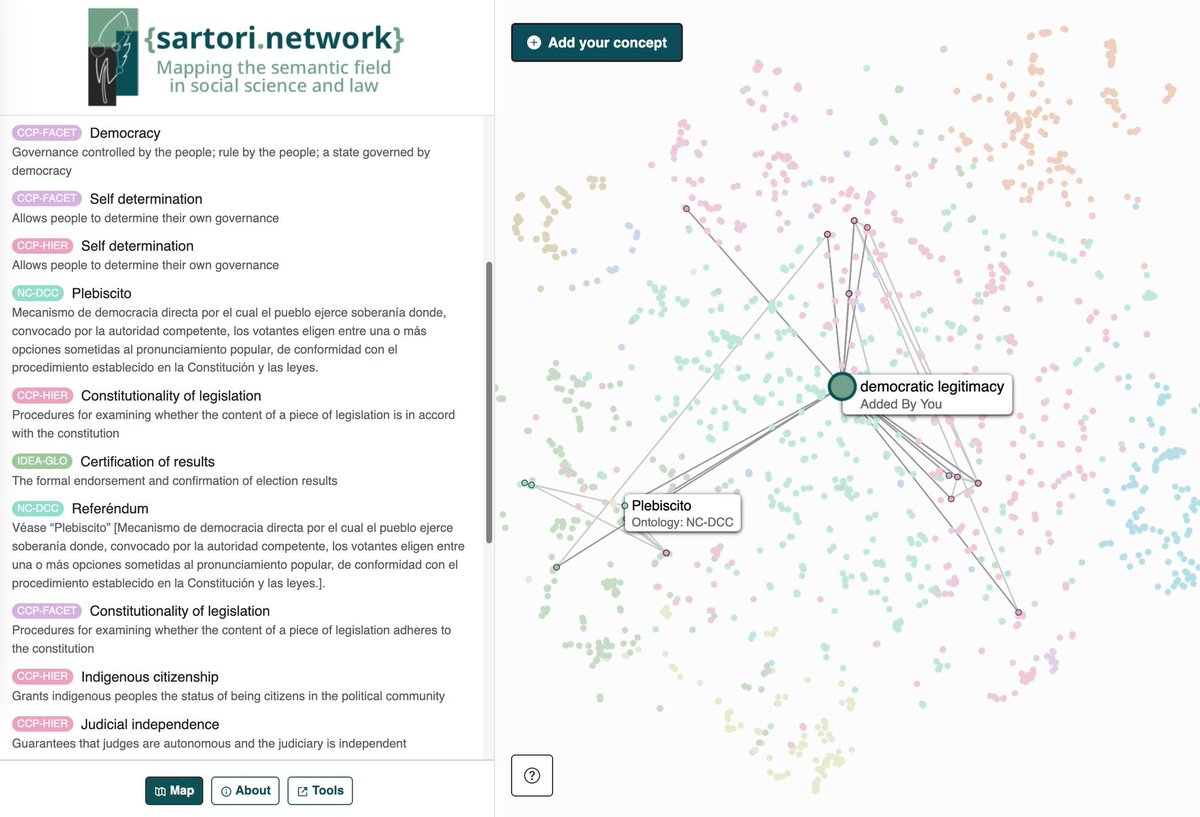
New from the CCP 🚨 Giovanni Sartori told political scientists to take their vocabulary seriously. Now there's a tool for that. https://t.co/bVNbTiGywS lets you explore how 10 research teams across law and political science define and connect 2,010 concepts.
In her article for CS, Ruth Rubio-Marín explores #teaching law in an age of #extremes, exploring how to foster #inclusion and #engagement amid increasing #polarization.
Read her article at https://t.co/9VpRE94b4S.
Sign up for future CS issues at https://t.co/xV6WkWkxAv.
🙏🏽 We have lost Ran Hirschl, a great person, scholar, and teacher. He passed away earlier this week on Tuesday, May 19. My condolences to his partner and wife, Ayelet Shachar, and to their son, Shai.
📝 The University of Toronto has published this announcement: https://t.co/UupDlqRPiB.
🕊️ May Ran rest in peace.
In her article for CS, Dian Shah assesses how #courts in #Asia engage with #socialcohesion in constitutional adjudication, depending on local context and cases.
Read her article at https://t.co/hRaUmI7TPK.
Sign up to receive future CS issues at https://t.co/xV6WkWkxAv.
For decades, David Collier has shaped how political scientists think about concepts. This book collects his essential work, with research notes from 13 scholars who apply, debate, and extend his ideas. Out next month, edited by CCP co-director @ZedTex
🔗: https://t.co/rlCMIC54ts
Our latest paper — "Expanding Your Vocabulary: A Framework for Topic Integration in Texts" — is out now (OA) in @SSCRatSage! We introduce the segments-as-topic (SAT) method, combining automation + expert review to construct new topics from large corpora. https://t.co/vDwx4WkIg2
In his interview for CS, José María Serna de la Garza interviews Manuel Cepeda Espinosa, former President of the Constitutional Court of #Colombia.
Available in #Spanish, #English, and #Mandarin at https://t.co/PJwWC61BfG.
Sign up for future issues at https://t.co/xV6WkWl5q3.
Este es el nuevo paper que escribimos con el equipo del CCP y que se publicó hoy en Social Science Computer Review. Introduce un nuevo método (segments-as-topics) para construir temas a partir de grandes volúmenes de textos, como constituciones. Pasen a mirarlo 👇
Our latest paper — "Expanding Your Vocabulary: A Framework for Topic Integration in Texts" — is out now (OA) in @SSCRatSage! We introduce the segments-as-topic (SAT) method, combining automation + expert review to construct new topics from large corpora. https://t.co/vDwx4WkIg2
Our paper "Expanding Your Vocabulary" on the Segments-As-Topic (SAT) method has been accepted at @SSCRatSage! The SAT framework combines automated NLP with domain expertise for topic discovery and integration in large textual corpora.
Pre-print/tools: https://t.co/4L36BMGWLh
Have you used the CCP's data in your own work? Let us know! We want to showcase your research on our "CCP in the Wild" page.
Submit yours → https://t.co/QUL721FDeV
Browse the collection → https://t.co/9PcFqYtKLD
Version 6 of the Comparative Constitutions Project's Chronology of Constitutional Events is out now! It now covers all events through 2025 — 81 new observations and 20,600+ country-years of events since 1789, free to download. https://t.co/c4DAqN9exR
In their article for CS, Netta Barak-Corren, Hanna Lerner, and Tirza Kelman explore #constituent#assemblies to renew #democracy amid #division.
Available in #English and #Spanish at https://t.co/g1Tawye7jB.
Sign up for CS future issues at https://t.co/xV6WkWkxAv.
In his new article, Yasuo Hasebe explores the #history and intertwined trajectories of #academicfreedom and #democracy, using #Japan as an example.
Available in #English and #French at https://t.co/qJXOKBW2Zo.
Sign up to receive future CS issues at https://t.co/ewdRDLOsuI.
Version 6 of the Comparative Constitutions Project's Chronology of Constitutional Events is out now! It now covers all events through 2025 — 81 new observations and 20,600+ country-years of events since 1789, free to download. https://t.co/c4DAqN9exR
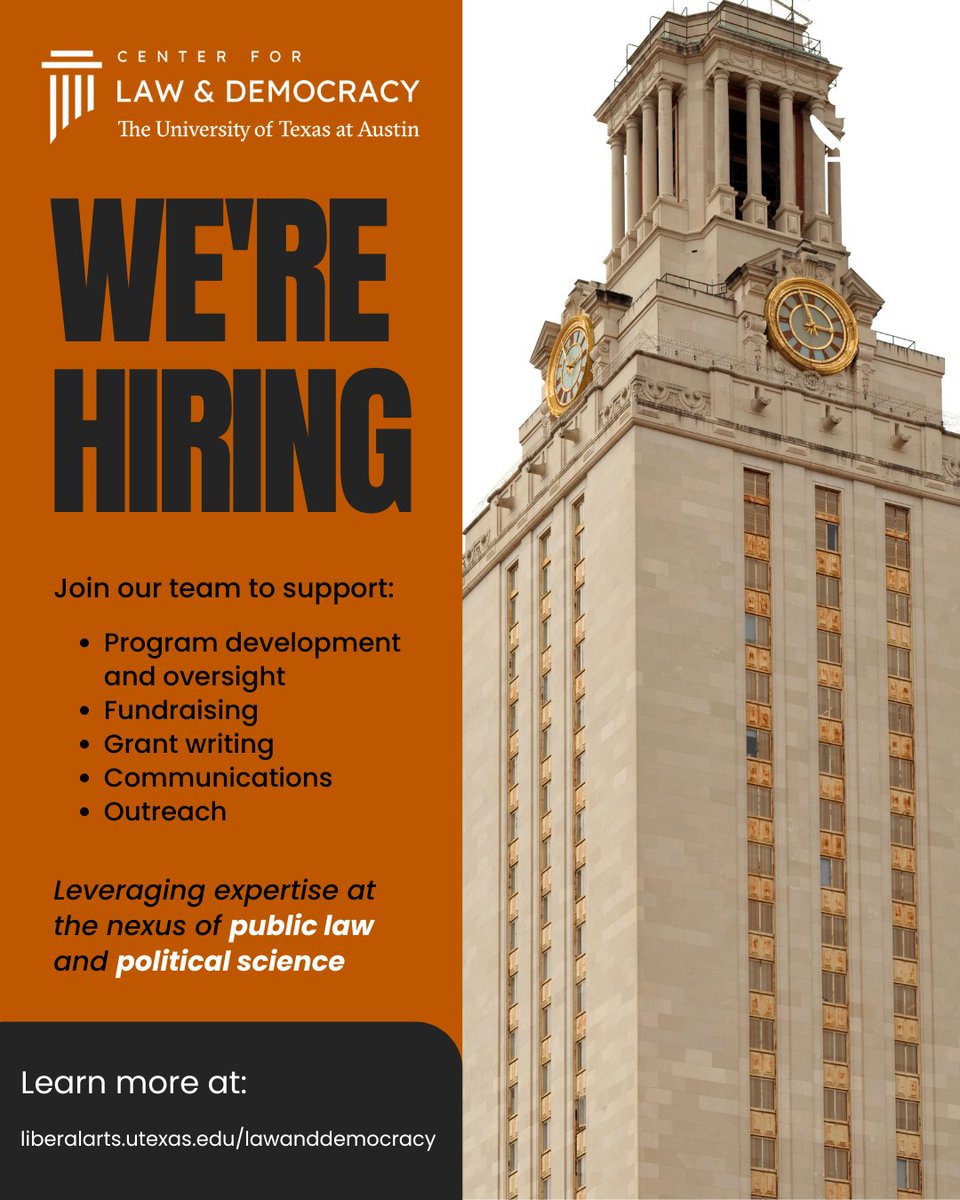
We are #hiring! If you have a passion for law and democracy, join us to oversee daily program operations, develop and fund new programs, and work with stakeholders across UT and globally to advance democracy.
Read more at https://t.co/GeRb72Yoku.
We look forward to connecting!
Our paper "Expanding Your Vocabulary" on the Segments-As-Topic (SAT) method has been accepted at @SSCRatSage! The SAT framework combines automated NLP with domain expertise for topic discovery and integration in large textual corpora.
Pre-print/tools: https://t.co/4L36BMGWLh
Our postdoctoral researcher, Matthew Martin, has a new article out in Comparative Politics based on his interviews with constitution-makers in Chile and Cuba. Check it out below!
New article on Fast Track by Matthew Martin, “From Citizen Input to Elite Legitimation: The Logic of Will-Confirmation in Constitution-Making,” https://t.co/VGsCHspQKN
Have you seen our Constitutional Chronology? We've been updating our data with constitutional events from 2024–25, some of which are now displayed on our interactive global timeline. See something important missing? Let us know! Explore the timeline → https://t.co/lQjOXV6dub