15 mil estrellas en GitHub en menos de 24 horas.
Este proyecto es del famoso creador de contenido PewDiePie y lo está explotando.
Se llama Odysseus y es una especie de ChatGPT/Claude, pero pensado para usarse en IA local.
Tiene agentes con tools, MCP, archivos y memoria.
Funciona en Windows, macOS y Linux:
https://t.co/xylKxBFQie
“No escuchen a los fracasados de siempre que están ahí para poner piedras en el camino y que no quieren el bien de la Selección”: Néstor Lorenzo en Noticias Caracol con Javier Hernández Bonnet y Juan Roberto Vargas
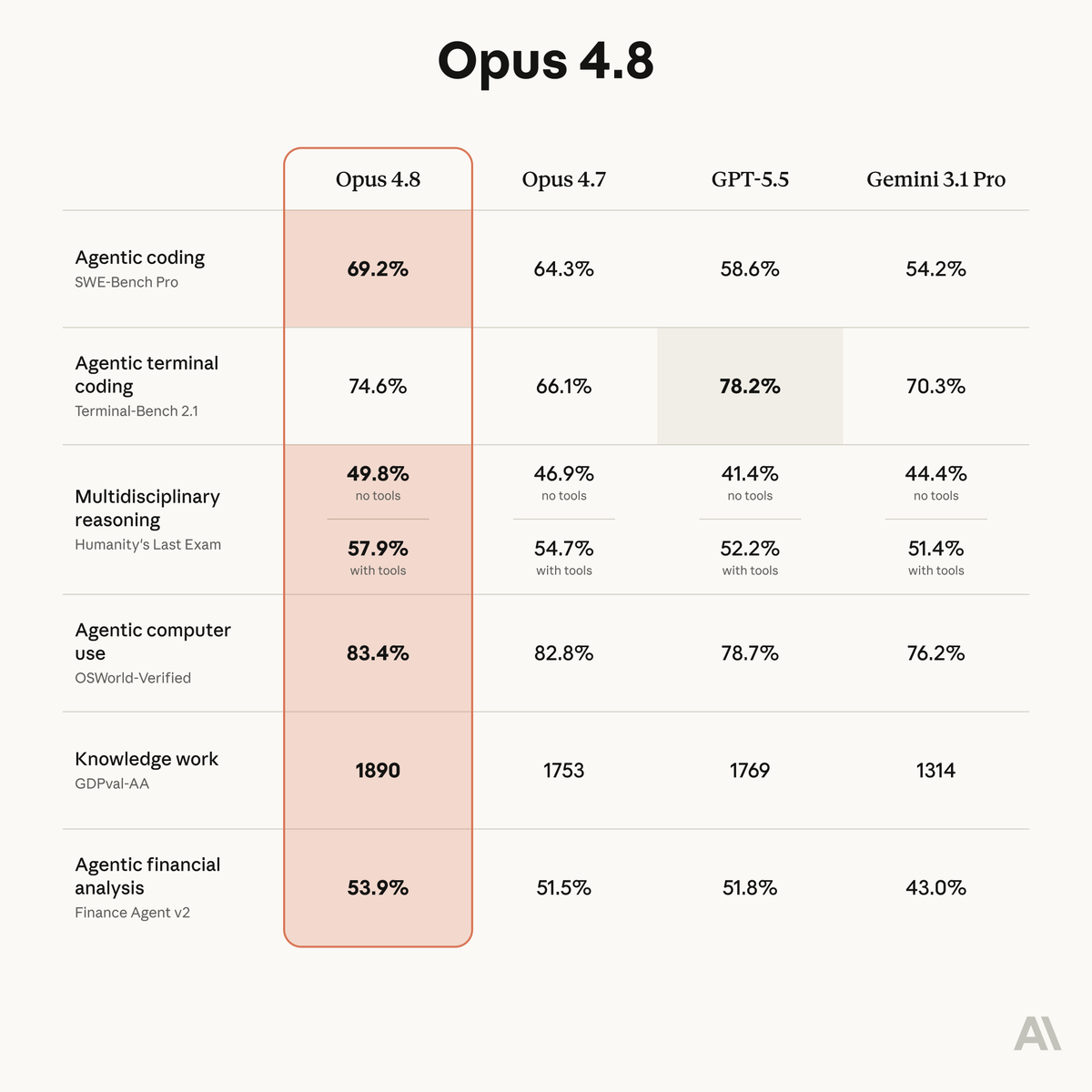
Introducing Claude Opus 4.8: it builds on Opus 4.7 with sharper judgment, more honesty about its own progress, and the ability to work independently for longer than its predecessors.
Available today at the same price.
"Creemos que con la IA podemos reemplazar a todos los desarrolladores junior de nuestra empresa"
Matt Garman, CEO de AWS: "Es la mayor estupidez que he escuchado en mi vida".
Personal update: I've joined Anthropic. I think the next few years at the frontier of LLMs will be especially formative. I am very excited to join the team here and get back to R&D. I remain deeply passionate about education and plan to resume my work on it in time.
VS Code was already used by millions of developers for agentic coding. However, the editor layout has traditionally been optimized for single-task and single-workspace workflows.
Today, we're introducing a new window to enable our users (and ourselves!) to work with multiple agents across multiple projects: Agents.
Now available in VS Code stable!
Introducing SubQ - a major breakthrough in LLM intelligence.
It is the first model built on a fully sub-quadratic sparse-attention architecture (SSA),
And the first frontier model with a 12 million token context window which is:
- 52x faster than FlashAttention at 1MM tokens
- Less than 5% the cost of Opus
Transformer-based LLMs waste compute by processing every possible relationship between words (standard attention).
Only a small fraction actually matter.
@subquadratic finds and focuses only on the ones that do.
That's nearly 1,000x less compute and a new way for LLMs to scale.
Code with Claude, our developer conference, returns next week.
Whether you're just getting started with Claude Code or you've been building for a while, there's a session for you.
Register for the livestream: https://t.co/GJwOPMDLEC
OpenClaw - the agentic software spreading like wildfire - was built on top of Pi, a minimalist, self-modifying agent. I sat down with Pi's creator, @badlogicgames and longtime Pi user (+ the creator of Flask) @mitsuhiko to talk Pi, and their (very grounded!) takes on building with AI.
Timestamps:
00:00 Intro
07:30 How Mario, Armin, and Peter Steinberger met
15:15 How 30 dev teams use AI agents: learnings
21:50 The importance of judgment
24:26 Challenges when non-engineers write code
28:30 Downsides of over-automation
32:18 Pi
48:09 OpenClaw + Pi
50:54 “Clankers”
57:32 Open source and AI
1:00:22 Complexity as the enemy
1:02:50 Building an AI-native startup
1:11:52 “Slow the F down”
1:16:40 MCPs vs. CLI
1:25:03 Predictions and staying up to date
• YouTube: https://t.co/u9n7ePTaAO
• Spotify: https://t.co/TvbqPnbfNz
• Apple: https://t.co/4ACETLJ1Zm
Brought to you by:
• @statsig – The unified platform for flags, analytics, experiments, and more. https://t.co/ZCSOIcWv31
• @SonarSource — The makers of SonarQube, the industry standard for code verification and automated code review. Try it out for yourself. https://t.co/QtBhYDH9UX
• @WorkOS – WorkOS gives you APIs to ship enterprise features – SSO, directory sync, RBAC, audit logs – in days, not months. Visit https://t.co/jhFNq3a7n7 to learn more.
---
Three parts I found especially interesting in this discussion:
1. New trend: AI makes it harder for senior engineers to reject pointless complexity.
Historically, senior engineers kept software complexity at bay simply by saying “no” a lot. But Armin observes that these days, more junior engineers and product managers deploy agent-scripted counterarguments when a senior colleague kicks an idea to the curb. This makes decision-making exhausting, and more bad ideas make it into production as a result.
2. It should be MUCH easier to build specialized tools for specific tasks.
Different projects need different harness types because, as Mario points out, the same hammer is not ideal for every single construction job. As such, Pi is built with the goal of allowing the creation of specialized harnesses. It can modify itself so that a user can create the bespoke harness needed for any task. Mario believes it’s a preview of how self-modifiable software might look in the future.
3. Automation bias is one of the biggest risks of working with AI agents.
Once devs confirm that an AI agent can produce acceptable code, they start to review its output less often, even though agents can – and do! – produce slop. Mario advises being far more sceptical with agents, and cautions that the quality of their output isn’t guaranteed, however well they performed previously.
Martin Fowler acaba de publicar "Structured-Prompt-Driven Development" en su web.
Un framework de Thoughtworks para tratar los prompts como artefactos de ingeniería, no como conversaciones de chat.
No es otro post sobre "cómo promptear mejor". Es un método. Hilo 🧵
We’re introducing the Cursor SDK so you can build agents with the same runtime, harness, and models that power Cursor.
Run agents from CI/CD pipelines, create automations for end-to-end workflows, or embed agents directly inside your products.
For XPENG IRON, we developed a general-purpose framework that mimics human skeletal geometry and utilized a muscle-like lattice structure to replicate actual muscular movement.
Today, we’re launching the @link wallet for agents. It lets you securely empower agents to spend on your behalf. Your payment credentials are never exposed and you approve every purchase.
https://t.co/TcvEiVNth9
Bronze: Maieutic by Paula Vasquez-Henriquez from Chile
An educational coding tool that requires you to think before you type. Students can't write code until they can explain what they're building and why.
https://t.co/heZ6zSo9fs
Just wrapped our quarterly earnings call.
We are focused on delivering AI infrastructure and solutions that empower every business to eval-max their outcomes in this agentic computing era.
Our AI business surpassed a $37 billion annual revenue run rate, up 123%.
We are at the beginning of one of the most consequential platform shifts that will change the entire tech stack as we move from end-user driven workloads to workloads driven by end-users and agents.
This will drive TAM expansion and change the value creation equation across the entire economy.
To capture this opportunity, we are executing against two major priorities:
Ahora Claude Code puede leer documentaciones completas sin gastar un solo token.
Solo necesitas conectarlo a NotebookLM de Google vía MCP.
Aquí el tutorial de cómo hacerlo. ⬇️
You can now ask Gemini to create Docs, Sheets, Slides, PDFs, and more directly in your chat. No more copying, pasting, or reformatting, just prompt and download.
Available globally for all @GeminiApp users.