AI Supercycle Thread #2
Ever since the COVID reckless money printing, crypto asset valuation has been following $NDX during 2020-2021. This is largely driven by liquidity.
As inflation hit new high and market's anticipation of Fed tightening in 3Q 2021 (reflects future expectations), correction followed.
While tech stocks had a 50-70% correction, crypto suffered 70-95% in 2022.
Starting 2023, after #ChatGPT launched, the AI supercycle began
Look at the gradient of $NDX's increase vs $NVDA , both are moving in similar gradient.
While many believe crypto's bull market will only begin after #bitcoin halving, I believe that the parabolic melt up has already began (credits of @DaveHcontrarian)
And this time it will be led by the AI supercycle
It is matter of time that money from TradFi and VC will spill over to crypto, especially after Blackrock filing for spot BTC ETF and $XRP v SEC case
Old crypto narratives will not be the top performer
I strongly believe that this year's AI narrative will strongly outperform the rest.
I am very confident that $TAO will eventually do a 100x, but I will not make a prediction of the price for 2023/2024.
My guess is that it will be likely be in the 4 digits
What is the AI Supercycle?
According to @PwC and @ARKInvest, by 2030 AI could capture from $14 trillion to $15.7 trillion of the global economy.
@McKinsey reported that #GenerativeAI alone can capture $4.4 trillion annually.
AI will increase human productivity and efficiency, and contribute to global economies at a scale beyond the Internet revolution.
While most of the developments we have seen today comes from Big Tech such as @OpenAI, @Google and others, they are mostly closed doors and each company trains their AI models independently.
Why Open Source and Decentralization matters?
- It allows anyone to contribute to the model training, share data and improve existing models, resulting in exponential growth
- Decentralization makes this valuable resource unstoppable
Bittensor Network $TAO is the moonshot play of Decentralized AI @opentensor
- The First Open, Decentralized Neural Network: any trained AI models can participate and compete in the incentive system, data output is ranked by validators and rewarded
- Apps can be built on top of validator layer, imagine Bittensor network is an App store where apps can be deployed to harness intelligence and challenge Web2 incumbents (Future OpenAI and MidJourney can give birth from here)
- Fair Tokenomics: (Fair launched, No Pre-mine, No ICO , Regulatory compliant, 21M max supply 4-Year halvings ,similar to $BTC)
[1] https://t.co/0WKtfKv7sr
[2] https://t.co/nJm6ptfWmw
[3] https://t.co/2so9uzhf4u
I have never been more bullish on crypto.
Because the rules-based order is collapsing and the code-based order is rising. So the short term price doesn’t matter.
As international law breaks down, we will need not just onchain currencies, but onchain companies. As the post-war order breaks down, we’ll similarly need the post-internet order. States will fail, and the network will take their place.
We need internet capitalism, we need internet democracy, and we need internet privacy. So we need cryptocurrency.
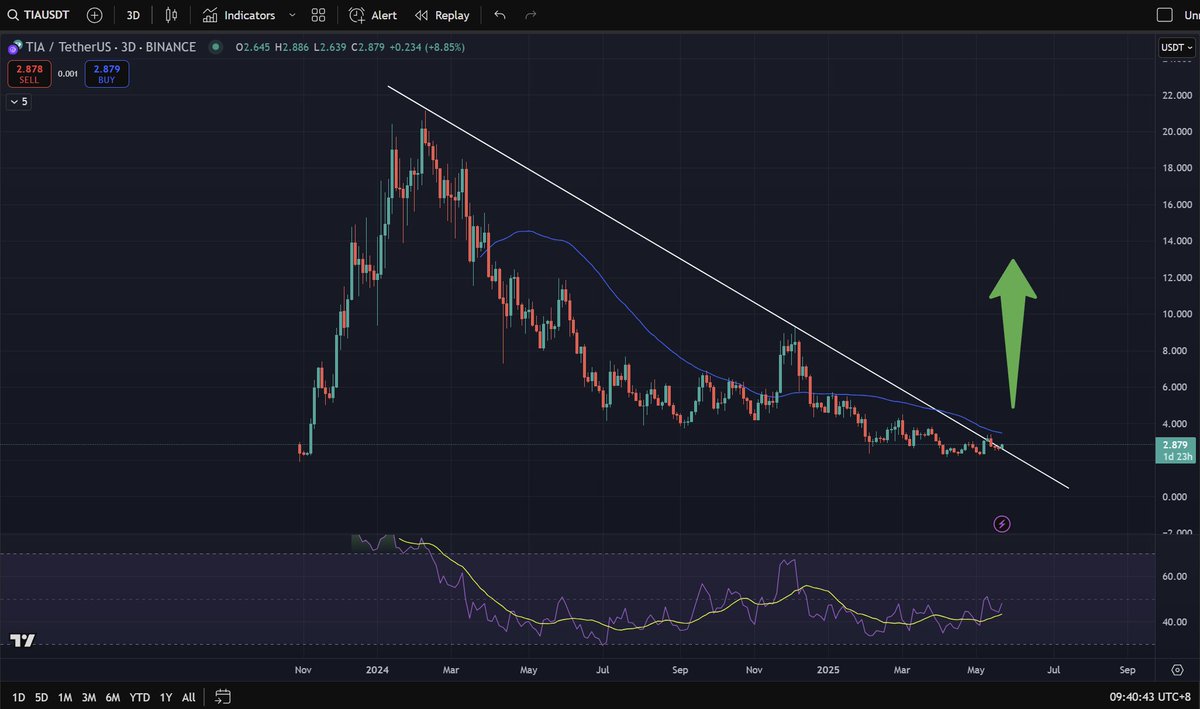
celestia's lotus (🪷) upgrade is days away. and while it's flying under the CT radar it's celestia’s biggest economic and interoperability refactor yet
in other words it has significant implications that make me extremely bullish in the short to medium term
what to expect:
→ native interop
cip-32 bakes hyperlane into celestia (x/core + x/warp), enabling native tia transfers
you can think of this as a first stepping stone to bootstrapping a more native rollup ecosystem on celestia
importantly, it paves the way for a zk-based security module to hyperlane which allows for proof-based bridging of celestia rollups to the celestia base layer (a public testnet for this is expected to follow shortly -- july or sooner)
→ leaner tokenomics
cip-29 slashes both inflation and its yearly decay by 33 %. this will make onchain use of tia more attractive and reduce the amount of forced selling due to taxes and other offchain liabilities
annual issuance will drop from ~7 % to ~4.8% in the first year of the reduction (on its way towards a 1.5% endgame)
→ aligned investors
cip-31 routes investor staking rewards through the same vesting schedule as their locked principal, ending the constant drip of liquid tia from some early backers (without destroying their ability to compound)
→ tax efficient rewards
cip-30 turns off mandatory auto-claiming—delegators can now choose when to harvest, creating meaningful tax efficiencies (which in turn reduces sell pressure)
in sum, probably nothing 🦣
@badenglishtea agree, and current price reflects that tokenomics has max extracting from the market.
I do think the underlying tech has a good chance to evolve the whole blockchain landscape
From IPO and M&A to crypto?
The tech M&A era may be ending.
But the crypto era could be just beginning.
Because the combined effect of new policies is to make it much harder for startups to IPO or M&A, but much easier to sell equity-backed security tokens on the Internet.
Let me explain.
1) It's hard to IPO. First, for decades the SEC's Sarbox rules have made it onerous for small companies to go public. They made these rules to stop the next Enron, but they didn't do that (nor did they stop the financial crisis). What they did do was chop the number of publicly traded US companies in half[a] from its 1999 peak:
2) It's hard to M&A. As a consequence, starting in the mid-2000s, the conventional wisdom became that tech companies should stay private for longer. Because IPOs were hard, that meant M&A loomed much larger as a path to liquidity for venture-backed tech startups. This period of about 20 years included huge exits like Instagram ($1B), Oculus ($2B) and WhatsApp ($19B).
But since the advent of Lina Khan's FTC, big M&As have been blocked on the grounds that this would increase competition by disallowing big fish from eating smaller fish. That was the (ostensible) rationale for the joint EU/US/UK regulatory assault on Adobe's proposed acquisition of Figma[b], which would have been a huge exit that funded many more startups:
Khan's reasoning is fundamentally incorrect because when a big company buys a small competitor at a high price it's actually a surrender — and a huge capital injection into the VC ecosystem to create many more such competitors. If there are fewer such exits — either IPOs or M&As — then there's no capital for tech startups. And hence no competition.
3) The new admin is still anti-M&A! Tech guys thought the new admin would be friendlier to M&A. But surprisingly, the new administration has bought into Lina Khan's logic — and is apparently continuing[c] her policies:
I think this is partly due to their (understandable) tribal animus against Big Tech companies for media-driven censorship during the 2020 election. But unless things change, it means tech M&A isn't coming back.
Moreover, there is continuity with Biden anti-M&A policies on another front. Japan's Nippon Steel was blocked from acquiring US Steel by Biden, but the new admin upheld the block. However, they seem to be offering a different path[d] where Nippon Steel invests in the US company but doesn't own it.
Regardless: neither big companies nor foreign companies may easily acquire US companies. And the thing is, M&A is already hard. It's like getting married, it's a huge production. If you layer some unpredictable government risk on top of an already difficult-to-do deal, many M&As just won't even be contemplated.
4) But the crypto window is open. However, when Gov closes a door it sometimes opens a window. Even though IPOs are still expensive, even though M&A has been made much more difficult...the new administration has de facto deregulated crypto with the launch of the presidential memecoins and the pro-crypto executive orders.
No one yet knows what the new rules are, but if you can do an unbacked memecoin you should almost certainly be able to do an equity-backed ICO, also known as a securities token offering (STO):
In fact, STOs actually fit the admin's vision that "the world should invest in US-founded coins" and that "small entities should be able to be independent for longer."
And remember their idea that Nippon Steel investing[d] in US Steel is ok, but owning it is not ok? This could be a way to square the circle. If you disallow Big Tech companies from buying Little Tech companies, you need to allow the latter to raise capital somehow in order to compete with Big Tech.
So let the world invest in them onchain without owning them, just like Nippon Steel is investing in US Steel. And just like Masa[e] and Saudi[f] are investing hundreds of billions in US companies without owning them outright.
That's a financial win/win that preserves sovereignty.
Moreover, mom and pop shops (restaurants and the like) can in theory STO as well. In theory, the STO takes the capital cost of going public from millions to zero. But you'd need to layer new decentralized regulatory mechanisms on such a market, similar to Uber/Airbnb/Amazon's star ratings and bans of bad actors.
5) From blue states to blockchains. Anyway: there are a zillion details to be worked out in terms of putting cap tables on chain and conducting high-trust public offerings with lockups and the like.
But this is ultimately where we wanted to go anyway. California is no longer the only place to operate, Delaware is no longer the best place to incorporate, and New York is no longer a great place to trust in the rule of law.
Blue states are over, but blockchains are in.
Because obviously Internet companies should exist in an Internet-native form onchain and be able to access Internet-scale capital markets via crypto. And indeed, even as the number of New York-listed stocks has been falling, the number of Internet-listed digital assets has been rising.
So, to my tech friends: yes, the tech IPO and M&A windows may be closed. But the tech STO window could be thrown wide open.
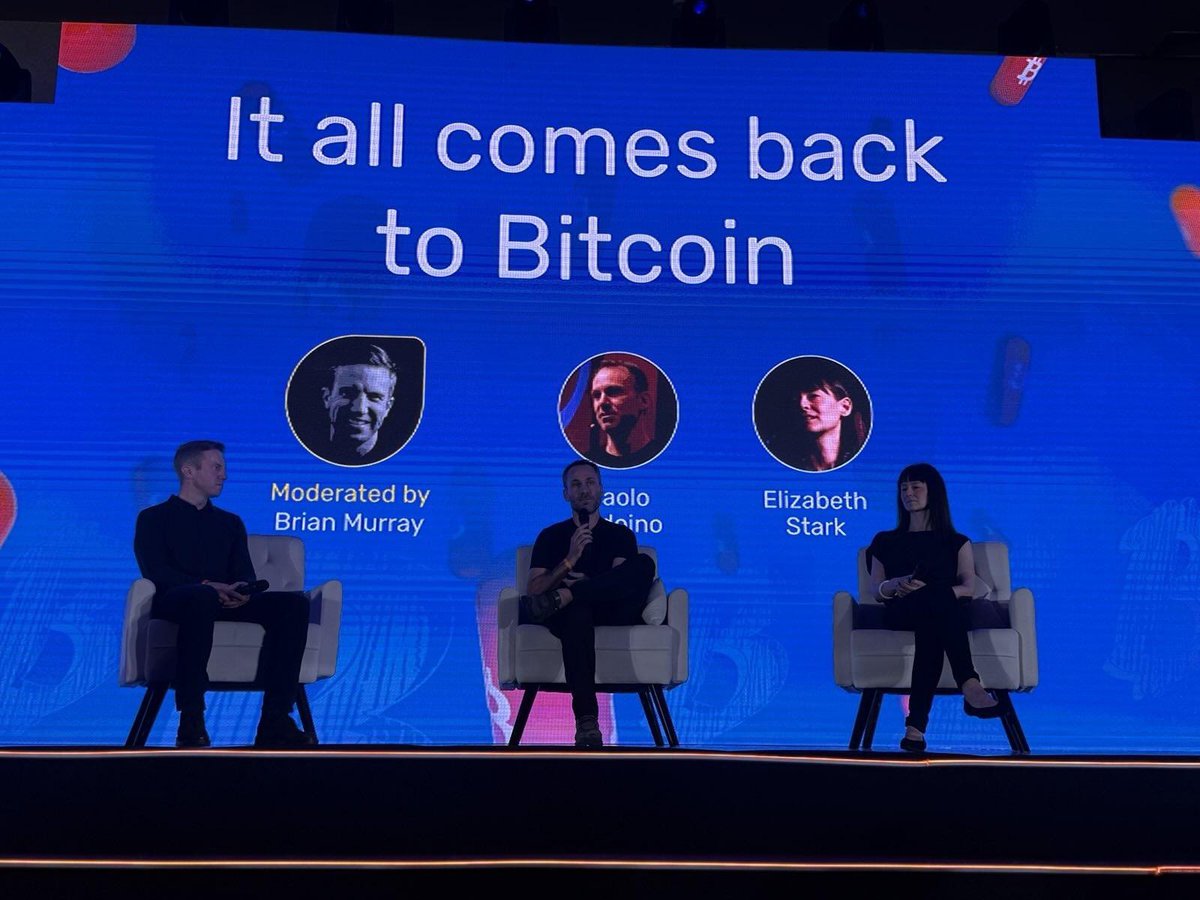
Today we're announcing that Tether is coming to bitcoin and Lightning! 💸⚡
With the security and decentralization of bitcoin and the speed and scalability of Lightning, USDT will bring hundreds of millions of users and trillions in volume.
It all comes back to bitcoin.
Old Taoism wisdom.
A man once told TAOmonk, “I want Pump”.
TAOmonk replied, “First, remove ‘I’; that’s ego.
Then remove ‘want’;that’s desire.
And now all you’re left with is Pump
$TAO
Little has changed for crypto over the last month but sentiment, and the dip in sentiment has reduced risk, while likely increasing future reward, for the balanced investor.
I find it curious that some people think that @cz_binance ‘s sentence was lenient.
BNP Paribas was fined more than double what Binance was (9 billion ) for the exact same charge of compliance failures regarding sanctioned countries and organisations. UBS was fined about the same. (4 billion) for the same failures.
Their CEOs were not charged, much less sentenced to prison.
So no. @cz_binance ‘s sentence was not lenient. The judge said in court that whilst he respects precedence, he isn’t bound by them.
This is the first time in history that an executive with this exact same charge (without others) as CZ’s has been sent to prison.


![ccwdavid's tweet photo. What is the AI Supercycle?
According to @PwC and @ARKInvest, by 2030 AI could capture from $14 trillion to $15.7 trillion of the global economy.
@McKinsey reported that #GenerativeAI alone can capture $4.4 trillion annually.
AI will increase human productivity and efficiency, and contribute to global economies at a scale beyond the Internet revolution.
While most of the developments we have seen today comes from Big Tech such as @OpenAI, @Google and others, they are mostly closed doors and each company trains their AI models independently.
Why Open Source and Decentralization matters?
- It allows anyone to contribute to the model training, share data and improve existing models, resulting in exponential growth
- Decentralization makes this valuable resource unstoppable
Bittensor Network $TAO is the moonshot play of Decentralized AI @opentensor
- The First Open, Decentralized Neural Network: any trained AI models can participate and compete in the incentive system, data output is ranked by validators and rewarded
- Apps can be built on top of validator layer, imagine Bittensor network is an App store where apps can be deployed to harness intelligence and challenge Web2 incumbents (Future OpenAI and MidJourney can give birth from here)
- Fair Tokenomics: (Fair launched, No Pre-mine, No ICO , Regulatory compliant, 21M max supply 4-Year halvings ,similar to $BTC)
[1] https://t.co/0WKtfKv7sr
[2] https://t.co/nJm6ptfWmw
[3] https://t.co/2so9uzhf4u](https://pbs.twimg.com/media/F05rg6CaEAAnrAd.jpg)
![ccwdavid's tweet photo. What is the AI Supercycle?
According to @PwC and @ARKInvest, by 2030 AI could capture from $14 trillion to $15.7 trillion of the global economy.
@McKinsey reported that #GenerativeAI alone can capture $4.4 trillion annually.
AI will increase human productivity and efficiency, and contribute to global economies at a scale beyond the Internet revolution.
While most of the developments we have seen today comes from Big Tech such as @OpenAI, @Google and others, they are mostly closed doors and each company trains their AI models independently.
Why Open Source and Decentralization matters?
- It allows anyone to contribute to the model training, share data and improve existing models, resulting in exponential growth
- Decentralization makes this valuable resource unstoppable
Bittensor Network $TAO is the moonshot play of Decentralized AI @opentensor
- The First Open, Decentralized Neural Network: any trained AI models can participate and compete in the incentive system, data output is ranked by validators and rewarded
- Apps can be built on top of validator layer, imagine Bittensor network is an App store where apps can be deployed to harness intelligence and challenge Web2 incumbents (Future OpenAI and MidJourney can give birth from here)
- Fair Tokenomics: (Fair launched, No Pre-mine, No ICO , Regulatory compliant, 21M max supply 4-Year halvings ,similar to $BTC)
[1] https://t.co/0WKtfKv7sr
[2] https://t.co/nJm6ptfWmw
[3] https://t.co/2so9uzhf4u](https://pbs.twimg.com/media/F05rg5PaUAAxp7H.jpg)


![balajis's tweet photo. From IPO and M&A to crypto?
The tech M&A era may be ending.
But the crypto era could be just beginning.
Because the combined effect of new policies is to make it much harder for startups to IPO or M&A, but much easier to sell equity-backed security tokens on the Internet.
Let me explain.
1) It's hard to IPO. First, for decades the SEC's Sarbox rules have made it onerous for small companies to go public. They made these rules to stop the next Enron, but they didn't do that (nor did they stop the financial crisis). What they did do was chop the number of publicly traded US companies in half[a] from its 1999 peak:
2) It's hard to M&A. As a consequence, starting in the mid-2000s, the conventional wisdom became that tech companies should stay private for longer. Because IPOs were hard, that meant M&A loomed much larger as a path to liquidity for venture-backed tech startups. This period of about 20 years included huge exits like Instagram ($1B), Oculus ($2B) and WhatsApp ($19B).
But since the advent of Lina Khan's FTC, big M&As have been blocked on the grounds that this would increase competition by disallowing big fish from eating smaller fish. That was the (ostensible) rationale for the joint EU/US/UK regulatory assault on Adobe's proposed acquisition of Figma[b], which would have been a huge exit that funded many more startups:
Khan's reasoning is fundamentally incorrect because when a big company buys a small competitor at a high price it's actually a surrender — and a huge capital injection into the VC ecosystem to create many more such competitors. If there are fewer such exits — either IPOs or M&As — then there's no capital for tech startups. And hence no competition.
3) The new admin is still anti-M&A! Tech guys thought the new admin would be friendlier to M&A. But surprisingly, the new administration has bought into Lina Khan's logic — and is apparently continuing[c] her policies:
I think this is partly due to their (understandable) tribal animus against Big Tech companies for media-driven censorship during the 2020 election. But unless things change, it means tech M&A isn't coming back.
Moreover, there is continuity with Biden anti-M&A policies on another front. Japan's Nippon Steel was blocked from acquiring US Steel by Biden, but the new admin upheld the block. However, they seem to be offering a different path[d] where Nippon Steel invests in the US company but doesn't own it.
Regardless: neither big companies nor foreign companies may easily acquire US companies. And the thing is, M&A is already hard. It's like getting married, it's a huge production. If you layer some unpredictable government risk on top of an already difficult-to-do deal, many M&As just won't even be contemplated.
4) But the crypto window is open. However, when Gov closes a door it sometimes opens a window. Even though IPOs are still expensive, even though M&A has been made much more difficult...the new administration has de facto deregulated crypto with the launch of the presidential memecoins and the pro-crypto executive orders.
No one yet knows what the new rules are, but if you can do an unbacked memecoin you should almost certainly be able to do an equity-backed ICO, also known as a securities token offering (STO):
In fact, STOs actually fit the admin's vision that "the world should invest in US-founded coins" and that "small entities should be able to be independent for longer."
And remember their idea that Nippon Steel investing[d] in US Steel is ok, but owning it is not ok? This could be a way to square the circle. If you disallow Big Tech companies from buying Little Tech companies, you need to allow the latter to raise capital somehow in order to compete with Big Tech.
So let the world invest in them onchain without owning them, just like Nippon Steel is investing in US Steel. And just like Masa[e] and Saudi[f] are investing hundreds of billions in US companies without owning them outright.
That's a financial win/win that preserves sovereignty.
Moreover, mom and pop shops (restaurants and the like) can in theory STO as well. In theory, the STO takes the capital cost of going public from millions to zero. But you'd need to layer new decentralized regulatory mechanisms on such a market, similar to Uber/Airbnb/Amazon's star ratings and bans of bad actors.
5) From blue states to blockchains. Anyway: there are a zillion details to be worked out in terms of putting cap tables on chain and conducting high-trust public offerings with lockups and the like.
But this is ultimately where we wanted to go anyway. California is no longer the only place to operate, Delaware is no longer the best place to incorporate, and New York is no longer a great place to trust in the rule of law.
Blue states are over, but blockchains are in.
Because obviously Internet companies should exist in an Internet-native form onchain and be able to access Internet-scale capital markets via crypto. And indeed, even as the number of New York-listed stocks has been falling, the number of Internet-listed digital assets has been rising.
So, to my tech friends: yes, the tech IPO and M&A windows may be closed. But the tech STO window could be thrown wide open.](https://pbs.twimg.com/media/GkIT1CebQAAKmuR.jpg)
![balajis's tweet photo. From IPO and M&A to crypto?
The tech M&A era may be ending.
But the crypto era could be just beginning.
Because the combined effect of new policies is to make it much harder for startups to IPO or M&A, but much easier to sell equity-backed security tokens on the Internet.
Let me explain.
1) It's hard to IPO. First, for decades the SEC's Sarbox rules have made it onerous for small companies to go public. They made these rules to stop the next Enron, but they didn't do that (nor did they stop the financial crisis). What they did do was chop the number of publicly traded US companies in half[a] from its 1999 peak:
2) It's hard to M&A. As a consequence, starting in the mid-2000s, the conventional wisdom became that tech companies should stay private for longer. Because IPOs were hard, that meant M&A loomed much larger as a path to liquidity for venture-backed tech startups. This period of about 20 years included huge exits like Instagram ($1B), Oculus ($2B) and WhatsApp ($19B).
But since the advent of Lina Khan's FTC, big M&As have been blocked on the grounds that this would increase competition by disallowing big fish from eating smaller fish. That was the (ostensible) rationale for the joint EU/US/UK regulatory assault on Adobe's proposed acquisition of Figma[b], which would have been a huge exit that funded many more startups:
Khan's reasoning is fundamentally incorrect because when a big company buys a small competitor at a high price it's actually a surrender — and a huge capital injection into the VC ecosystem to create many more such competitors. If there are fewer such exits — either IPOs or M&As — then there's no capital for tech startups. And hence no competition.
3) The new admin is still anti-M&A! Tech guys thought the new admin would be friendlier to M&A. But surprisingly, the new administration has bought into Lina Khan's logic — and is apparently continuing[c] her policies:
I think this is partly due to their (understandable) tribal animus against Big Tech companies for media-driven censorship during the 2020 election. But unless things change, it means tech M&A isn't coming back.
Moreover, there is continuity with Biden anti-M&A policies on another front. Japan's Nippon Steel was blocked from acquiring US Steel by Biden, but the new admin upheld the block. However, they seem to be offering a different path[d] where Nippon Steel invests in the US company but doesn't own it.
Regardless: neither big companies nor foreign companies may easily acquire US companies. And the thing is, M&A is already hard. It's like getting married, it's a huge production. If you layer some unpredictable government risk on top of an already difficult-to-do deal, many M&As just won't even be contemplated.
4) But the crypto window is open. However, when Gov closes a door it sometimes opens a window. Even though IPOs are still expensive, even though M&A has been made much more difficult...the new administration has de facto deregulated crypto with the launch of the presidential memecoins and the pro-crypto executive orders.
No one yet knows what the new rules are, but if you can do an unbacked memecoin you should almost certainly be able to do an equity-backed ICO, also known as a securities token offering (STO):
In fact, STOs actually fit the admin's vision that "the world should invest in US-founded coins" and that "small entities should be able to be independent for longer."
And remember their idea that Nippon Steel investing[d] in US Steel is ok, but owning it is not ok? This could be a way to square the circle. If you disallow Big Tech companies from buying Little Tech companies, you need to allow the latter to raise capital somehow in order to compete with Big Tech.
So let the world invest in them onchain without owning them, just like Nippon Steel is investing in US Steel. And just like Masa[e] and Saudi[f] are investing hundreds of billions in US companies without owning them outright.
That's a financial win/win that preserves sovereignty.
Moreover, mom and pop shops (restaurants and the like) can in theory STO as well. In theory, the STO takes the capital cost of going public from millions to zero. But you'd need to layer new decentralized regulatory mechanisms on such a market, similar to Uber/Airbnb/Amazon's star ratings and bans of bad actors.
5) From blue states to blockchains. Anyway: there are a zillion details to be worked out in terms of putting cap tables on chain and conducting high-trust public offerings with lockups and the like.
But this is ultimately where we wanted to go anyway. California is no longer the only place to operate, Delaware is no longer the best place to incorporate, and New York is no longer a great place to trust in the rule of law.
Blue states are over, but blockchains are in.
Because obviously Internet companies should exist in an Internet-native form onchain and be able to access Internet-scale capital markets via crypto. And indeed, even as the number of New York-listed stocks has been falling, the number of Internet-listed digital assets has been rising.
So, to my tech friends: yes, the tech IPO and M&A windows may be closed. But the tech STO window could be thrown wide open.](https://pbs.twimg.com/media/GkITDMJaAAQisZA.png)
![balajis's tweet photo. From IPO and M&A to crypto?
The tech M&A era may be ending.
But the crypto era could be just beginning.
Because the combined effect of new policies is to make it much harder for startups to IPO or M&A, but much easier to sell equity-backed security tokens on the Internet.
Let me explain.
1) It's hard to IPO. First, for decades the SEC's Sarbox rules have made it onerous for small companies to go public. They made these rules to stop the next Enron, but they didn't do that (nor did they stop the financial crisis). What they did do was chop the number of publicly traded US companies in half[a] from its 1999 peak:
2) It's hard to M&A. As a consequence, starting in the mid-2000s, the conventional wisdom became that tech companies should stay private for longer. Because IPOs were hard, that meant M&A loomed much larger as a path to liquidity for venture-backed tech startups. This period of about 20 years included huge exits like Instagram ($1B), Oculus ($2B) and WhatsApp ($19B).
But since the advent of Lina Khan's FTC, big M&As have been blocked on the grounds that this would increase competition by disallowing big fish from eating smaller fish. That was the (ostensible) rationale for the joint EU/US/UK regulatory assault on Adobe's proposed acquisition of Figma[b], which would have been a huge exit that funded many more startups:
Khan's reasoning is fundamentally incorrect because when a big company buys a small competitor at a high price it's actually a surrender — and a huge capital injection into the VC ecosystem to create many more such competitors. If there are fewer such exits — either IPOs or M&As — then there's no capital for tech startups. And hence no competition.
3) The new admin is still anti-M&A! Tech guys thought the new admin would be friendlier to M&A. But surprisingly, the new administration has bought into Lina Khan's logic — and is apparently continuing[c] her policies:
I think this is partly due to their (understandable) tribal animus against Big Tech companies for media-driven censorship during the 2020 election. But unless things change, it means tech M&A isn't coming back.
Moreover, there is continuity with Biden anti-M&A policies on another front. Japan's Nippon Steel was blocked from acquiring US Steel by Biden, but the new admin upheld the block. However, they seem to be offering a different path[d] where Nippon Steel invests in the US company but doesn't own it.
Regardless: neither big companies nor foreign companies may easily acquire US companies. And the thing is, M&A is already hard. It's like getting married, it's a huge production. If you layer some unpredictable government risk on top of an already difficult-to-do deal, many M&As just won't even be contemplated.
4) But the crypto window is open. However, when Gov closes a door it sometimes opens a window. Even though IPOs are still expensive, even though M&A has been made much more difficult...the new administration has de facto deregulated crypto with the launch of the presidential memecoins and the pro-crypto executive orders.
No one yet knows what the new rules are, but if you can do an unbacked memecoin you should almost certainly be able to do an equity-backed ICO, also known as a securities token offering (STO):
In fact, STOs actually fit the admin's vision that "the world should invest in US-founded coins" and that "small entities should be able to be independent for longer."
And remember their idea that Nippon Steel investing[d] in US Steel is ok, but owning it is not ok? This could be a way to square the circle. If you disallow Big Tech companies from buying Little Tech companies, you need to allow the latter to raise capital somehow in order to compete with Big Tech.
So let the world invest in them onchain without owning them, just like Nippon Steel is investing in US Steel. And just like Masa[e] and Saudi[f] are investing hundreds of billions in US companies without owning them outright.
That's a financial win/win that preserves sovereignty.
Moreover, mom and pop shops (restaurants and the like) can in theory STO as well. In theory, the STO takes the capital cost of going public from millions to zero. But you'd need to layer new decentralized regulatory mechanisms on such a market, similar to Uber/Airbnb/Amazon's star ratings and bans of bad actors.
5) From blue states to blockchains. Anyway: there are a zillion details to be worked out in terms of putting cap tables on chain and conducting high-trust public offerings with lockups and the like.
But this is ultimately where we wanted to go anyway. California is no longer the only place to operate, Delaware is no longer the best place to incorporate, and New York is no longer a great place to trust in the rule of law.
Blue states are over, but blockchains are in.
Because obviously Internet companies should exist in an Internet-native form onchain and be able to access Internet-scale capital markets via crypto. And indeed, even as the number of New York-listed stocks has been falling, the number of Internet-listed digital assets has been rising.
So, to my tech friends: yes, the tech IPO and M&A windows may be closed. But the tech STO window could be thrown wide open.](https://pbs.twimg.com/media/GkISq4OaAAAlgJN.png)




![ccwdavid's tweet photo. What is the AI Supercycle?
According to @PwC and @ARKInvest, by 2030 AI could capture from $14 trillion to $15.7 trillion of the global economy.
@McKinsey reported that #GenerativeAI alone can capture $4.4 trillion annually.
AI will increase human productivity and efficiency, and contribute to global economies at a scale beyond the Internet revolution.
While most of the developments we have seen today comes from Big Tech such as @OpenAI, @Google and others, they are mostly closed doors and each company trains their AI models independently.
Why Open Source and Decentralization matters?
- It allows anyone to contribute to the model training, share data and improve existing models, resulting in exponential growth
- Decentralization makes this valuable resource unstoppable
Bittensor Network $TAO is the moonshot play of Decentralized AI @opentensor
- The First Open, Decentralized Neural Network: any trained AI models can participate and compete in the incentive system, data output is ranked by validators and rewarded
- Apps can be built on top of validator layer, imagine Bittensor network is an App store where apps can be deployed to harness intelligence and challenge Web2 incumbents (Future OpenAI and MidJourney can give birth from here)
- Fair Tokenomics: (Fair launched, No Pre-mine, No ICO , Regulatory compliant, 21M max supply 4-Year halvings ,similar to $BTC)
[1] https://t.co/0WKtfKv7sr
[2] https://t.co/nJm6ptfWmw
[3] https://t.co/2so9uzhf4u](https://pbs.twimg.com/media/F05rg7HaUAApyYj.jpg)


![balajis's tweet photo. From IPO and M&A to crypto?
The tech M&A era may be ending.
But the crypto era could be just beginning.
Because the combined effect of new policies is to make it much harder for startups to IPO or M&A, but much easier to sell equity-backed security tokens on the Internet.
Let me explain.
1) It's hard to IPO. First, for decades the SEC's Sarbox rules have made it onerous for small companies to go public. They made these rules to stop the next Enron, but they didn't do that (nor did they stop the financial crisis). What they did do was chop the number of publicly traded US companies in half[a] from its 1999 peak:
2) It's hard to M&A. As a consequence, starting in the mid-2000s, the conventional wisdom became that tech companies should stay private for longer. Because IPOs were hard, that meant M&A loomed much larger as a path to liquidity for venture-backed tech startups. This period of about 20 years included huge exits like Instagram ($1B), Oculus ($2B) and WhatsApp ($19B).
But since the advent of Lina Khan's FTC, big M&As have been blocked on the grounds that this would increase competition by disallowing big fish from eating smaller fish. That was the (ostensible) rationale for the joint EU/US/UK regulatory assault on Adobe's proposed acquisition of Figma[b], which would have been a huge exit that funded many more startups:
Khan's reasoning is fundamentally incorrect because when a big company buys a small competitor at a high price it's actually a surrender — and a huge capital injection into the VC ecosystem to create many more such competitors. If there are fewer such exits — either IPOs or M&As — then there's no capital for tech startups. And hence no competition.
3) The new admin is still anti-M&A! Tech guys thought the new admin would be friendlier to M&A. But surprisingly, the new administration has bought into Lina Khan's logic — and is apparently continuing[c] her policies:
I think this is partly due to their (understandable) tribal animus against Big Tech companies for media-driven censorship during the 2020 election. But unless things change, it means tech M&A isn't coming back.
Moreover, there is continuity with Biden anti-M&A policies on another front. Japan's Nippon Steel was blocked from acquiring US Steel by Biden, but the new admin upheld the block. However, they seem to be offering a different path[d] where Nippon Steel invests in the US company but doesn't own it.
Regardless: neither big companies nor foreign companies may easily acquire US companies. And the thing is, M&A is already hard. It's like getting married, it's a huge production. If you layer some unpredictable government risk on top of an already difficult-to-do deal, many M&As just won't even be contemplated.
4) But the crypto window is open. However, when Gov closes a door it sometimes opens a window. Even though IPOs are still expensive, even though M&A has been made much more difficult...the new administration has de facto deregulated crypto with the launch of the presidential memecoins and the pro-crypto executive orders.
No one yet knows what the new rules are, but if you can do an unbacked memecoin you should almost certainly be able to do an equity-backed ICO, also known as a securities token offering (STO):
In fact, STOs actually fit the admin's vision that "the world should invest in US-founded coins" and that "small entities should be able to be independent for longer."
And remember their idea that Nippon Steel investing[d] in US Steel is ok, but owning it is not ok? This could be a way to square the circle. If you disallow Big Tech companies from buying Little Tech companies, you need to allow the latter to raise capital somehow in order to compete with Big Tech.
So let the world invest in them onchain without owning them, just like Nippon Steel is investing in US Steel. And just like Masa[e] and Saudi[f] are investing hundreds of billions in US companies without owning them outright.
That's a financial win/win that preserves sovereignty.
Moreover, mom and pop shops (restaurants and the like) can in theory STO as well. In theory, the STO takes the capital cost of going public from millions to zero. But you'd need to layer new decentralized regulatory mechanisms on such a market, similar to Uber/Airbnb/Amazon's star ratings and bans of bad actors.
5) From blue states to blockchains. Anyway: there are a zillion details to be worked out in terms of putting cap tables on chain and conducting high-trust public offerings with lockups and the like.
But this is ultimately where we wanted to go anyway. California is no longer the only place to operate, Delaware is no longer the best place to incorporate, and New York is no longer a great place to trust in the rule of law.
Blue states are over, but blockchains are in.
Because obviously Internet companies should exist in an Internet-native form onchain and be able to access Internet-scale capital markets via crypto. And indeed, even as the number of New York-listed stocks has been falling, the number of Internet-listed digital assets has been rising.
So, to my tech friends: yes, the tech IPO and M&A windows may be closed. But the tech STO window could be thrown wide open.](https://pbs.twimg.com/media/GkIWauhaAAAIDLl.png)