@teortaxesTex It's a bit more complex than that. There are also many users are actually asking them to provide the option to accept payments to use DS frontend app/web, simply because the simplicity of the interface and to keep their long chat sessions. (Role play etc.)
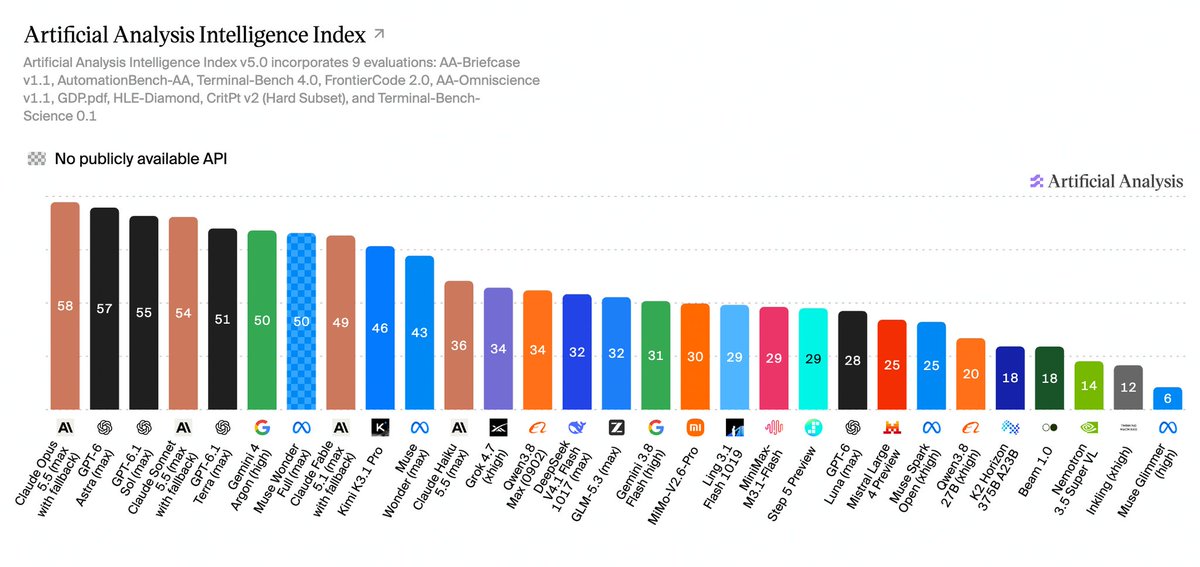
Open weights models fall further behind in v5. The leader, Kimi K3.1 Pro (weights not yet released), scores 46, 12 points behind the leader, compared with a 3-point gap in v4.3. Of models with released weights, DeepSeek V4.1 Flash 1017 (max) and GLM-5.3 (max) score highest at 32, and Claude Haiku 5.5 (max) outscores all of them.
The gap is widest on HLE-Diamond and Terminal-Bench-Science, where Kimi K3.1 Pro scores 37% and 34%, compared with 68% for Claude Opus 5.5 (max) and 63% for GPT-6 Astra (max).
Announcing Artificial Analysis Intelligence Index v5, featuring 2 new benchmarks and 3 upgrades. For the first time, the majority of the Index is built on private datasets
The Artificial Analysis Intelligence Index is our composite measure of model capabilities across tasks reflecting real-world usage today. v5 is our biggest upgrade since v4 launched in January. With v5, 60% of the Index is now based on evaluations with private test sets or held-out answers.
Alongside Intelligence Index v5, we’re launching the Artificial Analysis Progress Index v1, which tracks model capability over time on one continuous scale.
New to the Intelligence Index:
➤ FrontierCode 2.0: Cognition's newly-launched private benchmark of real-world coding tasks, graded on whether a repository maintainer would merge the agent's change
➤ Terminal-Bench-Science: 70 agentic scientific research tasks, run in a terminal environment
Upgraded:
➤ HLE-Diamond (replacing Humanity's Last Exam): a refined 1,000-question version of Humanity's Last Exam, split evenly between reasoning and knowledge questions
➤ AA-Omniscience v1.1: An updated dataset with saturated and public set questions removed, new questions added, and ambiguous or erroneous questions revised
➤ CritPt v2: a private, 40-question hard subset of CritPt v2, revised by the CritPt authors and run with a code-execution tool
Staying in the Index: AA-Briefcase, AutomationBench-AA, GDP.pdf and Terminal-Bench 4.0
Removed from the Index: GDPval-AA v2.1, SciCode, and AA-LCR v1.1
Key results:
➤ Claude Opus 5.5 (max) leads at 58, ahead of GPT-6 Astra (max, 57) and GPT-6.1 Sol (max, 55): Anthropic and OpenAI hold the top five models. Gemini 4 Argon (high) is next at 50
➤ The open weights gap widens from 3 points to 12: Kimi K3.1 Pro (weights not yet released) is the top open weights model at 46. Among released weights, DeepSeek V4.1 Flash 1017 (max) and GLM-5.3 (max) lead at 32 - 26 points behind the leader and below Claude Haiku 5.5 (max, 36)
➤ Cost per task varies by more than 13x among the leading models: of the 10 highest-scoring models shown, GPT-6.1 Terra (max) is the cheapest at $0.96 per Intelligence Index task and Claude Fable 5.1 (max) the most expensive at $13.04
Not sure why people still asks for SKILL. Models will get much better and simply incorporate whatever the "SKILL" teaches in due time.
No SKILLs needed, that's the end game harness.
This. People keep asking me for my setup. It's really just any harness, multiple agents concurrently, barely any skills, and using adversarial reviews. There's no magic sauce (or source!). The models are great out of the box.
Up, up, and away. 🚀
Today, in partnership with @planet, we launched a prototype satellite carrying four TPUs into orbit on @SpaceX's Transporter-18 rideshare mission. This launch is the first step of Project Suncatcher, our long-term research moonshot to see whether we can one day host scalable machine learning infrastructure in space.
Over the coming weeks, we'll gather in-orbit data on how our TPUs handle the physical stress, radiation, and thermal extremes of space. Whatever we learn, we'll use it to refine our future designs.
Nearly half a year of silence. We spent it studying one problem: how far RL can scale.
MiMo-V2.6 is in the middle of its RL run right now. Three things we scaled: compute (~2B tokens per step, 1568 prompts × 16 rollouts, fully async), environments and harnesses (multi-task agentic RL, mixed across multiple harnesses in one run), and grader compute (agentic in-group credit assignment, with test-case and rubric-based rewards). We'll open-source the details piece by piece over the coming weeks.
Streaming the run: https://t.co/ZSxahzJRju
you can just hallucinate the entire internet with Qwen 3.8 27b running at 2,000 tokens/second?
part 2 of turning @cerebras + @Alibaba_Qwen 3.8 27B into an OS:
built an offline browser with zero network calls and mounted it directly the JIT ubuntu desktop.
no wifi. no scraping. zero packets sent to external CDNs.
you search a site, set a year, and qwen 27b at 1,950 tok/s synthesizes the entire DOM on the fly.
here is youtube in 2045 vs 1999:
→ search google for youtube inside the OS
→ scrub to 2045: instant futuristic feed
→ scrub to 1999: raw web 1.0 time capsule in seconds
at this speed, browsing isn't retrieving files from a server, it's querying an alternate reality.
a 2D browser window is just step zero.
imagine full operating systems, virtual worlds, and complex simulation engines existing purely as model weights. zero gigabytes stored on disk, just pure interactive reality streamed on demand.
What else becomes a possibility with the qwen 3.8 27b (dense) at 2000 tokens/sec?
U.S. Vice President JD Vance had some unusually strong words for Anthropic on the All-In Podcast.
If an AI company develops technology that can be used for harmful purposes, such as cyberattacks, he believes that company has an obligation to help others defend themselves against those capabilities rather than relying primarily on government regulation.
----
"Why is it that the people who are at the frontier of the AI economy are throwing up their hands and saying, “Well, we’ve built Frankenstein,” and the solution to Frankenstein, apparently, is to create a one-world governance structure for artificial intelligence?
What I would say to those people is: if you’re building Frankenstein, stop. Or maybe, if the cat is out of the bag, then build the defensive mechanism against Frankenstein.
At the same time, that you have this sort of cyber-hacking tool that’s come out of Anthropic’s newest models, you have companies that are desperate for the defensive mechanisms to defend against that cyber-hacking tool, and they’re being denied access to it.
So, if you’re going to create Frankenstein, don’t come to the government and say, “We need regulation.” Look inward and accept that if you’re building Frankenstein, number one, you should stop.
And number two, when the companies come to you and say, “We need the tools to fight back against Frankenstein,” give them those tools."
----
full video link in comment on @theallinpod
JUST IN: Chinese Fields Medal winner Deng Yu announces he’ll retire from mathematics & write romance novels if AI becomes capable of solving all math problems.
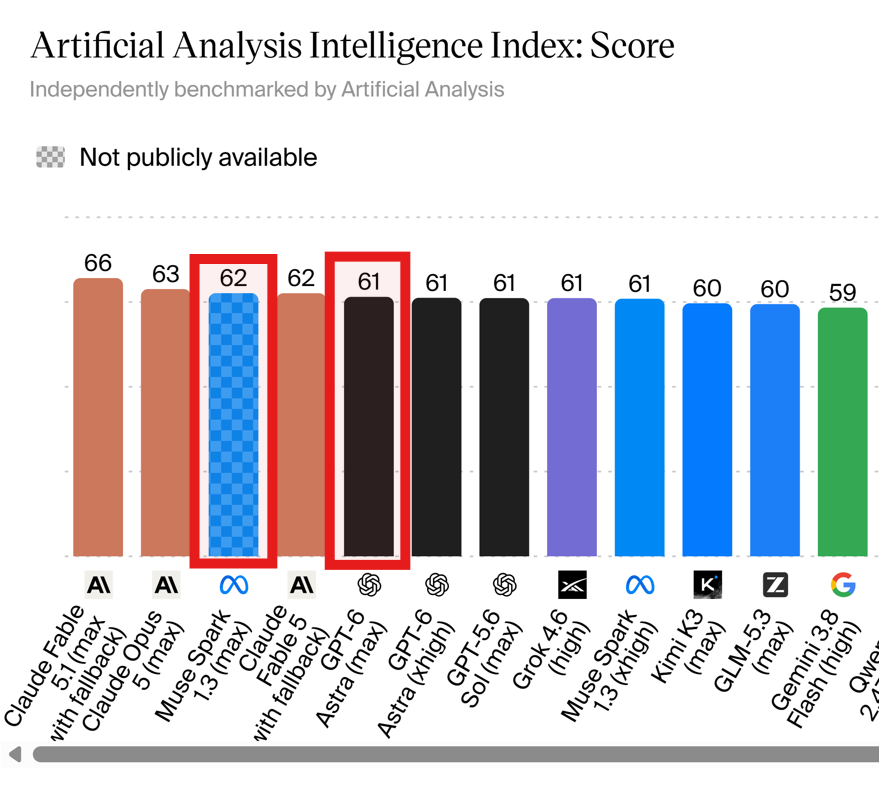
The Artificial Analysis Intelligence Index is starting to lose its credibility.
It ranks Muse Spark 1.3 above GPT-6 Astra:
• Muse Spark 1.3: 62
• GPT-6 Astra: 61
Yet GPT-6 Astra got:
• 98.6% on ARC-AGI-3
• 97.6% on FrontierMath
• 100% on ExploitBench
No disrespect to Muse. But if this index puts it above GPT-6 Astra, it is no longer telling us which model is actually smarter.