DO YOU WORK FOR FREE?
Real news gathering (which requires research, travel, street reporting, editing, fact-checking, real writing, sourcing, spending hours listening to harrowing stories from victims, public record requests that governments charge thousands of dollars for, legal review, sitting through hours and hours of court testimony...the list goes on...) COSTS MONEY.
You get this for far less than what you are paying for cable tv or streaming, and I would argue it pays for itself by informing you what your local government and school boards are doing with your money.
Support local news. Know the value of what you read on social media vs. real journalism.
Green donors' new political playbook paid off in the blue wave.
Limit climate talk
Focus on affordability & how clean energy advances it
Exploit opponents' flaws
“We want members of Congress to see that we’re willing to get dirty if needed,” @tommatzzie told me.
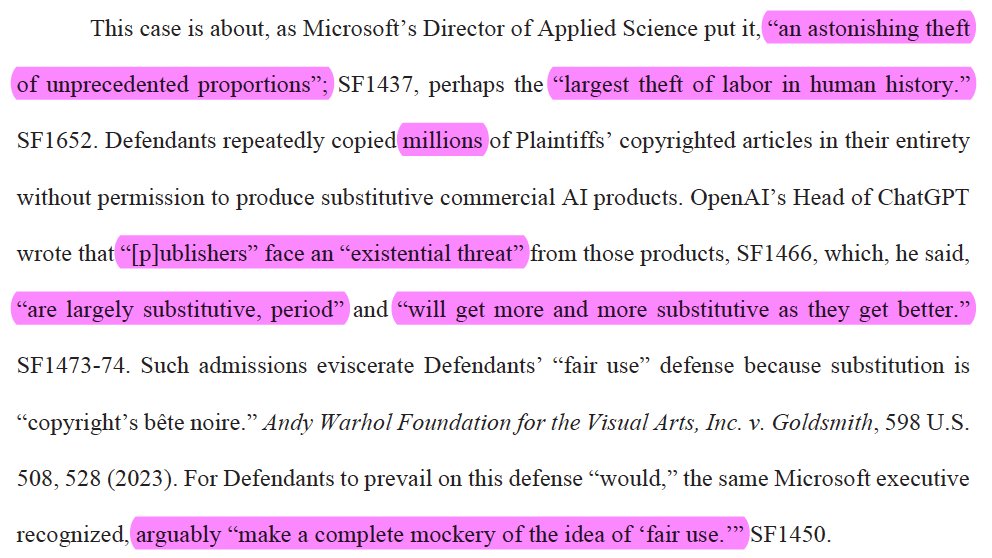
woah. Court just unsealed Summary Judgment motions in New York Times v OpenAI / Microsoft.
Easy to see why the AI companies had so many redactions (pink). Their own people wrote the lede for NYT, the "largest theft of labor in human history"... "more and more substitutive..." /1
😦
“It is a development long watched for in the war in Ukraine, presaging a dystopian future in which killer robots roam the skies making life-or-death decisions that reduce targets to data points.” https://t.co/c0K7pE61qz via @NYTimes
Scoop: BlocPower is shutting down and liquidating its assets, according to a letter sent to investors. Senior creditors like Goldman Sachs are first in line to be repaid and may not be made whole. Read the full story by @ceboudreau here: https://t.co/8OYypn4f70
A $960M transmission line was approved in 2022, partly to serve growing data center load in northern Virginia. Then the AI boom happened. Now that same load growth is the reason it might not get built.
@maevemallsup joins @shaylekann on #Catalyst 🎙️ https://t.co/GzGMGsxlnb
@natsfert I’m sure you’ll land somewhere great soon, and in the meantime, I hope you can enjoy a much-deserved break the flexibility in the freelance life.
On @SquawkCNBC@andrewrsorkin: Is some of your customer demand related to climate?
Fervo CEO @TimMLatimer: I think it is.
@JoeSquawk: That's too bad.
Latimer: We have a technology that stands on its own economics. The fact that it can address climate change is a bonus.
Geothermal developer @fervoenergy raised $1.9B in its IPO.
SVP Sarah Jewett said helping solve climate change is why many employees go to work every day.
Read about Fervo's deal w/ @Google & plans to get costs down ~$3,000/kWh: https://t.co/0u99VrAe1C @_LatitudeMedia
BURGUM: When the sun goes down, solar produces zero electricity
HUFFMAN: I want to enter into the record this amazing new technology that apparently the secretary is unaware of -- it's a battery
NEW: Absent a biblical rainfall event this summer, Corpus Christi will be the first American city in modern history to run out of water. 💦
Schools & hospitals hope to drill wells. Lawns are dry. How will petrochemical plants handle it? We don’t know.
https://t.co/psk7ZU2Jfa
@Microsoft is going off-grid. @Fermilab is trying to build an 11 GW "Hypergrid." The headlines are loud. But the developers building these projects say off-grid won't be "a huge part of the market."
@ceboudreau reports from Transition-AI 👇
https://t.co/9NwtOC8Fao
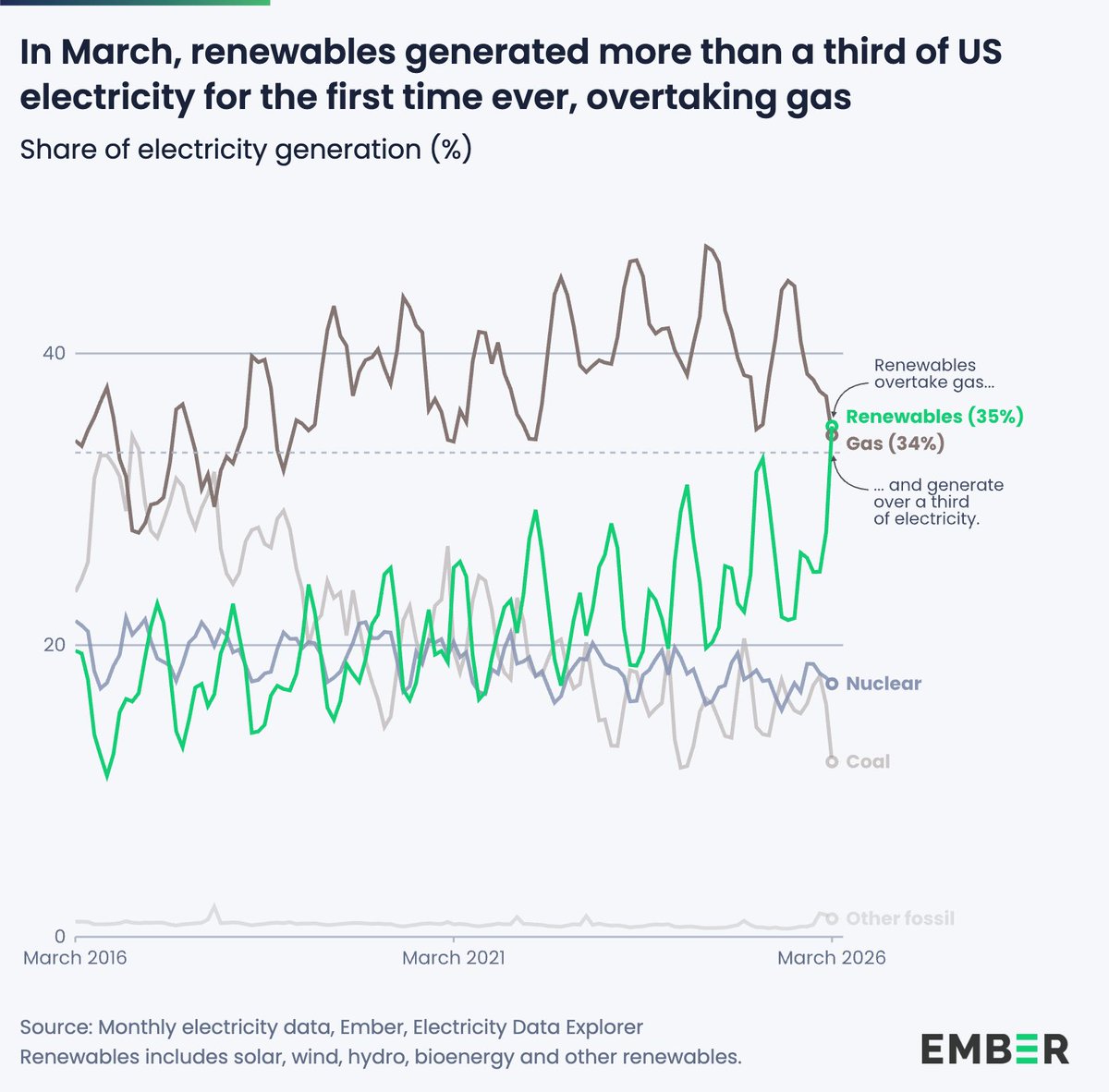
NEW US electricity data ⚡️
In March, renewables produced more than a third of US electricity for the first time ever, even overtaking gas generation!
Wind and solar combined reached over a quarter (26%) for the first time.
There’s a growing amount of excitement and trepidation around off-grid data centers.
I’m not convinced many will actually go fully off-grid -- probably as a bridge in most cases. But it’s surfacing a more interesting tension about how we build the system.
As @ceboudreau detailed, that tension played out on stage at CERAWeek between Fermi and Google.
Fermi is leaning into the “power island” model that pairs data centers with dedicated generation, starting with gas and potentially nuclear. The idea is to move faster, avoid interconnection bottlenecks, and not push costs onto the broader system.
Google pushed back on that framing. Their view is that once you start building isolated systems, you end up overbuilding for reliability and tie up more capital into assets that run a fraction of the time. And none of that investment actually improves the grid. There’s also a concern that it could lead to higher system costs over time if those resources aren’t shared.
We will clearly see some version of both of these approaches, but I agree more with Google's @AmandaCorio on this one: “We are focusing too narrowly on this moment and the bottlenecks, and not thinking collectively as a system in 10 years."