Our development of machine-learned transferable coarse-grained models in now on Nat Chem! https://t.co/HGngd8Vpop
I am so proud of my group for this work! Particularly first authors Nick Charron, Klara Bonneau, @sayeg84, Andrea Guljas.
Our latest paper on the interpretation on Neural Network Potentials is now published on Nature Communications: https://t.co/6mOkNhlfrO. Congratulations to Klara Bonneau, Jonas Lederer and all authors. In collaboration with Klaus-Robert Müller's group.
Our development of machine-learned transferable coarse-grained models in now on Nat Chem! https://t.co/HGngd8Vpop
I am so proud of my group for this work! Particularly first authors Nick Charron, Klara Bonneau, @sayeg84, Andrea Guljas.
Meet Cecilia Clementi @CecClementi, Physics Prof at @FU_Berlin + speaker at the QBI/@rezo_tx “AI in Biology” symposium next week!
She’ll share how machine learning can model protein dynamics, and why blending theory + experiment is more powerful than ever.
Join us June 17–18 @UCSF: https://t.co/oOSNqhNyyg
#QBI #Rezo #AIinBiology #UCSF #BiotechInnovation
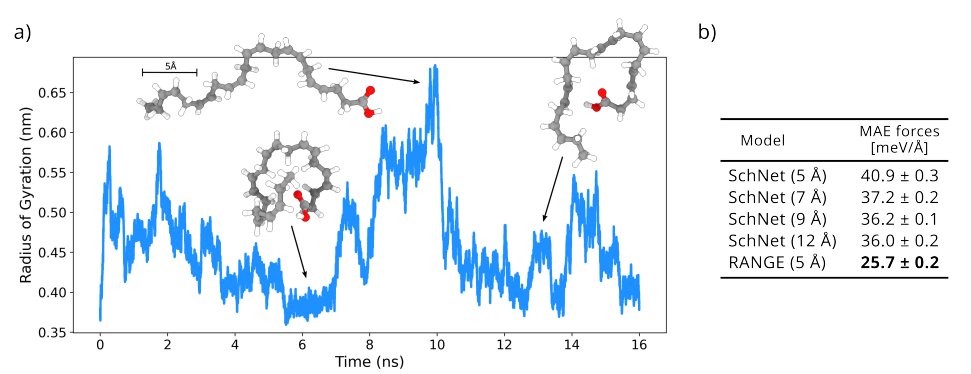
Extending the RANGE of Graph Neural Networks: Relaying Attention Nodes for Global Encoding
Virtual nodes introduced that pass information via attention; reduces oversquashing; improves GNN on molecules; MD22!!
P: https://t.co/d9TMOqACx3
@atAndreasBurger@acaruso0@FrankNoeBerlin we have tried SchNet, PaiNN , and SchNet+Ewald so far, we are now testing everything else. We need to check on oversquashing. We wanted to preprint it now, but we are still performing tests. We will keep this post updated.
Our preprint is out: https://t.co/VRylYIZ9oN
We present a new architecture to address the problem of "short-sightedness" of MLFF based on GNN, which outperform in speed and accuracy Ewald-based GNN.
In collaboration with @FrankNoeBerlin, great work by Alessandro Caruso and Jacopo Venturin in my group, with precious help from Lorenzo Giambagli and Edoardo Rolando. Thanks to @Einstein_Berlin, DFG , and BMBF for funding!
Super excited to preprint our work on developing a Biomolecular Emulator (BioEmu): Scalable emulation of protein equilibrium ensembles with generative deep learning from @MSFTResearch AI for Science.
#ML#AI#NeuralNetworks#Biology#AI4Science
https://t.co/yzOy6tAoPv
Scalable emulation of protein equilibrium ensembles with generative deep learning @MSFTResearch
• BioEmu, a novel generative deep learning system, enables scalable emulation of protein equilibrium ensembles, achieving a 10,000-fold speed-up over molecular dynamics (MD) simulations while maintaining similar accuracy in free energy predictions.
• Key innovation: BioEmu combines large-scale data from AlphaFold structures, 200ms of MD simulations, and experimental protein stabilities to predict conformational changes, binding states, and equilibrium probabilities with errors under 1 kcal/mol.
• Unlike traditional MD simulations, BioEmu generates thousands of equilibrium samples in minutes, making it cost-effective and accessible for exploring protein folding, domain motions, and cryptic pocket formation.
• Benchmarks demonstrate BioEmu’s superiority in sampling biologically relevant conformations. It accurately predicts large-scale motions (e.g., domain rearrangements), local unfolding events, and the formation of cryptic binding pockets.
• BioEmu’s predictive power extends to estimating protein stability and mutational impacts. It uses a novel fine-tuning algorithm, Property Prediction Fine-Tuning (PPFT), for incorporating experimental data without requiring protein structures.
• Case studies on complex proteins like ACE2 and intrinsically disordered proteins highlight BioEmu’s flexibility and applicability across diverse biological systems, offering insights for drug discovery and protein engineering.
• Practical implications: BioEmu shifts the role of MD simulations from production to validation, serving as a bridge between computational efficiency and experimental relevance in molecular biology.
@FrankNoeBerlin@CecClementi@shu_xin_zheng @martenlienen @AndrewC_ML@VStimper@fedzbar@jigyasa_nigam@rneschneuing@SoojungYang2@hello_yaoyi@vgsatorras@AndrewFoongYK@YuuuXie@josejimlun@tmhmpl
📜Paper: https://t.co/GnF7mSx2u7
#ProteinDynamics #GenerativeModels #AIInBiology #EquilibriumEnsembles #ComputationalBiology
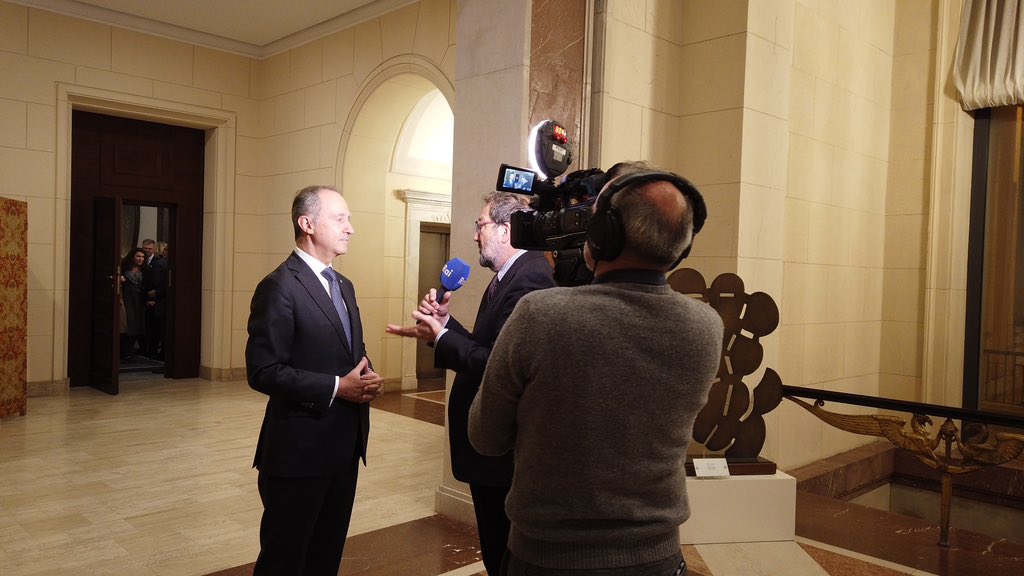
L’eccellenza scientifica italiana protagonista in Ambasciata in occasione del riconoscimento del network di scienziati 🇮🇹 SIGN come associazione no-profit, con un panel sulle applicazioni scientifiche dell’IA @G_Cuniberti@CecClementi@FrankNoeBerlin@DPasserone@SIGNnw@ItalyMFA
Progress towards rigorous #quantum statmech from classical dynamics by #MachineLearning quantum corrections to potentials. In this collaboration with @CecClementi, we obtain exact statics (beyond a centroid description) for paradigmatic aqueous system
https://t.co/MrYnNqBr7a
As the sun sets on our conference we take a look at the talks from the last day..
@CecClementi presented her group's work on developing a state-of-the-art machine learned coarse-grained #forcefield which will fold #PDB structures with 25% sequence similarity