If you're looking for an order to try this in:
1. mise
2. hk (parallel git hooks will change your life)
3. aube (you are now immune to JS hacks)
4. pitchfork (a 'nicer' foreman)
5. fnox (higher up if your team is heavy into password managers and everyone uses diff ones)
The AI ponzi scheme goes like this:
Everyone is generating all these long ass docs and then passing them off for others to read
Then the person receiving is like, wtf this is way too long, and hands that into an AI to read and summarize
Then they are generating a long ass response back
and this cycle goes like that forever. and we call this work now 😅
The token lords watch this from their towers nodding and grinning.
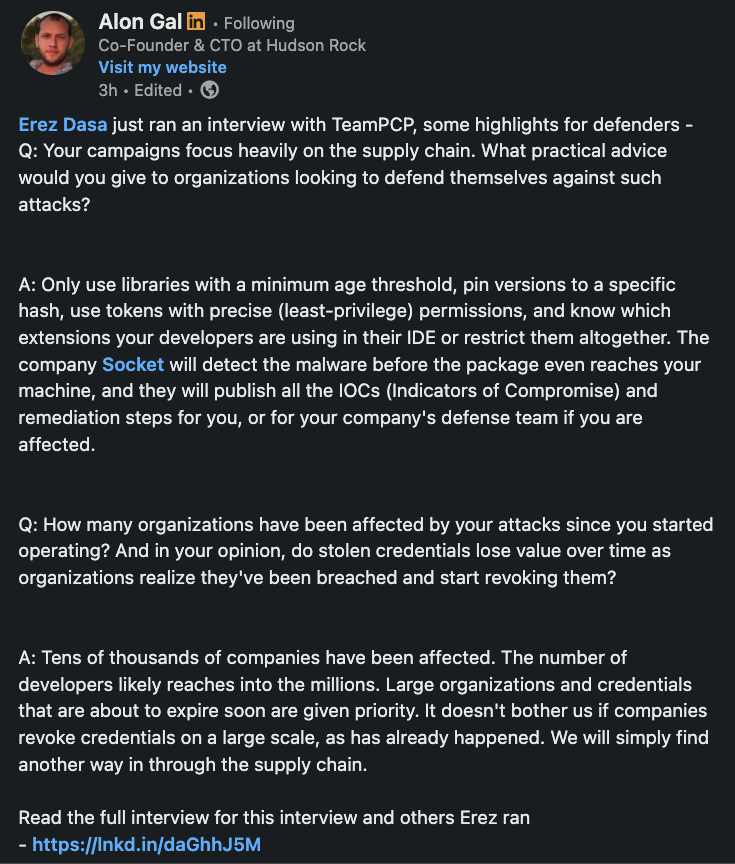
TeamPCP just did an interview where they were asked what defenders should do to stop supply chain attacks.
Their advice: pin versions to a specific hash, use least-privilege tokens, restrict IDE extensions. And then, verbatim: "The company Socket will detect the malware before the package even reaches your machine."
So... thanks, I think?
We're not putting this on the testimonials page.
But at the same time, if you're not yet using @SocketSecurity to protect your supply chain, what are you waiting for?
The performance issues are always the database (on the server) or big latency for the users far away from your server‘s location (on the client).
This is about 99.99% of the issues you may hit.
I shipped a Rails app to the App Store. Without writing a single line of Swift.
Tried 4 different approaches. Here's what I learned from each.
https://t.co/8vNYYSrZBK
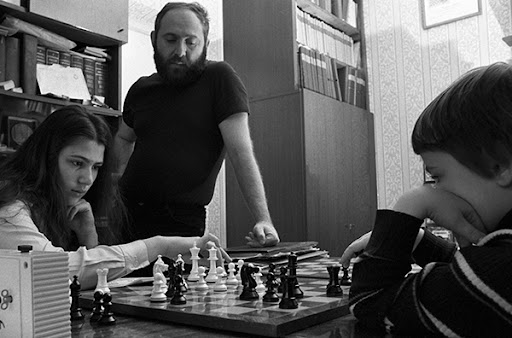
A Hungarian psychologist raised three daughters to prove that any child could become a chess grandmaster through early specialization. He succeeded. Two of them became grandmasters. One became the greatest female chess player who ever lived.
Then a sports scientist looked at the data and found something nobody wanted to hear.
His name is David Epstein. The book is called "Range."
The Polgar experiment is one of the most famous case studies in the history of deliberate practice. Laszlo Polgar wrote a book before his daughters were even born arguing that geniuses are made, not born. He homeschooled all three girls in chess from age four. By their teens, Susan, Sofia, and Judit were dominating tournaments against grown men. Judit became the youngest grandmaster in history at the time, breaking Bobby Fischer's record. The story became the gospel of early specialization. Pick a domain young, drill it hard, and you can manufacture excellence.
Epstein opens his book by telling that story honestly and then quietly demolishing the conclusion most people drew from it.
Chess works that way. Most things do not.
Here is the distinction that took him four years of research to articulate, and that almost nobody who quotes the 10,000 hour rule has ever read.
There are two kinds of environments in which humans develop expertise. Psychologists call them kind and wicked. A kind environment has clear rules, immediate feedback, and patterns that repeat reliably. Chess is the cleanest example. Every game ends with a winner and a loser. Every move is recorded. The board never changes shape. The pieces never invent new ways to move. A child who plays ten thousand games will see most of the patterns that exist in the game, and pattern recognition is exactly what chess mastery is built on.
A wicked environment is the opposite. Feedback is delayed or misleading. Rules shift. The patterns that worked yesterday may be exactly the wrong patterns to apply tomorrow. Most of the real world looks like this. Medicine is wicked. Investing is wicked. Building a company is wicked. Scientific research is wicked. Almost every job that involves a complex changing system with humans in it is wicked.
The Polgar sisters trained in the kindest environment any human can train in. Their success was real and the method was correct. The mistake was generalizing the method to fields where the underlying structure of the environment is completely different.
Epstein's research is what made the implication impossible to ignore.
He looked at the careers of elite athletes outside of chess and golf and found that the pattern was almost the inverse of what people assumed. The athletes who reached the very top of their sports were overwhelmingly people who had played multiple sports as children, specialized late, and often switched disciplines well into their teens. Roger Federer played squash, badminton, basketball, handball, tennis, table tennis, and soccer before tennis became his focus. The kids who specialized in tennis at age six and trained year-round for a decade mostly burned out, got injured, or topped out at lower levels of the sport.
The same pattern showed up everywhere he looked outside of kind environments. Inventors with the most patents had worked in multiple unrelated fields before their breakthrough work. Comic book creators with the longest careers had drawn for the most different genres before settling. Scientists who won Nobel Prizes were dramatically more likely than their peers to be serious amateur musicians, painters, sculptors, or writers.
The skill that mattered in wicked environments was not depth in one pattern. It was the ability to recognize when a pattern from one domain applied unexpectedly in another. That kind of thinking cannot be built by drilling a single subject. It can only be built by accumulating mental models from many subjects and learning to move between them.
The deeper finding is the one that should change how you think about your own career.
Specialists in wicked environments often get worse with experience, not better. Epstein cites studies of doctors, financial analysts, intelligence officers, and forecasters showing that years of experience in a narrow domain frequently produce more confident judgments without producing more accurate ones. The expert builds elaborate mental models that feel comprehensive and turn out to be increasingly disconnected from the actual structure of the problem. They stop noticing what does not fit their framework. They mistake fluency for understanding.
Generalists do better in wicked domains for a reason that sounds almost mystical until you understand the mechanism. They have less invested in any single mental model, so they abandon broken models faster. They are used to being a beginner, so they are not threatened by the discomfort of not knowing. They have seen enough different domains that they can usually find an analogy from one field that unlocks a problem in another. The technical name for this is analogical thinking, and the research on it is one of the most underrated bodies of work in cognitive science.
The single most useful sentence in the entire book is the one Epstein puts almost as a throwaway.
Match quality matters more than head start.
A person who tries six different fields in their twenties and finds the one that genuinely fits them will outperform a person who picked one field at fourteen and stuck to it on willpower alone. The lost years were not lost. They were the search process that produced the match. Every field they walked away from taught them something they later imported into the field they finally chose.
The reason this is so hard to accept is cultural, not empirical. We tell children to pick a path early. We reward the prodigy who knew at six. We treat the late bloomer as someone who failed to launch on time, when the data suggests they were running an entirely different and often more effective optimization process underneath.
The Polgar sisters were not wrong. The conclusion the world drew from them was.
If your environment is genuinely kind, specialize early and drill hard. If it is wicked, and almost every interesting human problem is, then the people who win are the ones who refused to specialize until they had seen enough to know what was actually worth specializing in.
You are not behind. You were running the right experiment all along.
As a blind programmer, this is one of the most meaningful things I've worked on!
I'd love your thoughts on the PR, especially if you've never thought about a11y. People new to it catch what I could be taking for granted.
Thanks to the Rails Foundation for the trust ❤️
IMO it's very disrespectful to post direct output from an AI into an email, Github comment, or other document intended for human consumption without any annotation saying that it's agent output.
Claiming that "all my code is now written by an agent" is ambiguous. It includes:
1. Folks who know what they are doing and care about software design, who can now produce code much faster.
2. Vibe coders who treat the agent as a black box that generates a working system.
I validate daily that, with the current models, vibe coding is not suitable for building minimally maintainable systems. Agents introduce major internal quality issues quickly and spread them even faster because they echo existing patterns so well.
I see two challenges for programmers today:
First, learning how to do (1) properly: how to create the right context for agents, how to orchestrate them and manage their memory, how to remove toil, parallelize work, etc. In other words: maximize the value we can extract from this new sorcery.
Second, vibe coding is fantastic for non-programmers to create value by doing things they could not do before: quickly iterating on ideas, automating workflows, building ad-hoc tools, and so on. The key question is: where internal software quality starts to matter, and how to enforce it without diminishing this new source of value.
I am also increasingly convinced that many companies that blindly embrace vibe coding and chase futuristic PR headlines are about to discover the terrors of technical debt at scale.
Adobe tried to buy Figma for $20 billion in 2022.
The deal collapsed. So Figma went public on the NYSE in July 2025 instead. Ticker FIG. Public company. Quarterly earnings. Wall Street pressure.
You know what happens to design tools after they IPO.
In March 2025, Figma raised the Professional Full seat 33%. From $15 to $20 a month. Organization seats jumped to $55. Enterprise to $90.
Then they took Dev Mode, which was free during beta, and locked it behind a paid seat. Your developers now pay extra to inspect the designs your designers already paid to create.
In March 2026, Figma started charging for AI credits on top.
If Figma raises prices again, you pay.
If Figma gets acquired, you pray.
If Figma shuts down, your files die with it.
Your design system. On their servers. In a proprietary format only their app can read. To draw rectangles on a screen.
There is an open source design platform that runs on your hardware. Stores your files in plain SVG. Costs $0 forever for unlimited users.
It is called Penpot. 45,700+ stars on GitHub.
A full Figma-grade design platform built on open web standards. Vector editing. Components. Design tokens to W3C spec. Flex and Grid layouts. Real-time multiplayer. Interactive prototyping.
Here's what it does:
→ Real-time collaboration. Live cursors. Comments in line.
→ Components, variants, shared libraries.
→ Auto layout, Flex, CSS Grid. The tool outputs production CSS, not lookalike CSS.
→ Interactive prototypes with overlays, animations, and flows.
→ Inspect tab. Free. Built in. Every developer grabs production CSS, SVG, HTML without a separate seat.
→ Plugin ecosystem. Figma import to migrate your files.
→ Self-host on Docker in one command. Your designs never leave your network.
Here's the wildest part:
Figma stores your designs in a proprietary format only Figma can read.
Penpot files are SVG. The same format your browser has rendered for 25 years. Open them in any editor. Open them in 20 years. Nobody can lock you out.
The feature Figma charges your developers extra for, Penpot gives away. Without asking permission.
Figma Professional: $20/month per seat. A 10-person team: $2,400/year.
Figma Organization: $55/month per Full seat. A 50-person org: $33,000/year.
Penpot: $0. Unlimited users. Unlimited files. Unlimited teams. Self-hosted. Free forever.
45,700+ stars. 2,700+ forks. 250+ contributors. MPL-2.0 license. Backed by a community that believes design tools should be free.
Your designs. Your files. Your standards.
100% Open Source.
(Link in the comments)
📊 The 2026 Ruby on Rails Community Survey is open!
9 years of tracking the @rails ecosystem — and we need your input to keep it going. Takes just a few minutes. Please share with your team!
https://t.co/pYVoTG1tAV
Git 2.54 is here with features like config-based hooks, new ways to rewrite history, and much more. ✨
Check out the highlights from this release. 👇
https://t.co/CmIInsdLkq