The grade cap doesn't take account of the fact that classes differ from one another in terms of difficulty, so an given grade in one doesn't necessarily mean the same as the same grade in another. Grade caps create some perverse incentives. Fortunately, ...
2/3
The Effects of High-Impact Tutoring on Student Attendance: Evidence From a State Initiative https://t.co/ErnTSn2Us1
"students were 1.2 percentage points less likely to be absent on days they were scheduled for tutoring...Bundling key features...further amplify the effect."
@Ed_Realist@skominers I'm not sure that grades ought to be (solely) used for required remediation, but grades certainly serve broader purposes than just determining remediation needs.
@Ed_Realist@skominers Stephen Curry's free throw shooting is somewhat (a little) unreliable, but Golden State is probably better off when he goes to the line compared to others. Same goes for grades, an A is no guarantee that someone knows material, but it's highly likely.
@Ed_Realist@skominers Unfair has a particular meaning in this context. It's possible that they are unfair, but we don't know that based on the fact that they aren't necessarily consistent. Unreliable is almost certainly right, but lots of things that are predictive are unreliable.
@Ed_Realist@skominers I think we need grades for all kinds of reasons: incentives, feedback, signaling, determining eligibility for various things. I'm guessing there are more too.
How to fix grade inflation in higher education? One option, implemented by Harvard is to have a (20%) cap on the number of As profs can award. This convo explains why that somewhat simple solution isn't so good. Why? 1/3
https://t.co/k5vjdLwaop
.@educationgadfly's Amber Northern on whether she found #DEI in @IESResearch grants: "If you're looking for it, you're going to find it. There are a handful of grants that sort of had those buzzwords in it, but for the most part, what I saw was not that way. ..." 1/2 #EWA26
I would add that despite showing high levels of job satisfaction our surveys also portray the challenges of the teaching profession. Teaching remains stressful and managing student behavior is the top source of stress identified by teachers
New @caldercenter working paper alert!
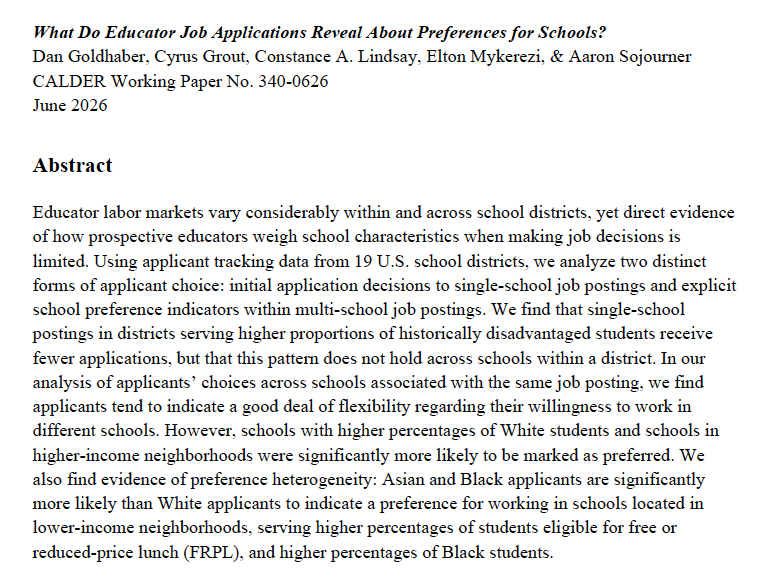
We (many authors) examine what applications to different teaching & principal jobs suggest about the preferences of job applicants for schools.
1/n
Principal labor markets looked somewhat different, but we also couldn't infer too much about principals given far smaller samples of principal jobs/applicants.
5/5
But I was surprised that much of the evidence of differences in applicants/posting was between rather than within districts (though there are some important caveats about this finding, you'll have to read more!).
4/n
And, we also found that Asian and Black applicants are significantly more likely than White applicants to indicate a preference for working in schools: located in
lower-income neighborhoods, serving higher percentages of FRPL students, & higher percentages of Black students.
3/n
We find some things that aren't so surprising, such as districts serving historically disadvantaged students receiving fewer teaching applications & applicants (when asked) preferring higher income schools & those w/ higher proportions of White students.
2/n
New @caldercenter working paper alert!
We (many authors) examine what applications to different teaching & principal jobs suggest about the preferences of job applicants for schools.
1/n