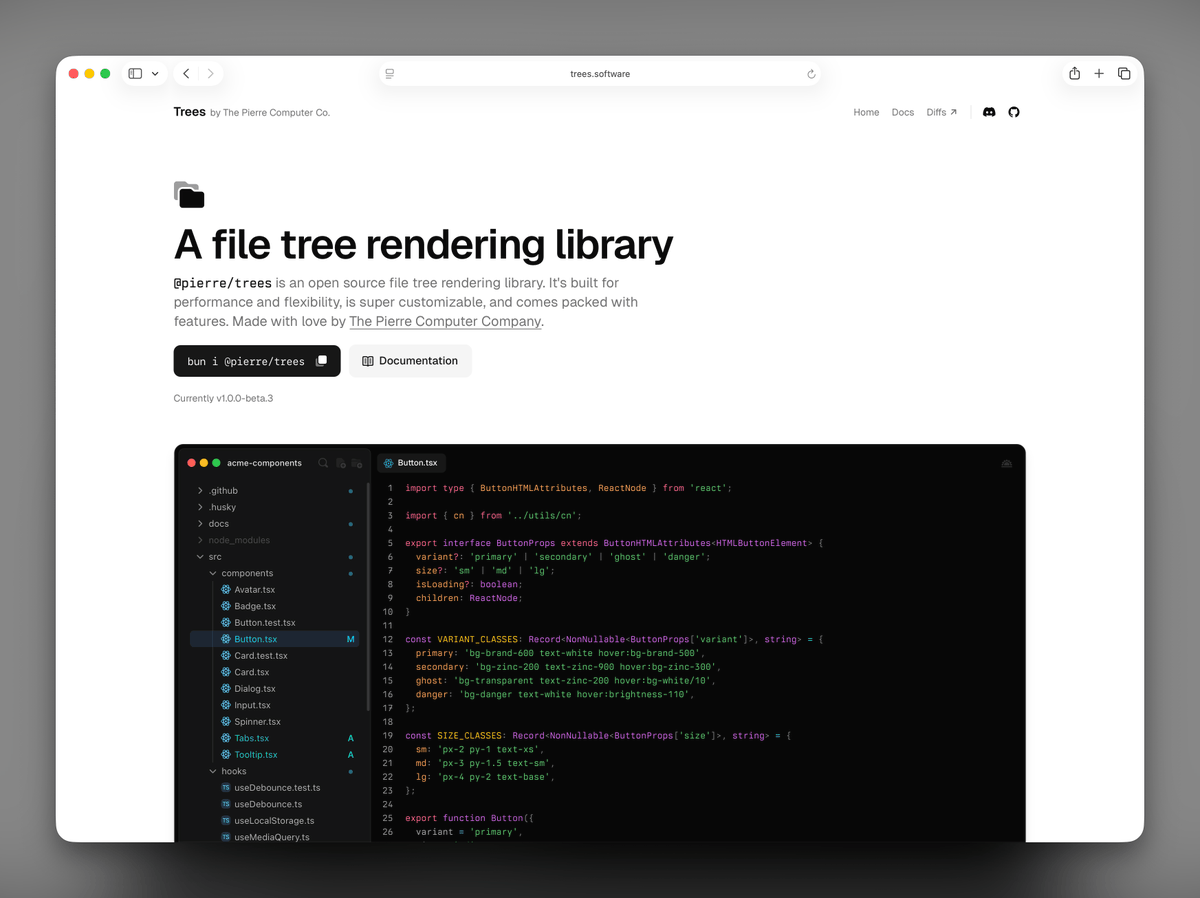
For the past few months, @pierrecomputer has been working on a brand new primitive, Trees. Just like Diffs, it’s an incredibly fast, modern, and beautiful library for rendering lists of files and folders.
https://t.co/CUraFV6Q5C
Monorepo and stacked diffs support is what I wanted for so long.
Source control is at the root of software development, can't shift left more than this. I expect Sapling to have knock on effects on how we build tools and develop software going forward.
Also check out https://t.co/Nez4vKXDhI
I think I lacked a theory of mind on how to approach documentation and the diataxis system cleared it up immediately.
CUE will adopt this methodology going forward for docs, which I know people have wanted to see for awhile😄
We had our first CUE community call focused on documentation: https://t.co/OZfqp2FDjy
Highly recommend watching. I think what we discussed will have wide effects on how we build software in a few years
@JplusCplusM @verdverm https://t.co/Zw43U9BpPJ
I cannot make the community call tomorrow, but I think code gen and working with ecosystems like IaC should be added as a discussion topic
@verdverm @JplusCplusM @HashiCorp@crossplane_io Im starting to lean more that CUE should do reconciliation closer to the runtime:
https://t.co/0J4HXoOYqf
The natural endpoint for a configuration language is an eventual configuration database
Truly massive configurations can flip all the tradeoffs on its head
Details like storage of keys, sharding the structure, and reconciling new data will be done first party in the language
@JplusCplusM @verdverm I will QRT this soon diving into more detail and what needs to be built, but in short:
- CUE libraries to model and add value on top of tools
- Sync infrastructure to merge and manage config
@JplusCplusM @verdverm Great question
I will say that specifically for IaC more tooling needs to be built out for using CUE to be a great experience
If you are comfortable with the idea of creating some automation to have "configuration builds" from CUE -> JSON that feeds into TF keep going
The natural endpoint for a configuration language is an eventual configuration database
Truly massive configurations can flip all the tradeoffs on its head
Details like storage of keys, sharding the structure, and reconciling new data will be done first party in the language
I will need to dig into Riff to understand the strategy, but Riff is willing to integrate with a language ecosystem and interface with Nix, instead of the Bazel/Nix approach of modeling the world in its own system as a first step.
https://t.co/kjpgDsmr7e
I like the framing https://t.co/vqcV9KWK5R has for Nix.
Cross-language dependencies is a massive pain point no matter the stack, so this is a strong place for Nix to make inroads for the average developer.
h/t @grhmc