I can’t stop thinking about how secrets are the dark matter of Los Angeles infamous social culture.
Secrets connect the transportation system, to destination, and human networks.
Posed differently: if you don’t know anyone, then how do you supposed to know where to drive?
Most don’t realize health insurance does a whole lot more like pre certifications feel like a pain but they actually are additional safety/necessity checks
The uninsured basically lose a check and balance on the care delivery industrial system
I recently learned it's common among wealthy people to use concierge doctors who don't accept insurance (more time with doctor, specialized care, etc) and just get insurance with a really high deductible to cover crazy expensive emergencies
Request for Startup: Health insurance that lets you self-insure (i.e., cash pay) for small stuff, with reinsurance for extraordinary events.
No claims processing except for extraordinary unpredictable things.
We might soon be able to predict diseases before you get them.
Many diseases leave detectable signals before they showed up in a medical record. People flagged by a machine-learning model as having a disease-like biomarker pattern were much more likely to later receive that diagnosis.
In a related study, as few as 5-20 blood proteins improved prediction for dozens of diseases up to 10 years before diagnosis, far outperforming standard clinical information.
California's 10 Billion dollar Bet on Undocumented Healthcare Deepens
The state's Medi-Cal program now grapples with annual costs nearing $10 billion, more than double initial projections, as the next governor prepares to confront tough fiscal choices.
Medi-Cal expansion to all eligible residents regardless of immigration status reached its final phase in 2024. Enrollment surged beyond expectations. By fiscal year 2024-25, state general fund spending on this population hit approximately $8.4 billion to $9.5 billion. That figure exceeds early estimates of $3 billion to $6 billion.
In 2025, lawmakers approved an enrollment freeze for new undocumented adults ages 19 and older starting January 2026. Existing enrollees retain coverage if they renew on time, and children under 19 may still join. Officials added $30 monthly premiums for certain adults beginning in 2027 and trimmed some benefits such as adult dental coverage.
California could lose tens of billions in annual Medicaid support amid national policy shifts and restrictions tied to state spending on non-citizens. Undocumented immigrants contribute about $8.5 billion yearly in state and local taxes, roughly matching the coverage cost.
Decisions made now will shape coverage for millions and influence California's fiscal health for years ahead.
https://t.co/vu2TbUX7v0
Researchers Simulate Entire Mouse Cortex on Supercomputer Advancing Brain Disease Research
Scientists have achieved a major milestone in computational neuroscience by simulating a complete mouse cortex with nearly 10 million neurons and 26 billion synapses.
This work conducted on Japan's Fugaku super-computer, signals important progress toward understanding and treating neurological diseases through large scale brain modeling.
A collaboration between the Allen Institute for Brain Science and Japanese research institutions produced the simulation.
This level of detail captures sub cellular dynamics that simpler models often miss. The simulation ran at 32 times slower than real time speed, yet demonstrated that full scale mammalian brain regions can now be replicated digitally.
Fugaku, which is one of the worlds fastest supercomputers, enabled the team to integrate vast amounts of biological data on neuron types connectivity and activity patterns. n tissue.
This type of digital brain offers new ways to study diseases. Conditions such as Alzheimers disease, epilepsy, and other neurological disorders that involve complex disruptions in neural circuits. Scientists can now test hypotheses in a fully controlled virtual environment.
Researchers Simulate Entire Mouse Cortex on Supercomputer Advancing Brain Disease Research
Scientists have achieved a major milestone in computational neuroscience by simulating a complete mouse cortex with nearly 10 million neurons and 26 billion synapses.
This work conducted on Japan's Fugaku super-computer, signals important progress toward understanding and treating neurological diseases through large scale brain modeling.
A collaboration between the Allen Institute for Brain Science and Japanese research institutions produced the simulation.
This level of detail captures sub cellular dynamics that simpler models often miss. The simulation ran at 32 times slower than real time speed, yet demonstrated that full scale mammalian brain regions can now be replicated digitally.
Fugaku, which is one of the worlds fastest supercomputers, enabled the team to integrate vast amounts of biological data on neuron types connectivity and activity patterns. n tissue.
This type of digital brain offers new ways to study diseases. Conditions such as Alzheimers disease, epilepsy, and other neurological disorders that involve complex disruptions in neural circuits. Scientists can now test hypotheses in a fully controlled virtual environment.
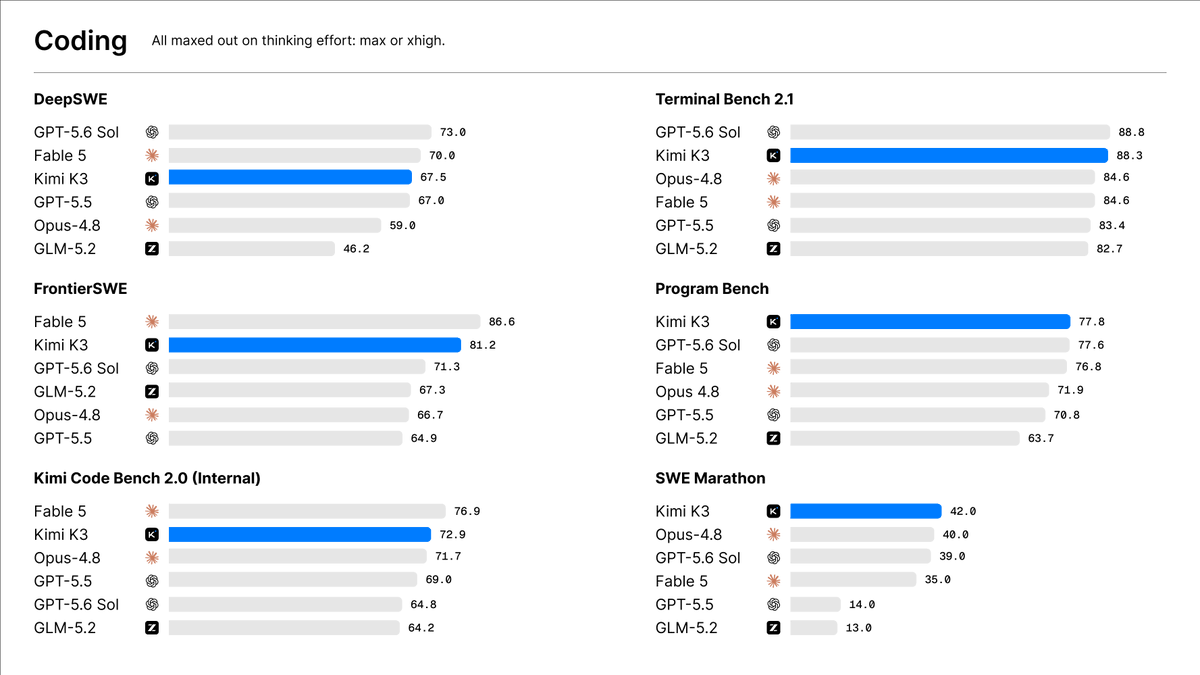
Introducing Kimi K3: Open Frontier Intelligence
🔹 2.8 Trillion Parameters, 1 Million Context, Native Multimodal
🔹 Kimi Delta Attention enables up to 6.3x faster decoding in million-token contexts
🔹 Attention Residuals deliver ~25% higher training efficiency at <2% additional cost
🔹 Built for long-horizon agentic coding and self-evolving workflows
Kimi K3 is now live on on https://t.co/zrk6zZxZUo, Kimi Work, Kimi Code, and the Kimi API.
Open Weights by July 27, 2026.
🔗 API: https://t.co/XCrgjXAqMw
🔗 Tech blog: https://t.co/YTfiMSNM1f
A new JAMA Pediatrics study finds roughly 1 in 5 American adolescents use AI chatbots for mental health advice, and most aren't telling anyone. https://t.co/MuFnAlsRBN
Don’t miss the heat — turn on notifications RIGHT NOW for every update, drop, and exclusive moment! 🔔
Stay locked in and never miss the action! Who’s ready?!
Even elementary schoolers are being put on popular weight-loss drugs such as Wegovy.
Doctors say that GLP-1 medications can prevent lifelong obesity and Type 2 diabetes in children—but there are some worries. 🔗 https://t.co/aqnbwlVeAz