I enjoyed writing this article with Mathias Benedek, where we imagine the future of creativity testing, building on PISA's 2022 Creative Thinking assessment. We're hoping to turn these ideas into reality in the coming year.
https://t.co/n0WOJeCwQB
LLMs still struggle with creativity. How can we make them more creative?
Train AI on what people actually consider creative.
We built a dataset of 200k+ human creativity ratings and used it to train a model that outperforms GPT-4o on creativity tests. https://t.co/Ld7OCDOC3T
🚨Check out our recent preprint on human-AI co-creativity in story writing!
🔍🔍🔍We investigate the mechanisms that underlie the outcomes of human-AI co-creativity in a highly naturalistic setting.
https://t.co/k1kf0oRsDH
Simone trained people to increase default mode and executive brain network coupling using neurofeedback, which boosted creative thinking—showing a double dissociation.
A big technical undertaking and his first-first author brain paper 👏
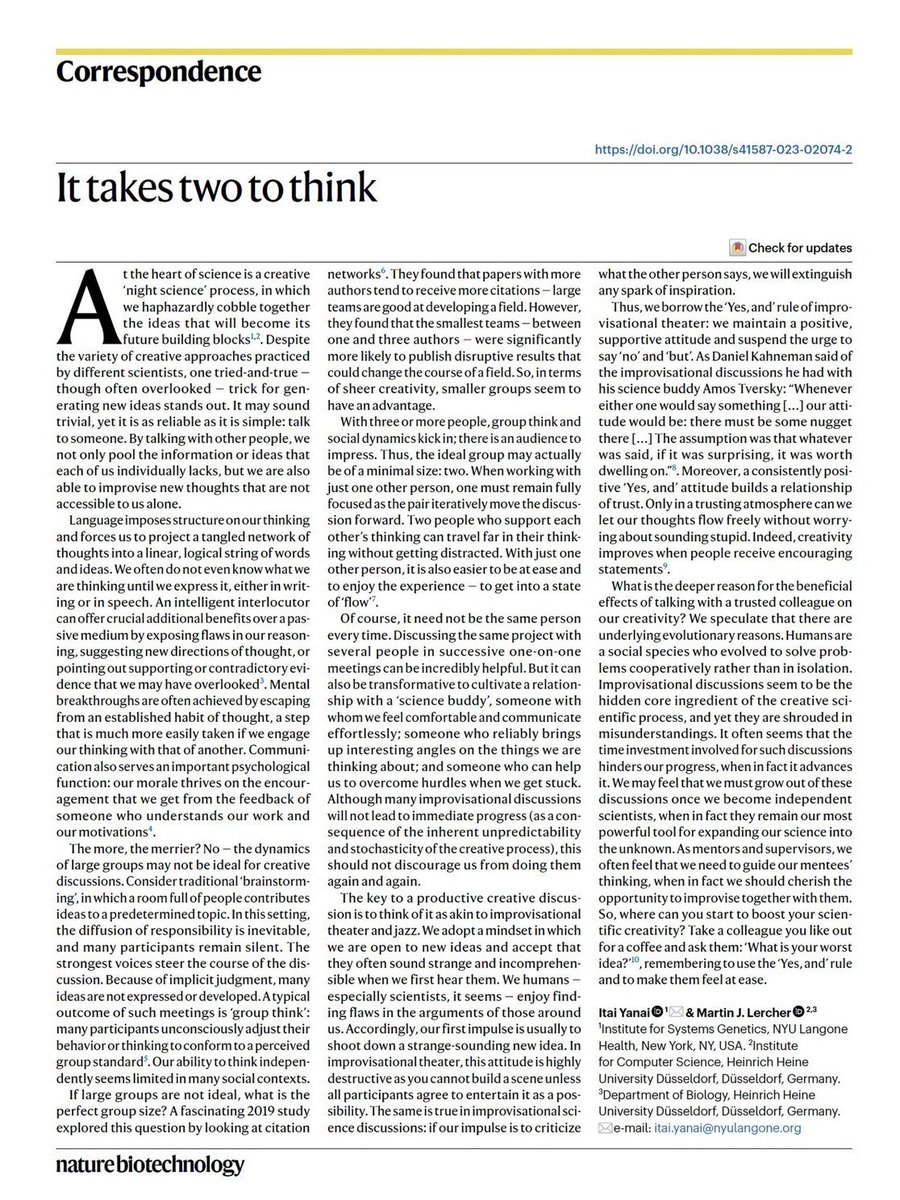
It’s crazy how talking with a science buddy is simultaneously what’s most likely to move the project forward and the thing that’s least prioritized in our schedule.
Meta-analysis (n=52 studies, 195 effect sizes) confirms the incubation effect: taking breaks away from a problem leads to more creative solutions (d=0.39)
https://t.co/yARP1HjHjI
New research in collaboration with @LucasBellaiche now published in the Creativity Research Journal -- Do Individual Differences in Creativity Predict AI-Assisted Art Quality?
https://t.co/cOLrq7r7Pd
The submission deadline for Div 10's 2025 conference in New Haven is slowly approaching!
Nov 1 is the deadline for symposia, talks, and posters.
Jan 25 is the posters-only "last call" deadline.
See below for details.
https://t.co/G29Jj5OsfN
The Call for Papers for Div 10's 2025 research conference in New Haven CT is out!
The submission deadlines are Nov 1 (symposia, talks, posters) and Jan 24 (posters only).
See below for details:
https://t.co/G29Jj5NUqf
ChatGPT can homogenize human creativity, causing generated ideas to be more semantically similar. Users also reported feeling less responsible for ideas produced with ChatGPT (compared to not using AI).
Happy to see Estonian students ranking 1st in Europe in the OECD’s PISA Creative Thinking test.
This confirms that our education system successfully develops students' creativity and problem-solving skills.
Smart ideas and effective solutions are key for future prosperity.
To our European friends, thank you for your patience and dedication in traveling to the US for so many SfNC meetings. It’s past time for a meeting in Europe—I can’t wait to see everyone in Paris next year!
Honored to be recognized as a creativity research star of the new millennium and to be invited to contribute to a SI in the Creativity Research Journal, modelling a new perspective to understand the role of individual differences in the creative process.
https://t.co/3z70siHNpu