Christian, marksman, RC Pilot, golfer. Best friend is Jesus. IU Grad, Family man, love my wife, 6 children, 10 grands #MAGA#secondamendment#IUBB#IUFB#NRA
36 seconds after liftoff, lightning hit the U.S. moon rocket Apollo 12 and knocked out the spacecraft's power, with President Nixon at the launch site.
One flight controller in Houston, raised on an Oklahoma farm, had seen that exact failure once before, and he fixed it with a single sentence.
It was 11:22 a.m. on November 14, 1969, at Kennedy Space Center, under solid overcast and rain. Nixon was the first sitting president to attend a crewed launch.
At 36.5 seconds the Saturn V set off a lightning bolt on its own as it climbed. All 3 fuel cells dropped offline, and the spacecraft fell back on batteries that could not carry the load.
At 52 seconds a second bolt struck. The "8-ball" that shows the crew which way the ship is pointing went out.
In Mission Control the numbers on the screens turned to garbage. Nobody on the ground could tell what still worked on a rocket that was still climbing.
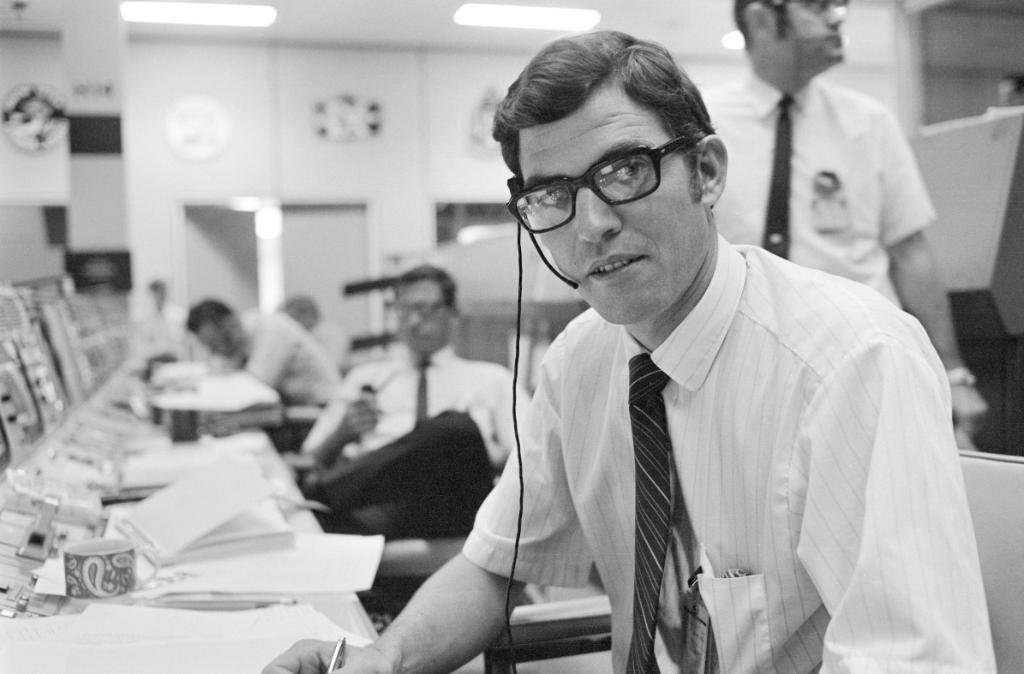
John Aaron sat at the EECOM console, in charge of the spacecraft's electrical system. About a year earlier he had watched a test at Kennedy throw up the same strange readings, and he had traced them to a box called the Signal Conditioning Equipment.
He keyed his mike: "Flight, EECOM. Try SCE to Aux."
Flight director Gerry Griffin did not know the switch. Neither did Gerald Carr, the astronaut on the radio, who passed it up anyway.
Commander Pete Conrad heard "FCE" and asked what the hell that was.
Alan Bean, in the right seat, knew. He threw the switch, the data came back clean, and then he brought the fuel cells back online.
One danger remained. Engineers feared the lightning had damaged the explosive bolts that open the parachute compartment.
Mission Control reasoned that if the parachutes were dead, an abort would kill the crew just the same. So it sent them on to the moon and kept the worry to itself.
Aaron said Conrad laughed all the way into orbit.
5 days later Conrad set the lunar module down on the Ocean of Storms, about 535 feet from Surveyor 3, a robot probe that had been sitting there since 1967.
And when Apollo 12 came home, the parachutes opened.
BREAKING: In a stunning moment, Republican Senator Ron Johnson just went on Fox News and admitted there is RAMPANT corruption within the Trump Administration. Every American needs to see this.
Disappointing is an understatement!!
Here’s an illusion to help take your mind off all the Dumbfucks who voted for socialism.
This is amazing how quick they switch to right side up!! 😳😳
If you take this SR-71 Blackbird, I’m going with it. 😁
I’m sitting in the cockpit of 971 at McMinnville, Oregon. The 971 was brought back to service in 1995 Congress force the Air Force to reinstate three SR 71’s. my father Colonel Richard “Butch” Sheffield was working for Lockheed Skunk Works. He was instrumental in making this happen along with his boss Ben Rich. Our victory was short-lived as the Air Force would not give the reinstated SR 71 a mission.
This SR- 71 is in great shape. Let’s keep this quiet OK.🤫
Linda Sheffield
Long post worth the read. I have a close friend who flies private jets. He flew Lear 60 for over 15 years and now flies a Gulfstream. This is a copy and paste of his response to me asking him if I thought Ice was the issue.
“We always fly in ridiculous cold temperatures.”
“Usually you get the bad ice when the temperatures are like 0 to negative 20. Believe it or not, there's a point where it gets too cold for ice. At negative 40, you pretty much can't get ice. Besides that, the airplane is equipped with hot wings and hot tail.”
“I flew the Lear 60 for like 15 years. It's a no joke airplane and probably the most dangerous airplane I've ever flown. It has a super critical wing. The airflow has to be perfect. When it gets into rough air and turbulence, it will easily stall. It has stalled on me at 41,000 feet just because we got into some turbulence. (On the way to Palm Beach as a matter of fact. ) we recovered and got her flying again around 30,000 ft. Scary
But here's the problem. This airplane has a terrible coffin corner. (At high altitudes) what that means is, you fly in a really narrow window where if you lose 20 knots, it stalls. And if you gain 20 knots, it goes into overspeed. The air goes supersonic over the wing and it goes into a high speed stall, or worse, a Mach tuck.
So if you stall, the normal recovery is to push the yoke forward to lower the nose and gain air speed again. At low altitude, you can push really hard and recover quickly. But in the 60... if you push hard, it will gain air speed and go into a high speed stall, it doesn't take much. It's very sensitive. The 60 has super short wings that don't make much lift. So then you high speed stall, and the computer is yelling at you... OVERSPEED! So then you pull back and enter a low speed stall. And you go back and forth trying to keep it in the air speed window.
This whole thing is pretty scary. And you should recover basically by using your finger tips using super small corrections. You can't over do it. If you try to muscle the recovery, she gets mad and will become unrecoverable. If she enters a mach tuck. You're done.”
“I taught the Lear 60 to other pilots and mentored them. I told them... this airplane has a soul and it's trying to kill you. Do not ever try to top the weather. Don't go over a thunderstorm. Go around it. If it means a half hour longer, then do it. Going over the thunderstorm will go into turbulence that you might not recover from.
These pilots went right over a thunderstorm. I think it stalled which caused them to drop down into the thunderstorm and ended up in mach tuck. They picked up so much speed that it ripped off the horizontal stabilizer. At that point... chuck Yeager can't fix it.
These same pilots did something similar a couple months ago. ATC got mad at them. They poked the bear one too many times.
This is not a beginner airplane. The Gulfstream would never do this. It has HUGE margins of error and won't stall like that. But then again... it's got HUGE wings. It's a pussy cat.
The Gulfstream is like driving a 4 wheeler. The Lear 60 is like riding a uni cycle.”
Physics hasn't changed, but the industry has.
At the start of my 38-year career, I spent a year flying in the bush in Alaska before landing my first Metroliner first officer job. I flew 1,200 hours a year for several years as a copilot before I ever sat in the left seat of anything larger than a Cessna. After that, I was hired by a major airline and spent several years as a flight engineer before upgrading to first officer. Along the way, I watched the men and women I flew with make mistakes—and I learned from them.
Today, pilots are placed in technologically advanced aircraft and taken to altitudes that were once the domain of astronauts and military pilots, often without ever having had the chance to learn from the mistakes of others. I am not saying the 20-year-old copilot was a bad or untalented pilot. She was inexperienced. She allowed her captain to fly them into a thunderstorm. The captain was responsible. An assertive first officer might have helped him make a better decision.
When I occasionally fly as second in command, I tell the captain I have three jobs, in this order:
Don't let you kill me.
Don't let you get me violated.
Make you look good.
General aviation needs to change. And it needs to change fast.
Writing this in my personal capacity, but I have been flying these types of aircraft for more than 20 years, with over 8,000 hours, and have reasonable familiarity with how the charter world operates. I feel compelled to post after seeing commentary about the Lear 60 crash, from missile strikes to DEI to critiquing this poor woman’s final radio calls.
That last part is what I find most troubling. She was the second-in-command (SIC), and while she was empowered to point out mistakes as part of good crew resource management, she was doing her job, communicating with ATC right to the end in a terrifying situation. She likely knew before many of those calls that she was going to die. I have heard final calls from friends, from military pilots with thousands of hours in fighter aircraft, and they are just as heartbreaking because they know the end is approaching.
I understand the public interest given the footage and audio. But you do not know the aircraft’s maintenance history, whether there was a structural failure, if any failure was induced by turbulence, overspeed, or overcontrol, or everything happening in that cockpit. I am sure weather will be part of the investigation, but beyond that, it is speculation. The charter industry routinely hires commercial pilots very early in their careers to gain experience alongside an ATP-qualified captain before they move up to the airlines. She would still have the appropriate training, qualifications, and checkouts by an FAA examiner or designee.
Let people investigate, learn, and share the facts. Be respectful to those who perished and the families who carry their memories. God bless them and their loved ones.
“Holy f*ck, we’re out of time” Heart crushing ATC audio captures the moments before a Learjet 60 crashed in Palm Beach County, Florida, killing all 9 souls on board.
VIA: @thenewarea51
Indiana is 35-3 since Cig arrived
8-1 this year
One TD misconnect from 9-0
Yet the national narrative seems to be nothing but negative towards Indiana.
Doubting Cig and Indiana at this point is laughable.... Actually delusional
You know, for some schools, this ride never starts.
For all schools, it eventually ends.
We just gotta keep enjoying every second of it and remembering how lucky we are to have it.
The best fighter plane of WW2 was the P-51 Mustang. A plane that almost didn't happen, started out mediocre, and only became great because someone stuck a British engine in it.
In 1940, Britain was desperate for fighters. The British asked the American company North American Aviation to build Curtiss P-40s for them under license.
North American said no. We'll design you something better.
They had never built a fighter before. They rolled out the prototype in roughly 100 days.
The Mustang had a sleek new wing design that cut drag and gave it long range. It was fast and handled well. But it had one big problem. Its American Allison engine ran out of breath at high altitude. Down low, it was excellent. Up high, where the air war over Europe was being fought, it was ordinary.
The RAF used those early Mustangs for low-level reconnaissance and ground attack. Useful. Not special.
Then in 1942, a Rolls-Royce test pilot named Ronnie Harker flew one. He came back with a suggestion. What if you put a Merlin in it? The same engine that powered the Spitfire.
They tried it. The result was stunning.
With the Merlin, the Mustang was suddenly fast at every altitude. It could fight anything the Germans had. And because of that efficient wing and extra fuel, it could do something no other single-engine fighter in Europe could do well.
It could fly all the way to Berlin and back.
That mattered more than anything.
By 1943, American B-17s and B-24s were flying deep into Germany in daylight. Their escort fighters ran low on fuel and turned back long before the targets. Then the Luftwaffe pounced. On the raid against Schweinfurt and Regensburg in August 1943, 60 bombers were lost. In October, on the second Schweinfurt raid, 60 more. Ten men in each.
The Army Air Forces couldn't keep losing crews like that.
The Merlin-powered Mustang started arriving in England at the end of 1943. By early 1944, Mustangs were escorting bombers all the way to their targets.
Then General Jimmy Doolittle changed the rules. Instead of keeping fighters glued to the bombers, he let them go hunting. Chase German fighters down. Strafe their airfields. Destroy them wherever you find them.
Mustangs swarmed across Germany. The Luftwaffe started losing pilots faster than it could train them. By D-Day in June 1944, the Allies owned the skies over France.
Hermann Göring supposedly said that when he saw Mustangs over Berlin, he knew the war was lost. Whether he really said it or not, it was true.
The Mustang flew everywhere. The Tuskegee Airmen painted the tails of theirs red and became famous escorting bombers over Europe. Chuck Yeager became an ace in one. Mustangs escorted B-29s to Japan from Iwo Jima.
Over 15,000 were built. In Europe alone, Mustangs were credited with nearly 5,000 enemy planes shot down in the air.
It didn't stop in 1945. Mustangs fought in Korea. Some air forces flew them into the 1980s. Today they're still racing and flying at airshows around the world.
The plane Britain asked for as a backup, built by a company that had never made a fighter, powered by a borrowed engine, ended up winning the air war over Germany.
Dear Barack Obama,
You are no longer president. Please hush your face. We the people do not miss you one bit. We love President Trump.
Sincerely,
Every American who shares this post.
Nearing peak fall color at Indiana University right now.
No wonder College Gameday chose Bloomington this week.
Showalter Fountain is going to be an all-time Gameday backdrop on the most beautiful campus in the country.