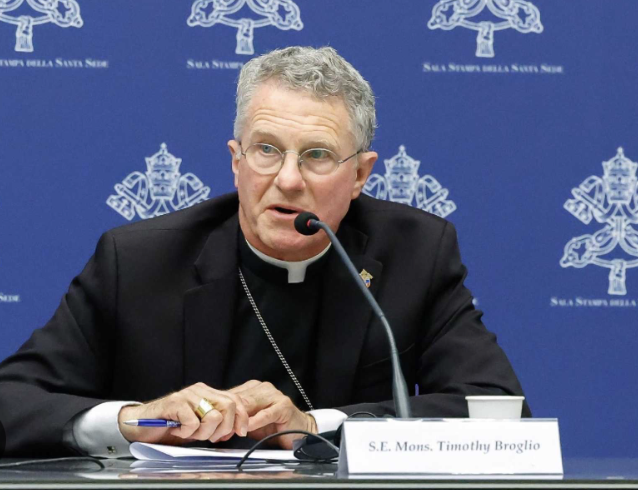
FLASH: On Good Friday, Archbishop Timothy Broglio, head of the Archdiocese for the US Military Services, declared the Iran war UNJUST.
The Archbishop has rendered an important final judgement.
Case closed.
For decades, Iran, as a responsible state, ensured the security of global shipping through the Strait of Hormuz at no cost. Today, the Israeli and U.S. regimes have plunged the region into instability through aggressive attacks, civilian casualties, assassinations, and the destruction of vital infrastructure. Iran is defending itself and remains committed to ensuring safe and secure passage through the Strait of Hormuz. It is recommended that the British government stand on the right side of history.
Today, the UK convened representatives from more than 40 countries to discuss the Strait of Hormuz, and the urgent need to restore freedom of navigation for international shipping, and see the Strait reopened once more.
🇺🇸⚔️🇮🇷 The strategic genius of victory that forges its own defeat
By @BPartisans
You had to see the scene: Washington and Tel Aviv announced a blitzkrieg intended to “break” Iran. A few weeks later, the result looks more like a masterclass in reverse geopolitics: the enemy we were promised would be brought to its knees has emerged tougher, more ideologically driven, and, above all, sitting on the global energy tap.
Reuters sums up the paradox with almost clinical bluntness: a war meant to weaken Tehran could leave it stronger, while exposing the Gulf. In other words, the surgical operation was a success, but the patient has taken control of the hospital.
The great strategic revelation of the moment is to envision an end to hostilities without a solid political agreement. A brilliant idea: bomb first, negotiate perhaps later, and above all leave the Strait of Hormuz under the permanent threat of an actor now transformed into a victorious survivor.
This is where satire meets cold reality. According to Reuters, the real anxiety of the Gulf monarchies is not so much the war itself as its uncertain end. For a war that ends “quickly” to satisfy the American political calendar may drag on for years for those living within missile range.
The Strait of Hormuz, the artery through which a major portion of the world’s oil flows, thus becomes not merely a maritime passage but a lever of civilization. Reuters quotes a Dubai-based analyst: Iran has laid its hand on “a pressure point of the global economy.” An elegant way of saying that the West has handed Tehran the role of tax collector for global energy trade.
The most ironic aspect remains Iran’s domestic political dynamics. While some imagined that a strike against the state’s leadership would trigger the regime’s collapse, the effect appears to be the opposite: consolidation, radicalization, and sanctification.
The assassination of the Supreme Leader, presented as the decisive blow, has above all transformed a contested authority into a martyr. Reuters speaks of a conflict now elevated to a “religious and civilizational” dimension.
In other words, instead of fracturing the system, the operation has provided it with its defining narrative of the century.
History, however, had already provided the opposite playbook. The U.S. Department of Energy and the International Energy Agency regularly remind us that Hormuz remains one of the planet’s most critical chokepoints for hydrocarbons. Any prolonged instability instantly impacts global prices, inflation, and supply chains.
But the most ironic aspect of this strategic tragedy lies elsewhere: the Gulf states, which neither initiated nor truly shaped this war, could end up footing the bill for a decade. Ports under threat, skyrocketing marine insurance premiums, weakened energy flows, and increased infrastructure vulnerability.
In short, a war sold as a show of strength risks achieving exactly the opposite: a surviving Iran, strengthened by the logic of siege, and a Gulf transformed into a buffer zone anxiously awaiting the next salvo.
The empire sought to punish. Above all, it has rewritten the terms of the balance of power.
As is often the case in geopolitics, the loudest victory is sometimes the quietest defeat.
Source: https://t.co/CdgqP4JlV9
🇺🇸🇮🇷 Former U.S. Army intel advisor to Petraeus: Iran likely set up "air defense ambushes" using pattern analysis on U.S. flight paths.
Possibly shoulder-fired missiles or optically-sighted guns, not radar-guided systems. Wow...
🇮🇷🇺🇸🇮🇱 A former Israeli Air Force commander explains why Iran is shooting down American jets...
Iran completely rebuilt its air defense doctrine after the 12-day war.
A former IAF commander told me "the days when flying over Iran was a walk in the park are over."
Here's what changed:
Each of Iran's 31 zones now operates independently if Tehran is cut off.
No more waiting for orders from a command center that might already be destroyed.
Mobile launchers use shoot-and-scoot tactics from tunnels and mountain terrain.
New passive infrared systems track jets without emitting radar signals, meaning pilots don't know they're being targeted until a missile is already in the air.
The biggest revelation: Iran is using China's HQ-9B, Beijing's best long-range surface-to-air missile, with both active radar and infrared seekers.
Standard electronic countermeasures struggle against it.
And Iran's homegrown Bavar-373 reportedly outperforms Russia's S-300 and possibly the S-400.
Iran ditched Russian technology, replaced it with Chinese and domestic systems, decentralized command, went mobile, went passive, and went underground.
The result: two American aircraft down in a single day after five weeks of assumed air dominance.
Source: @academic_la
@Nexo_Latino@AndreaEc1988 No!
El triunfo de los persas no es de un mes, es de muchos años de ser una de las civilizaciones más antiguas que siguen vivas al día de hoy
Para los yanquis todo se mide en el inmediatismo pero no es así para los persas o chinos
🇺🇲 Robert Peip, asesor del Pentágono:
- Irán saldrá de esta guerra como una superpotencia. En nuestra vida nunca hemos visto algo así: un nuevo centro de poder mundial que se ha formado en un mes.
#Opinión 🎙 ESTADOS UNIDOS PIERDE LA NARRATIVA
Marco Rubio impulsa una ofensiva con influencers para defender a EE.UU. y Israel, en un intento por manipular la conversación pública y recuperar el control de la narrativa global.
Opinión de: @CarlosVZenteno.
⛔️Believe it or not ‼️ This is the drunken clown who should not be the Secretary of Defense of the United States of America and who lost the war against Iran and who fired twelve honest American generals who refused to follow his orders and his Pedo Boss Orders‼️