Today in @Nature, we report a spatial single-cell atlas of human cortical development, revealing surprisingly early specification of human cortical layers and areas.
We built an interactive browser to explore the spatial data: https://t.co/Xy3JcsSpYw
Paper link below👇
Altogether, three-dimensional human organoid models remain an invaluable tool to study neurodevelopmental disorders, and as these models become less variable and more complex, we will gain valuable insight into the pathophysiology of neurological disorders.
Important considerations to the study include:
1.) Brain organoids cannot gyrify as of yet
2.) We did not correlate to human lissencephaly tissue
3.) Hyperactive mTOR signaling has been linked to increased seizure burden in patients and so a drug boosting mTOR poses this risk
Excited to share our group's first manuscript describing new anatomical connections that allow the eyes to act as an "immunological window to the brain" 👁️🧠 (1/)
https://t.co/mpIEqvZSE5
Excited (and a bit nervous) to share my first study as senior author! @ericsongg and I took a deep dive into whether IFNg signaling gene mutations indeed confer resistance to immune checkpoint blockade (ICB). Letter in @Cancer_Cell: https://t.co/LA9p4ocQSB
1/ Excited to share our #openaccess work in @LancetChildAdol where we evaluate existing algorithms and develop pragmatic, evidence-based algorithms to support evaluation for #pediatric pulmonary #tuberculosis
Link: https://t.co/tjDkk9xJm2
A summary 🧵
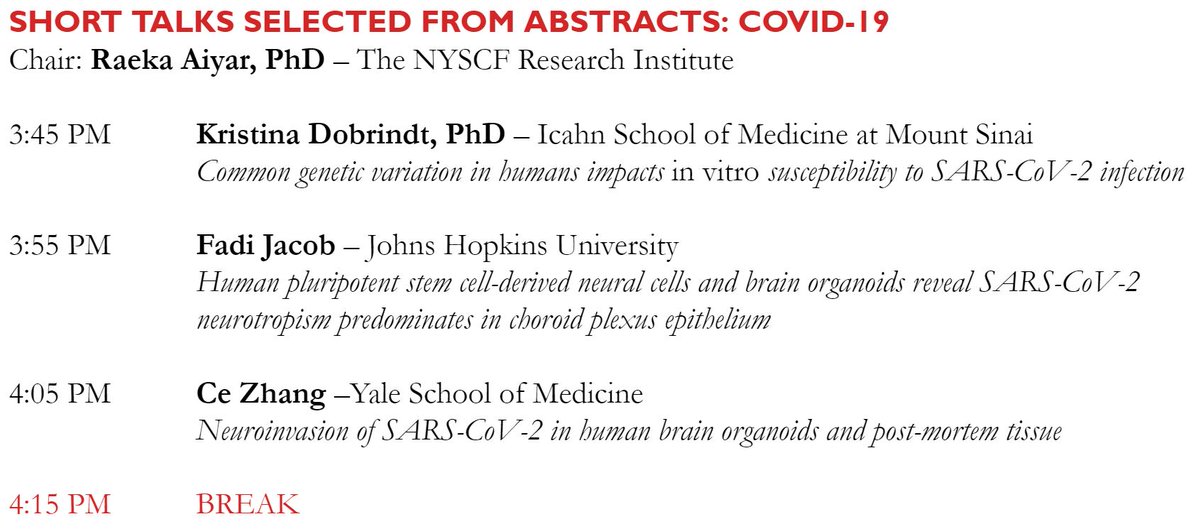
Excited to present our recent work on #SARSCoV2 neurotropism @nyscf conference on Oct. 20th. The session includes talks by @KristinaDobrind and @cezhang0, a former @UPenn_SongMing member and organoid mentor when I first rotated in the lab! Great faculty speaker line-up as usual!