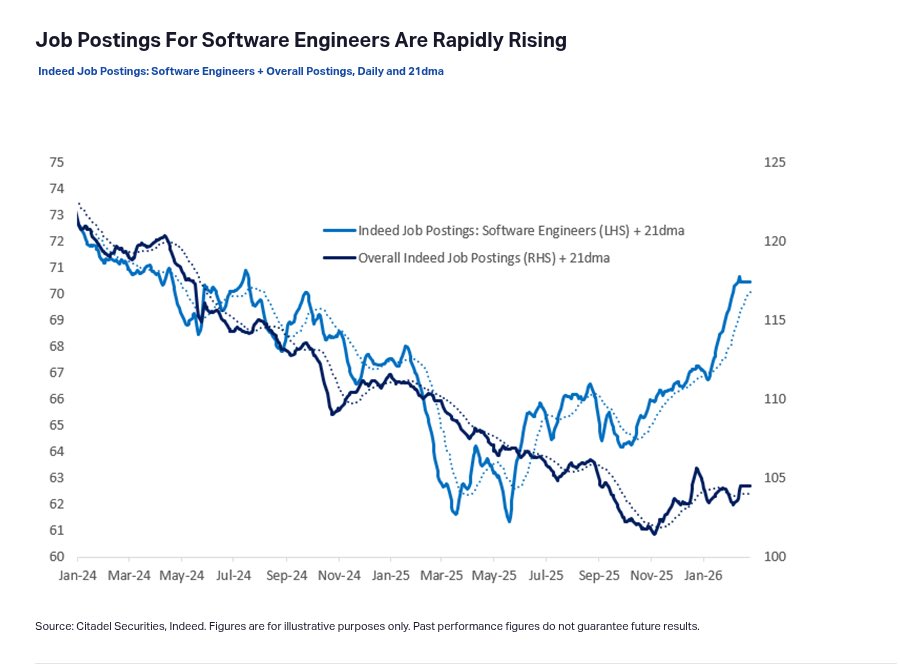
Q: How are job postings for software engineers rising rapidly despite AI agents automating coding?
A: Because there’s far more code to manage than ever before. We’re already seeing a 14x YoY increase in GitHub commits, and it’s accelerating.
AI has dramatically lowered the cost of writing code, so it’s now being used across far more businesses, applications, and use cases.
We’re at the beginning of a massive productivity boom driven by the proliferation of bespoke software throughout the entire economy.
Coding has been AI’s breakout use case this year. The fact that it’s increased demand for software engineers — rather than decreased it — should call into question the entire “AI will cause mass job loss” narrative.
You just patched last month’s Nginx vulnerability that was actively exploited in the wild?
It’s already time for a fresh 0-day RCE.
The whole world is basically “pwned-by-default”, patching vulnerabilities before they’re exploited feels like a Sisyphean task... 🫠
Google Cloud has blocked our account, making some Railway services unavailable. We have escalated this directly with Google. The Railway Platform team has since confirmed access to Google Cloud and is working on restoring access to all workloads.
We have access to some of our Google Cloud–hosted infrastructure and are working to restore the rest of the service. We apologize for the disruption.
Please everyone use Socket Firewall and set your package managers minimum release age. All node package managers as far as I found support this; set it to 7 days. This would mitigate most of your risks
🚨 UPDATE: Mini Shai-Hulud has crossed from @npmjs into @pypi and is still spreading.
Newly confirmed compromised artifacts:
@opensearch-project/opensearch: 3.5.3, 3.6.2, 3.7.0, 3.8.0 (1.3M weekly downloads)
mistralai: 2.4.6 on PyPI
guardrails-ai: 0.10.1 on PyPI
additional @squawk/* packages on npm
guardrails-ai 0.10.1 executes malicious code on import. On Linux, it downloads git-tanstack[.]com/transformers.pyz, writes it to /tmp/transformers.pyz, and runs it with python3 without integrity verification.
The git-tanstack.com domain displayed a message signed “With Love TeamPCP,” along with: “We've been online over 2 hours now stealing creds
Regardless I just came to say hello :^)”
The page also linked to a YouTube video and you can probably guess which one.
The New York Times: No puedes “gamificar” una educación real.
La obsesión por hacer que aprender sea siempre “divertido” ha llevado a llenar las aulas de pantallas, juegos y estímulos rápidos. Pero educar no es entretener: es exigir atención, esfuerzo y pensamiento profundo.
La tecnología debe ser una herramienta complementaria, no el centro del aprendizaje.
https://t.co/ar0gPMtXkh
A researcher spent two years documenting what AI is doing to the way humans think.
His conclusion fits in one sentence.
AI is standardizing human thought. Across societies. Across cultures. Across generations. Simultaneously. At a scale no technology in history has ever achieved.
The paper is called "The Impact of Artificial Intelligence on Human Thought." Published July 2025 on arXiv. Written by independent researcher Rénald Gesnot, categorized under Computers & Society and Human-Computer Interaction.
It is not a benchmark paper. It is not a capability paper. It is something rarer — a systematic analysis of what happens to human cognition, creativity, and intellectual diversity when billions of people outsource their thinking to the same machine.
Here is the mechanism the researcher describes.
When you ask an AI a question, you get an answer shaped by the model's training data, its fine-tuning, its alignment process, and the preferences of the company that built it. That answer is not neutral. It reflects a specific set of values, framings, and assumptions. Usually Western. Usually English-dominant. Usually optimized for engagement and approval.
When 500 million people ask the same AI similar questions and receive similar answers, those answers become reference points. People quote them. Build on them. Argue from them. The diversity of starting points — different cultures, different intellectual traditions, different ways of framing problems — begins to compress.
The researcher describes this as cognitive standardization.
Not censorship. Not propaganda. Something subtler and harder to reverse. A gravitational pull toward the outputs of a small number of models, trained by a small number of companies, reflecting a small number of worldviews.
The paper also documents algorithmic manipulation — AI systems that exploit cognitive biases to influence behavior. The way recommendation algorithms produce filter bubbles. The way AI-generated content exploits confirmation bias. The way personalization systems learn what you already believe and feed it back to you amplified.
And then the creativity question — the one nobody wants to answer directly.
When AI can produce a poem, an essay, a business plan, or a research summary in seconds — and when that output is often indistinguishable from or preferred over human-generated content — what happens to the human practice of creating those things? Not the output. The practice. The struggle. The failure. The slow development of a personal voice through years of imperfect attempts.
The researcher argues that cognitive offloading — delegating thinking tasks to AI — does not merely save time. It atrophies the mental capacity that the offloaded task was building.
Microsoft and Carnegie Mellon found this empirically in 2025: higher AI trust correlates directly with measurably lower critical thinking. The researcher provides the theoretical framework for why.
The paper ends with a question the researcher admits he cannot answer.
Once a generation grows up with AI as the default thinking partner — once the habit of outsourcing cognition is formed before the habit of independent thought is developed — what does intellectual autonomy even mean?
And is it already too late to find out?
Source: Gesnot, R. · "The Impact of Artificial Intelligence on Human Thought" · arXiv:2508.16628 · https://t.co/qoQR2Ow4YI · July 2025
If you think AI replaces software engineers, here’s a quick thought experiment.
Imagine you’re a life sciences company. 10 years ago you want to invest heavily in lab automation, processing data at scale, and other software. You look at the cost of doing so and realize you can’t compete with tech for as many engineers as you need, so you pare down your goals and do what you can. Every new software project has a fixed cost of a certain sized team, so you can only do so much given budgets, ability to compete for talent, and other trade offs.
Now, AI comes along. And all of a sudden you have the *exact same* output tokens as the best tech companies in the world. Your engineers are using the same AI models as the tech industry, which means you have just boosted your engineering team by a some meaningful amount, while also neutralizing your differences with tech.
Do you continue with your pared down approach, or do you start to hire more engineers because each engineer is 2X or 5X more capable than before? In almost every company I’m talking to, they’re doing the latter.
Now extrapolate this to every bank, manufacturer, industrial company, retailer, and on and on. And extrapolate it not to just large enterprises, but also every SMB up and down the stack of these value chains. Oh, and also extrapolate this to other job functions, not just engineers. Resource scarce domains in marketing, legal, finance, design, and so on.
If you’re wondering why new jobs show up because of AI this is the reason. Any other view of what happens doesn’t contemplate the variety of unmet needs there are in the economy.
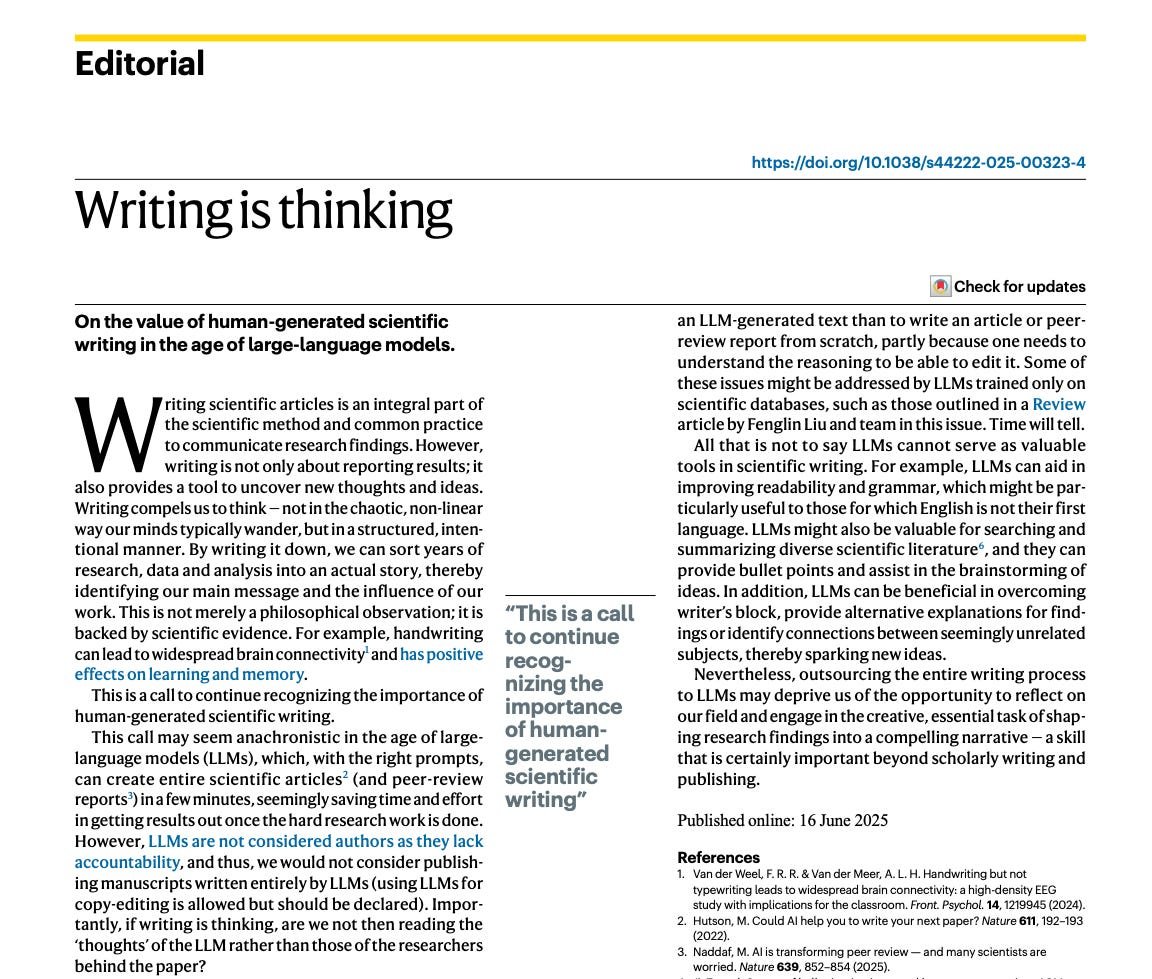
So it turns out that writing is thinking. It's the same process.
"Writing compels us to think — not in the chaotic, non-linear way our minds typically wander, but in a structured, intentional manner."
Outsourcing writing to LLMs is THE SAME THING as outsourcing thinking.
@hypersoren Interesting. Internally, agents optimize execution. Externally, it’s a dark forest. The bottleneck isn’t execution fluidity, its trust and context.
Update: Socket confirmed the Intercom compromise began with a local install of pyannote-audio, which pulled in compromised PyPI lightning as a transitive dependency. 🤯
That single install kicked off a chain of compromises:
PyPI lightning → npm intercom-client → Packagist intercom/intercom-php
One malicious dependency worming its way across three ecosystems.
cPanel, lightning (on PyPi), and intercom-client (on npm) were all pwn’d in the last 24 hours. We also had a brutal Linux zero day go public.
I fear this is only the beginning.



![SocketSecurity's tweet photo. 🚨 UPDATE: Mini Shai-Hulud has crossed from @npmjs into @pypi and is still spreading.
Newly confirmed compromised artifacts:
@opensearch-project/opensearch: 3.5.3, 3.6.2, 3.7.0, 3.8.0 (1.3M weekly downloads)
mistralai: 2.4.6 on PyPI
guardrails-ai: 0.10.1 on PyPI
additional @squawk/* packages on npm
guardrails-ai 0.10.1 executes malicious code on import. On Linux, it downloads git-tanstack[.]com/transformers.pyz, writes it to /tmp/transformers.pyz, and runs it with python3 without integrity verification.
The git-tanstack.com domain displayed a message signed “With Love TeamPCP,” along with: “We've been online over 2 hours now stealing creds
Regardless I just came to say hello :^)”
The page also linked to a YouTube video and you can probably guess which one.](https://pbs.twimg.com/media/HIFxSRYXgAA6u3V.jpg)