If you must have an ambition, back it up with the underlying hard work it demands. You make a mockery of your ambition when you show up only when it is convenient.
🚨 Another major scandal is coming out of NVIDIA.
And this one has nothing to do with Jensen Huang's affairs.
According to a Wall Street Journal report, Nvidia was offering billions in financial guarantees to AI companies that could not afford its chips, so they could keep buying them.
Some of these deals were being pushed by Jensen's own son-in-law, Nico Caprez, who became a vice president in January. His team was telling small cloud companies and data center builders that Nvidia could arrange credit support for them within a couple of weeks.
The goal was simple: turn them into long term buyers of Nvidia GPUs.
And the size of Nvidia's commitments has exploded. Its own filing shows $530 BILLION in commitments and guarantees, up from $184 billion just one quarter earlier.
Inside the company, CFO Colette Kress was raising concerns. She kept asking how these guarantees were priced and what Nvidia was really getting back.
In an August meeting, Jensen cut her off and called her "a deer in the headlights."
She was also the one who cut Nvidia's guarantee on OpenAI's Ohio data center from $250 billion to $105 billion.
Now Jensen is gone, and the CFO who questioned these deals is running Nvidia.
To understand why this is a big deal, you need to understand the AI funding loop.
Here is how it works:
1. Nvidia puts money into an AI company, or guarantees its loans and leases.
2. That company uses the money and credit to build a data center.
3. The data center is filled with Nvidia GPUs.
4. Nvidia reports those GPU sales as revenue.
5. If the company cannot rent out all its computing power, Nvidia agrees to buy the unused part.
SO NVIDIA IS THE INVESTOR, THE LENDER, THE SUPPLIER AND THE BACKUP CUSTOMER, ALL IN THE SAME DEAL.
The money goes out of Nvidia and comes back to Nvidia as sales.
CoreWeave is the clearest example. Nvidia owns a stake in it, sells it chips, and agreed to buy up to $6.3 billion of its unused computing capacity through 2032.
OpenAI is the biggest. Nvidia is guaranteeing up to $105 billion for its Ohio data center, supplying all the chips inside it, and invested $1.5 billion in the company building it.
Nvidia's own filing for the quarter ending July 26 shows where the money is tied up:
• Supply commitments for memory and chip wafers: $279 BILLION, up from $119 billion.
• Guarantee on the OpenAI Ohio data center: up to $105 BILLION.
• Deals to buy unused cloud capacity from neoclouds: $36 BILLION.
Nvidia's actual liabilities on its balance sheet: $91 BILLION.
That means the commitments outside the balance sheet are almost 6 times bigger than the debts on it.
Nvidia does not lose this money unless something breaks. A guarantee only costs Nvidia if a customer cannot pay.
But this is where it gets uncomfortable.
The WSJ says Jensen himself had started to panic. He warned executives that the biggest cloud companies were moving to their own chips to depend less on Nvidia.
At the same time, the wafers and memory Nvidia had committed to buy were coming at him like an "avalanche."
So the biggest customers were trying to leave, Nvidia was locked into buying huge amounts of supply, and smaller customers were being kept alive with Nvidia's credit.
And things were already starting to crack:
• Nvidia paused some of its financing deals in August.
• Nearly half of the $80 billion in data center bonds issued this year were rated junk.
• Neocloud stocks crashed this week, with Nebius down over 20% and CoreWeave down 17% at the lows.
• OpenAI raised less than it wanted, at a lower valuation.
And now Kress is the one deciding whether this continues.
If she pulls back on the financing, the companies that depended on Nvidia's money will have to borrow elsewhere, in a debt market that is already nervous.
If they cannot, they stop buying chips.
And if they stop buying chips, Nvidia's revenue drops.
That is the risk of a loop. It works perfectly when money keeps flowing, and it hurts on the way down.
"framework for meaningful sexuality" Yes!
If you've had an active sexual lifestyle for some time then you take a pause, recalibrate and decide to intentionally approach sexuality (in this case, sex only with your spouse) you see that it begins to make more sense and feel...
seriously reflect on, that is absolutely fine.
But I'd implore you not to think the rules are simply there for their own sake.
And they're not even about protecting you from anything...
But they do provide a framework for meaningful sexuality. And that's something that
It is Reboot Camp Szn 🔥
Let me know how excited you are in the comments.
Plan, pray, prepare!
Date: 3rd - 6th December, 2026
Venue: National Stadium Surulere
Tag someone you are inviting.
This is true, and I saw it happen in my own career.
At Shell I started on the technical side, then moved into management, and later into an executive role. Each move changed what I was being paid for.
On the technical side, you're paid for what you know. You understand how things work and you can fix them when they break. If your work is good, that's usually enough.
In management, you still need the technical knowledge, but a lot of your time goes into reviewing other people's work and explaining why something should be done a certain way. You spend more of your day getting people to agree with you.
At the executive level, most of the work is done by others, and your job is to get people to say yes. That could be a client, a board, a partner or your own team. So yes, it turns into a sales job.
The technical years still matter, though. They're a big part of why people trust you when you're the one asking them to back a plan.
The important thing is to know the level you’re at so you can play the game well.
Each level rewards something different, and a lot of people struggle because they keep playing the game of the level they just left.
If you're early in your career, get very good at the technical work, but also start learning how to explain your ideas to people outside your field.
everyone's posting fable 5.2 videos.
nobody's explaining how they made them.
i made this vox-style documentary on the $6.3B binance hack. fully in chat, no after effects
my biggest learnings:
1. make your ai study your references one large frame every quarter second, not skim them. this was a huge unlock.
2. use a project manager chat. one chat turns your thoughts into a brief, then hands the whole job to a fresh fable chat. my random thoughts stopped turning into rebuilds and it saved me so much usage
3. turn your notes into a numbered fix list. it changes only what's on the list and leaves everything else alone
want the prompt i used? comment "heist" (it's free)
“when you’re given an opportunity to change your life, be ready to do whatever it takes to make it happen. The world doesn’t give you things, you take things”
~Evelyn Hugo
I’m giving away the cold email script I use for outbound.
Not a “Hey {First Name}” template that is been used o
The actual structure behind the email.
Want it?
RT + comment “SCRIPT”
I’ll send it to you.
Follow for more outbound systems that actually make sense.
turned 27, some learnings
- take more risks, just believe risk reward is skewed in your favour and go for it
- lower your expectations to be happy
- say yes, more than you can
- your parents were right about some things
- people are stupid
- compounding truly is the 8th wonder
I will say it in a way you people will understand better. This is about $3,900 CAD and $2,760 USD.
A typical American or Canadian family cannot just come up with this amount of money to invest in personal critical infrastructure.
I know that many companies now offer financing for solar installations but please understand the comparison I am making here to understand the insanity we live in
I authorize all of you to say that you worked for Beni industries, aka Galvani Capital LLC, at any point from 2019-2025 when I dissolved it
Say that you were either an intern or a quantitative analyst
In the off chance they actually reach out to me, trust me to tell them all about how exceptional you were and how lucky they’d be to have you
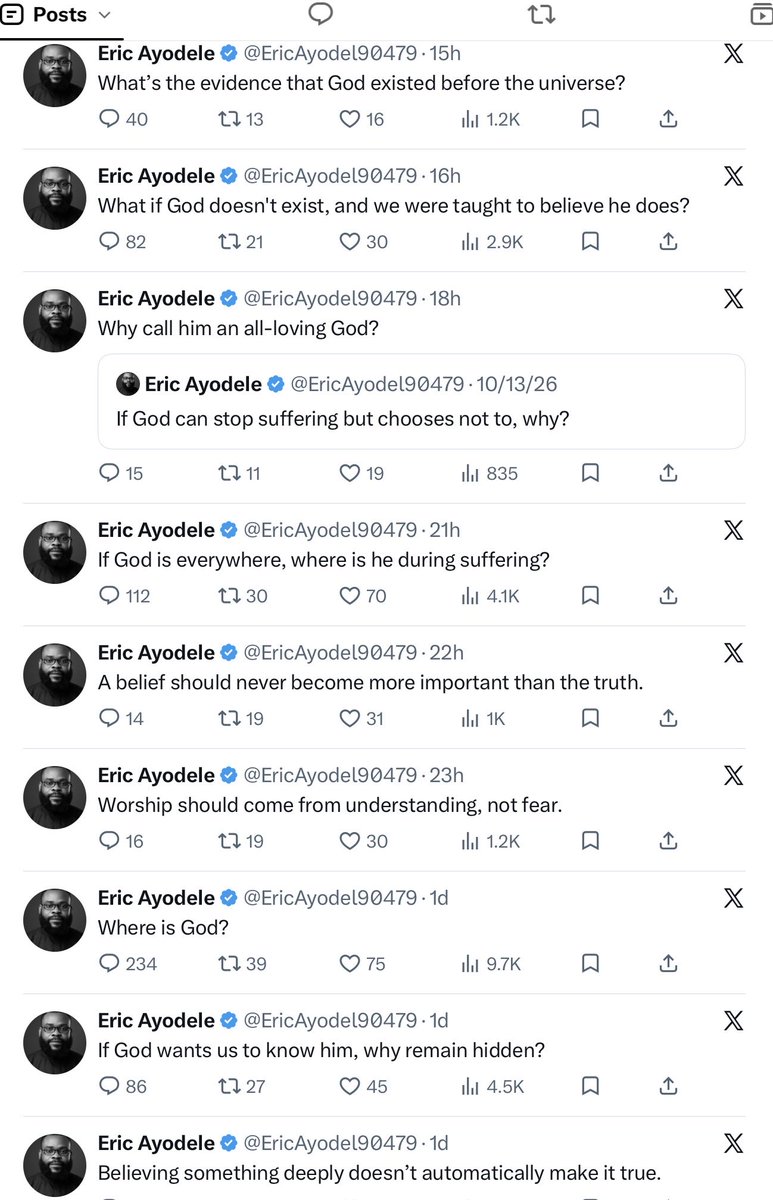
Before I answered this, I reviewed his previous posts. This is either someone seeking answers or someone seeking to disprove faith.
I have been on this journey before, until the day I defiantly stood outside the church, smoking my Marlboro cigarettes while waiting for my mother to give me food after Catholic Mass at school, and I heard Isaiah 55:8-9 being read.
First, God does NOT “need” worship. Humans need the sacrifice of worship as a reminder of grace. You can exist in life without faith without being punished for it, and still be used as an instrument by God to bring grace to others. My co-founder was an agnostic, but one of the best humans I ever met.
Faith is a private journey. It is sometimes lonely even in the midst of a multitude. Not everyone who claims to worship has faith; many have fear. I still remember a statement Chris Rock made once: believing in God while not going to church is evidence of more faith than that of others who go out of fear.
I have seen evidence in my life many times over that God exists, as I have been in the most desperate situations, asked earnestly, and then received answers. I have also received answers to burning questions outside of desperation and in abundance. My promise after my encounters of faith has been a covenant of worship and witness to God’s grace.
My personal journey is not enough evidence; you must go for yourself to come to where I am and possibly surpass my faith. The evidence of the multitude isn't enough; it is just a beacon showing you there is a simpler answer out there. We can never know enough, but seeking that knowledge is part of the divine grace. Only the living can seek answers.