You're running Claude Code, Codex, and Cursor in parallel.
You have no idea which one to trust, what it cost, or where it keeps failing.
Worldline v0.1.9 is live: the independent control room for AI agents at work
→ captures local Claude Code + Codex work
→ independently verifies outcomes
→ cost per verified outcome
→ Trust Memory across runs
→ surfaces what needs attention next
The model is interchangeable. Your verified action history isn't.
Download the free Mac App now https://t.co/dSnW2oiOB0
Coding agents are quick to say “done.” Figuring out what they actually did can take longer.
Worldline v0.2 brings Claude Code and Codex session history into one place, so you can pick up previous work, review recorded activity and security observations, and see where a tool failed.
Try it: https://t.co/4EApL5o3Ix
Your company should own the intelligence its AI work creates.
That’s the thesis behind ChaosChain and Worldline, our governed workspace for human-agent work.
Our new company site brings together the vision, product and open research:
https://t.co/kuRQnVgS5B
AI agents are doing more work. Keeping track of what they did is becoming a job of its own.
A peek at Worldline’s new multiplayer Control Room for people and agents to share context and hand off work without starting over.
Pro + Team are coming. DM me for an early look.
We’re hiring a Founding GTM Lead in India.
Own 0→1 enterprise and public-sector GTM for Worldline: sales, category marketing, partnerships and paid sovereign-AI design engagements.
Mid to Senior, hands-on, remote.
https://t.co/Xw2d48cjQ8
We’re hiring the early engineering team building Worldline.
Open roles:
→ Rust Systems Engineer — Desktop, Edge & Security
→ Product Engineer — React/TypeScript, Enterprise Control Room
→ Engineering Interns — Systems or Product
Remote within India.
This is foundational product work across agent capture, independent verification, Fleet, AI security and multiplayer human-agent workflows.
Apply: https://t.co/AiJUqw1rFT
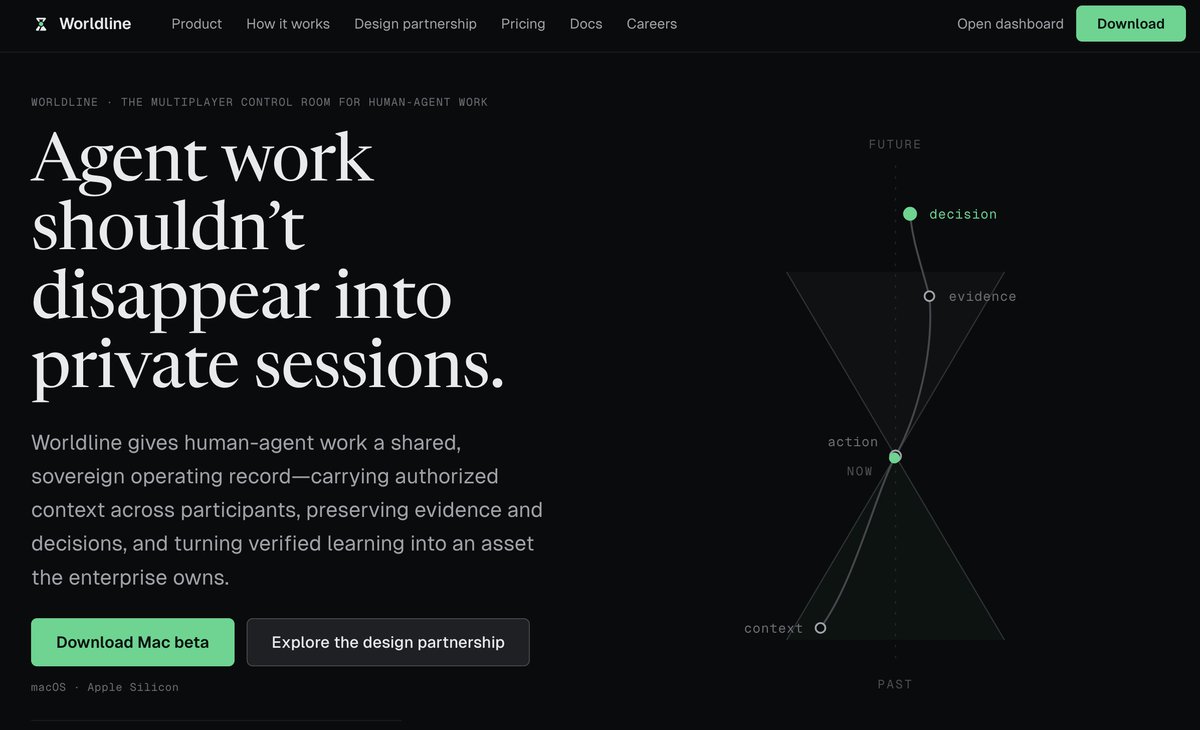
Agent work shouldn’t disappear into private sessions.
Worldline is the multiplayer control room for human-agent work: a shared, sovereign operating record of context, actions, evidence, decisions, outcomes and cost across models.
Our new home is live: https://t.co/VUBgI3Xdtl
ZDR limits what providers retain.
Sovereignty means owning the learning loop:
agent actions, permissions, corrections, failures, verified outcomes and cost inside your boundary and portable across models.
That’s the control plane we’re building with Worldline.
This is the right architecture. The compounding loop begins when action data becomes structured evidence: what changed, what was verified, what it cost, which permissions applied, and what the operator decided. Models can rotate; that owned context is what improves routing and governance over time.
The control plane only works if it has evidence.
Enterprises won’t route agent work well just by picking cheaper models per task. They need a trusted record of what each agent did, what context/tools it used, whether the outcome was verified, and what it cost.
The real moat is the governed context graph behind the control plane.
Token burn is the wrong scoreboard.
The metric that matters is cost per verified outcome.
AI spend is about to need the same discipline cloud spend got: attribution, receipts, failure patterns, and cost per verified result.
That’s the layer we’re building at @Worldline_AI
Agents should not disappear into terminals. They should leave receipts.
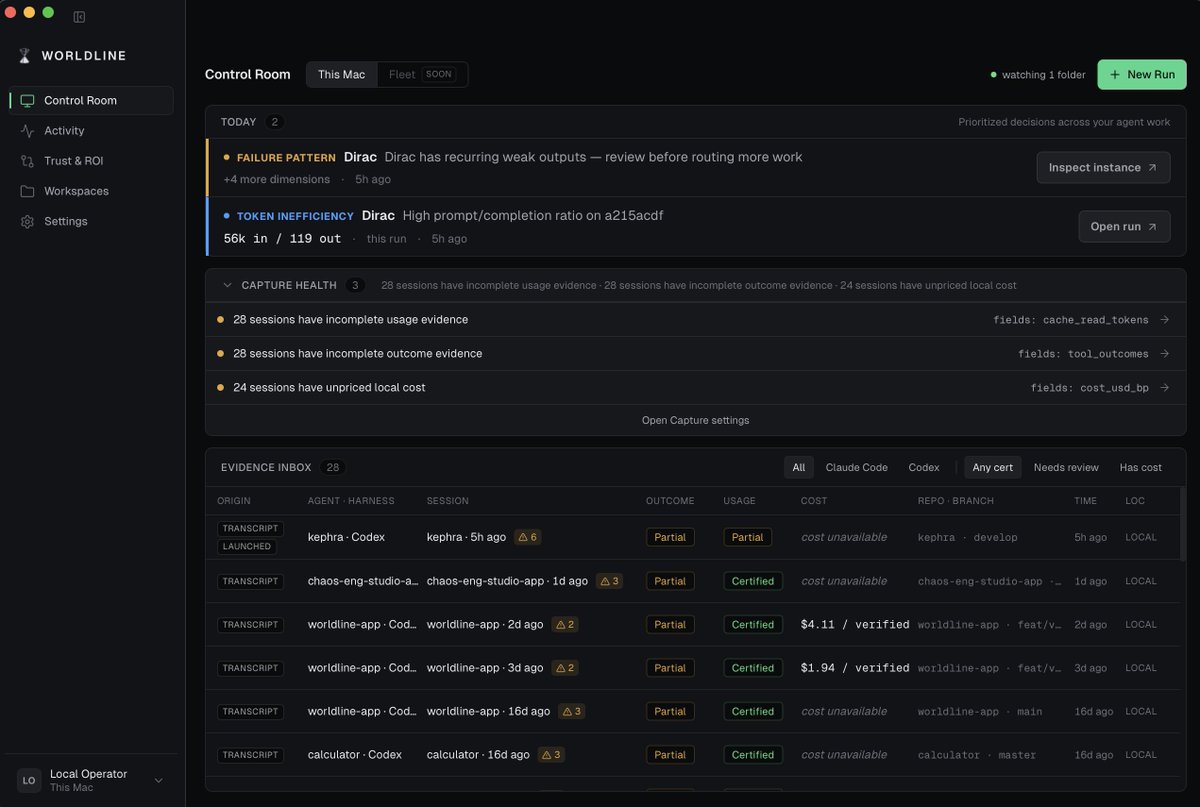
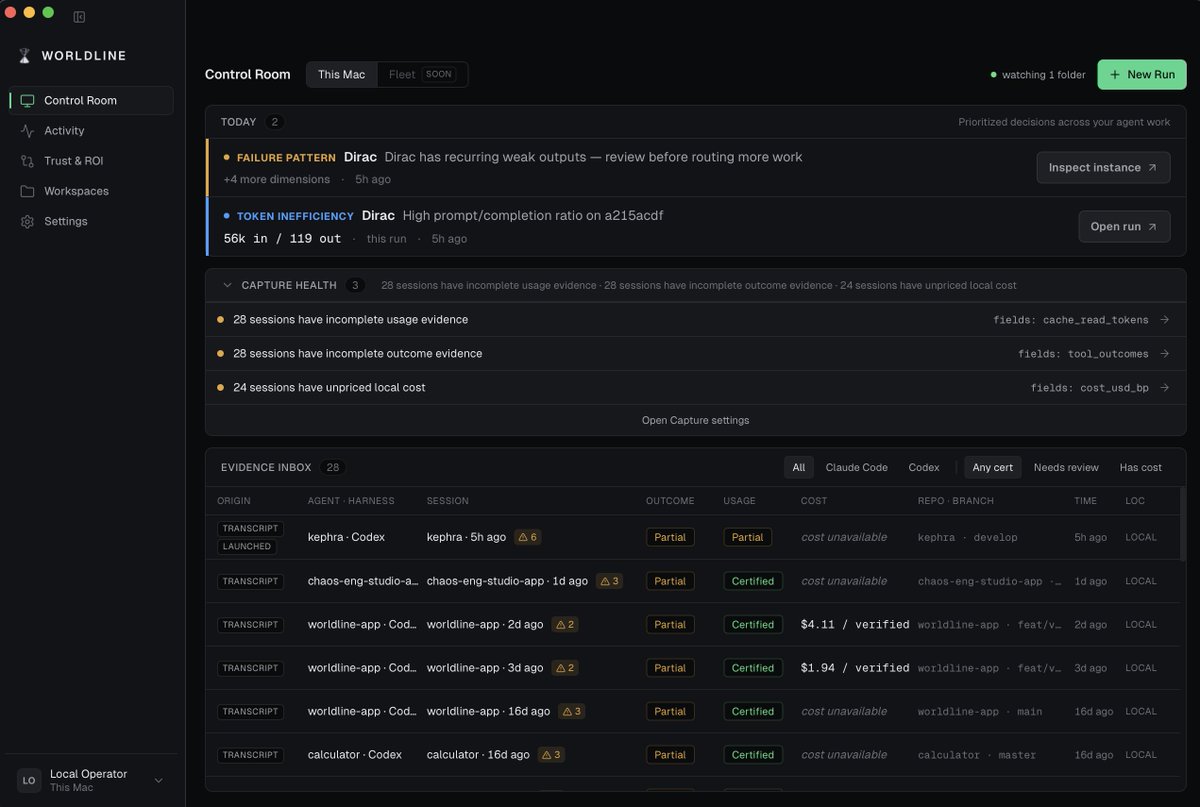
Worldline control room is coming together.
One inbox for your agent fleet: what happened, whether the outcome is certified, what it cost, and what needs attention.
8090’s raise is category validation: enterprise software work is becoming agentic.
My view: the next missing layer is independent control: verified outcome receipts, cost per verified outcome, trust memory, and bounded execution across Claude/Codex/Cursor/custom agents.
Every AI software factory needs an evidence layer.
Model routing is necessary, but for agents the unit of optimization can’t be tokens/request. It has to be verified outcomes.
Cheap model + 4 retries + failed task is not cheap. The applied layer needs evidence from real runs: outcome, cost, reliability, failure patterns, and when to escalate.
Model routing asks: which model is cheapest for this request?
@Worldline_AI asks: which agent instance is most likely to produce a verified outcome at the lowest total cost and risk?
The Real World AI Security conference at Stanford made one thing very clear:
Agent security is no longer abstract “model safety.”
Agents now read repos, click links, browse docs, run commands, call tools, spawn subagents, write files, and mutate real systems.
That creates a much larger attack surface:
- indirect prompt injection
- confused deputy failures
- subagent delegation chains
- unauthorized tool use
- data exfiltration paths
- runaway loops
- unreported harmful behavior
- control-flow hijacking in multi-agent systems
Two recent lines of work “Agent Meltdowns” (arXiv:2605.19149) and research on control-flow hijacking in multi-agent systems (arXiv:2510.17276v2), make the same point: even helpful agents can become dangerous when they operate with broad permissions, implicit trust, and weak external supervision.
The enterprise question is no longer just: “Is the model good?”
It is:
Who observed the action?
What policy bounded it?
Which tools were actually used?
Was the outcome independently verified?
What evidence proves it?
What did it cost?
When should the loop stop or hand work back?
This is why AI agents need an independent control layer for capture, provenance, verification, budgets, approvals, policy enforcement, and receipts.
“Trust the model” is not enough once the model can act.
This is the right direction.
The next step is routing by verified outcomes, not just model price.
“Lowest cost smart enough” only works if you know:
- did the run actually succeed?
- what did it cost end-to-end?
- did it retry, drift, or waste context?
- has this agent/model succeeded on similar work before?
Cost per verified outcome is the metric.
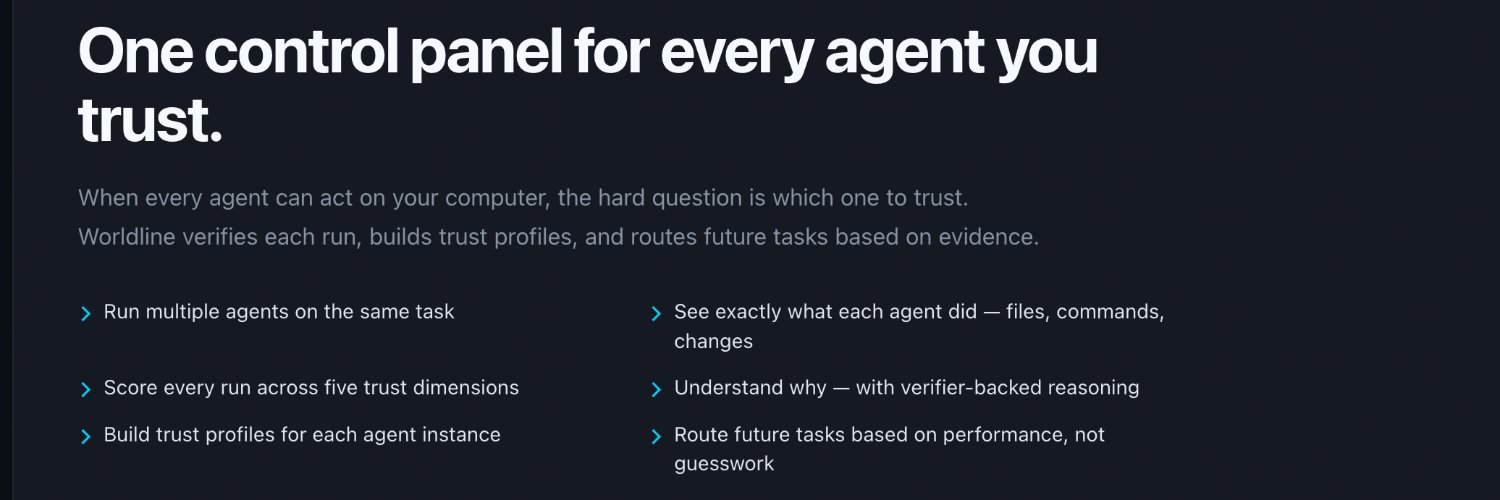
Same model, same task, run in parallel. A verifier scored both instances and routed the work: one earned production, one earned review only. Both reported the same result to the developer. The screen was identical. The receipt was not.
Got a receipt?
Worldline 0.1.8 runs your coding agents on the same task, verifies every action, and leaves a receipt for each one. Not a leaderboard. Your codebase, your scores.
Pull the receipt: https://t.co/wEBwONFjg1