BREAKING: China acquired +40 tonnes of gold in June via the London OTC market, marking their 2nd-largest monthly purchase since early 2025.
This is 167% more than the official +15 tonnes reported by China's central bank for June.
This also follows an estimated +48 tonnes acquired through the OTC market in May, +380% above the +10 tonnes officially reported by the central bank.
Meanwhile, China’s central bank officially added another +20 tonnes of gold in July, its largest monthly purchase since October 2023.
Year-to-date, China has officially increased its gold reserves by +60 tonnes, bringing total holdings to a record 2,366 tonnes.
Therefore, China acquired an estimated +88 tonnes of gold through the OTC market in just May and June, more than the amount officially reported for the entire year so far.
China is buying far more gold than their official data shows.
🔴Korean retail investors have been crushed:
Margin debt in South Korea is down to $19 billion, the lowest since the start of 2026.
Margin finance outstanding has dropped -$6 billion, or -27%, in a matter of weeks.
Furthermore, brokerage receivables, representing money owed to brokers by clients, have followed a similar path, falling back to around $0.6 billion in early August from a June peak near $1.2 billion.
Meanwhile, the liquidated amount-to-receivables ratio, which measures the share of brokerage receivables being forcibly liquidated each day, spiked as high as ~7% in June and ~5% in July, nearly 5-7 times its pre-boom baseline of roughly 1%.
The ratio repeatedly spiked throughout the summer as the single-stock leveraged ETF boom triggered waves of margin calls, before easing back toward its baseline in recent weeks.
As a result, ~1 trillion won, or $710 million, of retail investors’ positions were forcibly liquidated in June, followed by another 993 billion won, or $700 million, in July. These were the two largest monthly forced liquidation totals in South Korea in 2026.
The leverage party in Korea ended in tears.
황희가 목동 6단지에 산다더라.
20평형대가 30억, 30평형대는 40억을 호가하는 아파트임. 심지어 현재 목동 일대에서 재건축 속도가 가장 빠른 단지로 꼽히는 곳.
본인은 이런 노른자 땅 위에 발 딛고 서서, 정작 남의 집 자식들한테는 폐버스에 들어가 살라는 얘기를 아무렇지 않게 내뱉음.
현실성부터 따져보자. 폐버스에서 쏟아지는 하수와 오수는 대체 어떻게 처리할 셈인가.
상하수도 배관 하나 제대로 물릴 수 없는 고철 덩어리에 사람을 밀어넣겠다는 발상 자체가 기본적인 설계조차 안 된 것임.
단세포 생물도 이보다는 앞뒤를 재고 움직일 것 같은데, 어떻게 이런 아이디어가 공식 석상에서 나오는지 도무지 이해가 안 감.
더 근본적인 문제는 그 머릿속에서 나온 발상이 곧 악이라는 점. 청년의 삶과는 철저히 유리되고 괴리된 감각.
자기는 40억짜리 아파트에 살면서 남의 자식은 폐버스에 처넣겠다는 그 무신경함이야말로 지금 청년 세대가 느끼는 박탈감의 실체.
주거는 인간 존엄의 최소 조건인데, 그걸 고물 버스로 때우라는 건 사실상 60년대로 시계를 되돌리자는 소리 아닌가.
반세기 넘게 쌓아 올린 삶의 기준을 이렇게 손쉽게 후려치는 발상, 진심으로 부끄러운 줄 알아야 함.
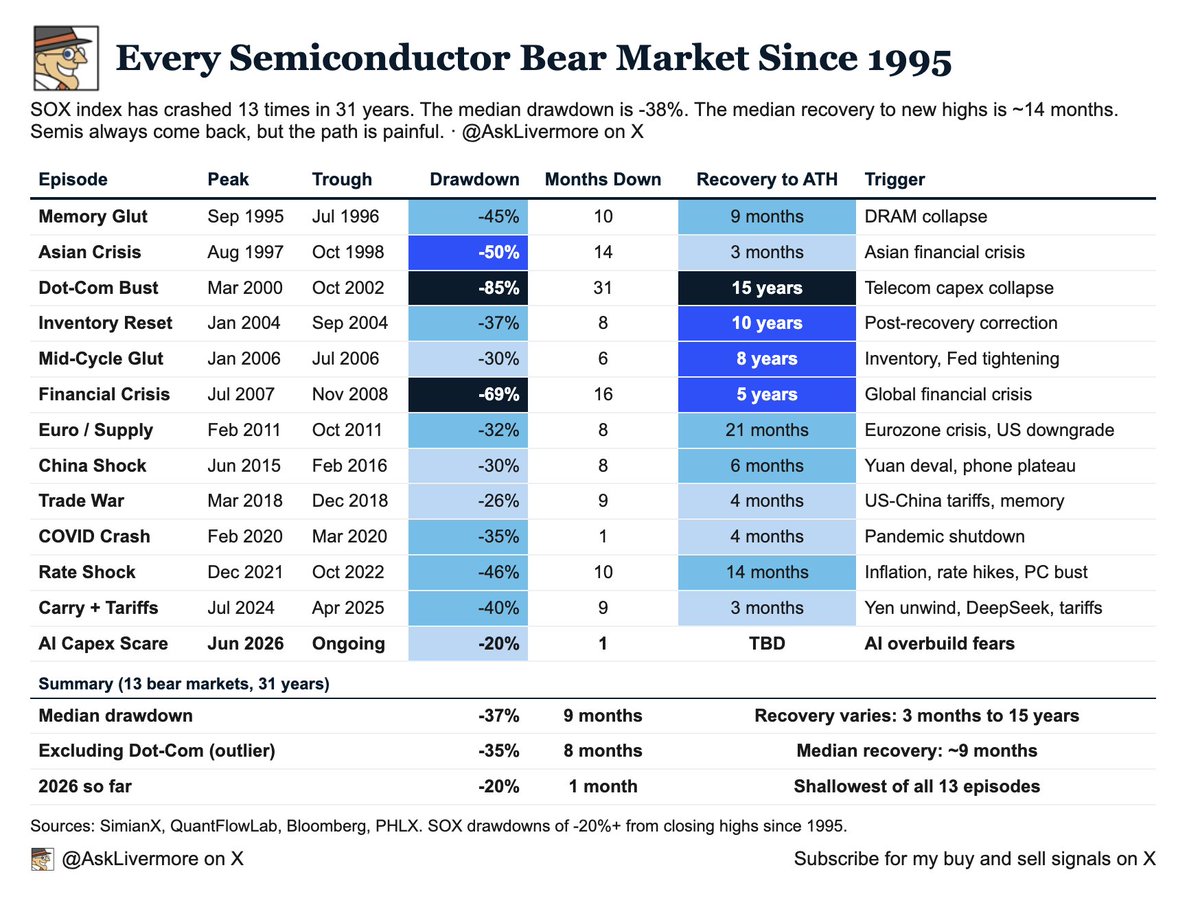
Semiconductors entered their 13th bear market in 31 years last month.
That is once every 2.4 years. This is not unusual. This is what semis do.
Here is every $SOX crash since 1995 and how long it took to recover:
• Asian Crisis: -50%, recovered in 3 months
• Trade War 2018: -26%, recovered in 4 months
• COVID 2020: -35%, recovered in 4 months
• China Shock 2015: -30%, recovered in 6 months
• Memory Glut 1995: -45%, recovered in 9 months
• Rate Shock 2022: -46%, recovered in 14 months
• Carry + Tariffs 2024: -40%, recovered in 3 months
• 2026 so far: -20%. The shallowest of all 13 episodes.
The median semi bear market drops 37% and lasts 9 months. We are at -20% and 1 month in. The most recent crashes(2018, 2020, 2024) all recovered in 3-4 months.
The only one that did not recover quickly was the Dot-Com bust. That took 15 years. But that was an -85% collapse with zero earnings behind it.
Today semis have record revenue, record margins, and every company on earth is buying chips for AI.
Semis crash. Then they come back. Every single time, in a few months.
한국 사람들은 돈에 왜그렇게 집착이 심한지 물어보는 글
특히 이런 사람들이 유독 서울에 많이 보임
그리고 일상생활이 너무 단조롭고 인구밀도 높음
시선이 다른 곳으로 분산되어야하는데 개인간 물리적 거리가
너무 가까워서 서로 비교하고 간섭하는게 자연스러워졌다고 함
매우 공감한다
월드컵 기간 중에 프로축구연맹이 21개 구단 데리고 해외 시찰(놀러) 다녀왔고 무려 7억원썼음ㅅㅂ
왜 데려갔냐? 바로 이들이 투표권이 있기 때문에
192명 중 K리그1,2 구단 대표들이 많고
축구는 승강제가 있기 때문에 언제든 1부에 갈 수 있음 결국 언제든 표를 줄 수 있는 잠재고객들이라서ㅋㅋㅋ
이러니깐 축구혁신위원회가 선거인단을 고인물 소수들이 아닌 1만명으로 늘리려고 하는거엿음 하.....
Morgan Stanley projects $MU gross margins could reach 90% in 2027 supported by 16 supply agreements with floor pricing and HBM sold out through 2027.
That contracted structure combined with a mix shift toward higher-margin HBM and data-center memory should structurally lift company-wide profitability while advanced packaging remains a huge chokepoint.
Also important to call out that HBM4 for $NVDA Vera Rubin platform began shipping in March 2026 and is ramping at roughly twice the pace of HBM3E 12-high scaling Micron’s highest-margin product into its strongest demand platform.
$MU Morgan Stanley just dropped a nuclear bull case.
Morgan Stanley is projecting Micron will print around $400 billion in combined non-GAAP operating income across 2026 and 2027. That is nearly 40% of the current market cap. Let that sink in.
Here are the numbers straight from their model:
- CY2026 Revenue: $172.9B (massive growth)
- Operating Income: $140.7B (81.4% margin)
- CY2027 Revenue: $285.9B (+65%)
- Operating Income: $248.7B (87.0% margin)
Gross margins are modeled at 85% to 89.5%. Yes, you read that right. In memory chips.
It is driven by explosive AI demand for HBM (High Bandwidth Memory). Micron is scaling fast alongside partners. The entire industry is riding the AI infrastructure wave. Memory is the critical bottleneck everyone needs more of.
Of course, nothing is guaranteed. Execution risk, competition from Samsung and SK Hynix, potential cycles, and macro shocks are real.
But when a top bank models 80%+ operating margins on triple-digit billions in revenue, the upside case is absurd.
Memory has always been cyclical. The difference this cycle? Structural AI demand that did not exist before. If Micron delivers even 70% of these numbers, the stock has plenty of room to run.
Position sizing, risk management, and your own due diligence still rule. But the setup is one of the most compelling in semis right now.
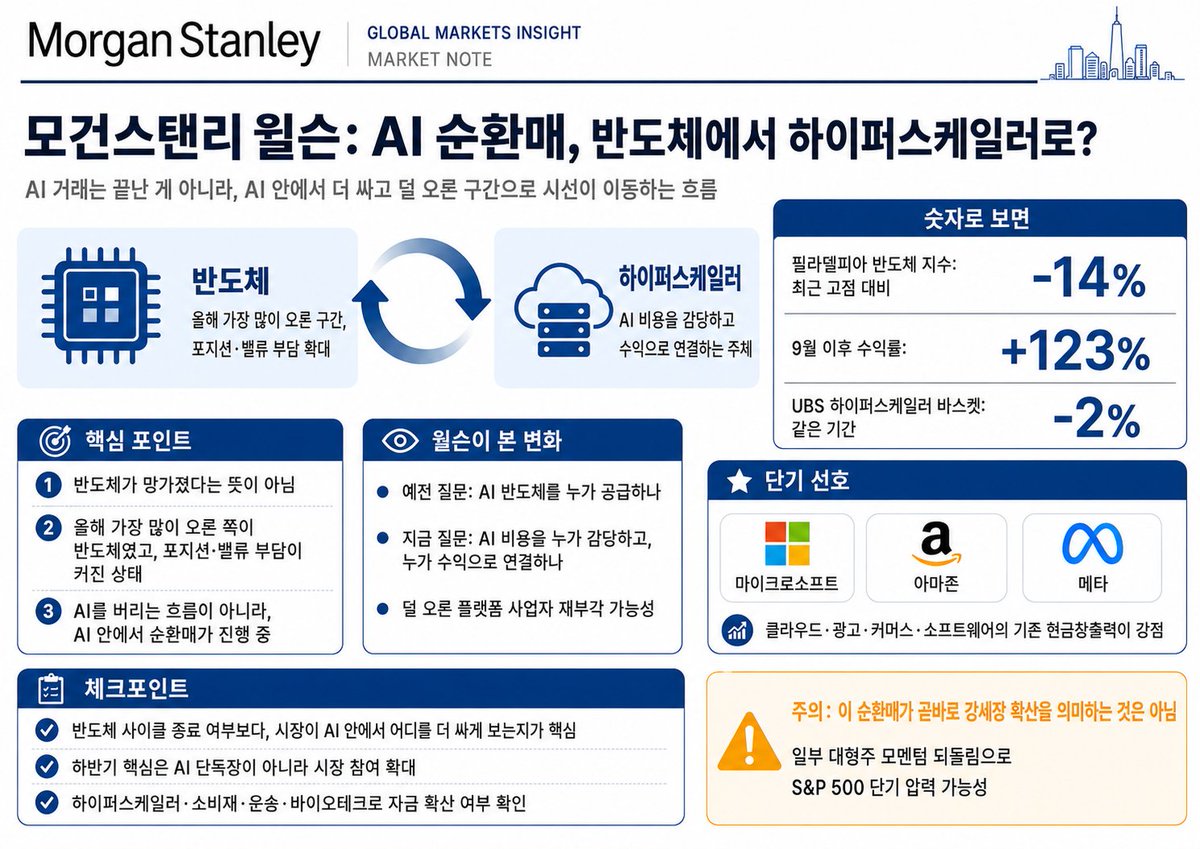
모건스탠리의 윌슨은 AI 랠리의 다음 순환매가 반도체에서 하이퍼스케일러로 옮겨갈 수 있다고 보고있다.
핵심은 반도체가 망가졌다는 얘기가 아니다.
올해 가장 많이 오른 쪽이 반도체였고, 그만큼 포지션과 밸류에이션 부담도 커졌다는 뜻이다.
필라델피아 반도체 지수는 최근 고점 대비 약 14% 빠졌지만, 9월 이후로는 여전히 123% 오른 상태다.
반면 UBS 하이퍼스케일러 바스켓은 같은 기간 오히려 2% 하락했다.
즉 시장은 AI를 버리는 게 아니라, AI 안에서 “이미 너무 오른 병목주”에서 “덜 오른 플랫폼 사업자”로 시선을 옮기고 있는 흐름에 가깝다.
윌슨이 단기적으로 선호한 쪽은 마이크로소프트, 아마존, 메타 같은 하이퍼스케일러다.
이들은 AI 투자 부담이 있지만, 동시에 클라우드, 광고, 커머스, 소프트웨어 같은 기존 핵심 사업의 현금창출력이 강하다.
그래서 시장이 “AI 반도체 수요가 얼마나 더 강한가”보다 “AI 투자를 감당할 수 있는 회사가 누구인가”를 보기 시작하면 하이퍼스케일러가 다시 부각될 수 있다.
다만 이 순환매가 무조건 강세장 확산을 의미하는 건 아니다.
윌슨도 일부 대형주 모멘텀 되돌림 때문에 S&P 500은 단기 압력을 받을 수 있다고 봤다.
정리하면 이렇다.
AI 거래는 끝난 게 아니다.
다만 시장의 질문이 바뀌고 있다.
전에는 “AI 반도체를 누가 공급하나”였다면,
이제는 “AI 비용을 누가 감당하고, 누가 실제 수익으로 연결하나”로 넘어가는 중이다.
그래서 하반기 핵심은 AI 단독장이 아니라 시장 참여 확대다.
반도체에서 일부 차익실현이 나오고, 하이퍼스케일러, 소비재, 운송, 바이오테크 등으로 돈이 퍼지는지 확인해야 한다.
여기서 진짜 중요한 건 하나다.
반도체 사이클이 끝났는지가 아니라, 시장이 AI 안에서 어떤 구간을 더 싸게 보고 있는가다.