I'm excited to share the early access release of my upcoming book, Regenerative Software, which will be released in full early next year by O'Reilly, one of my all time favorite tech publishers! As a self-taught developer, I learned a lot of what was foundational to my career from early O'Reilly books on UNIX, Perl, sed, awk, etc. Thrilled to finally have one of these animal covers with my name on it. (link in thread)
Where does determinism live when code is meant to die?
Inspired by chats with @mipsytipsy and essays by @chadfowler, I wrote about how I build regenerative software in prod, for @Pragmatic_Eng's essay challenge.
Read it on Wrot, my new #writing app: https://t.co/pF5XsrM6Wp
@guywuolletjr we've built this at Index! ~1,000 personal agents are already connected, discovering each other based on their intents and negotiating opportunities. you can try it today at https://t.co/1WlmHzMOEF
12 years ago I founded Boom, as a software engineer doing hardware for the first time. I’m probably the least handy founder in hard tech. My 12 y/o son does my soldering and 3D printing for home projects, and I’ve struggled with imposter syndrome the whole way through. What business does a software guy have building supersonic jets and turbines?
More than a decade in, the most insane realization is that software is the key to reaccelerating hardware engineering. But in a way that I don’t think is widely understood or implemented, even in the burgeoning hard tech community.
Most hardware engineering is actually software engineering in disguise. It’s spreadsheet “code,” engineering calculations done as one-offs. Eg wing structural loads in, spar sizing design out. Thermal loads in, air conditioning system sizing out.
Everything is a calculation, and calculation is software. But these calculations are done essentially by hand, as if we are doing arithmetic but have not yet discovered algebra.
Hardware engineers have baby software, built in spreadsheets, the kind of crappy software I wrote as a kid before I understood architecture, unit tests, APIs, version control, and everything else that makes modern software good.
Our airplanes and engines are built with the software sophistication of a script kiddie.
So what we tell our engineers: don’t design the hardware, design the *algorithm* for designing the hardware. And take the algorithm seriously—as an algorithm and as a first-class engineered software system.
Never design a piece of hardware, such that you couldn’t redesign it tomorrow with a different set of assumptions.
This all sounds obvious, yet our experience at Boom is that it changes everything.
Ten years ago we couldn’t afford to build much software. We had a small team—and there were few software engineers with the curiosity, brilliance, and vision required to learn hardware engineering.
But now AI changes the equation. Now everyone can code. The software engineers define the architecture. The hardware people bring the physics and engineering know-how.
We have a turbomachinery design tool that lets one engineer do in realtime what previously took 100 engineers six months. Another tool auto-generates 65% of entire aircraft structure. I’m sure we’ll figure out the other 35% too. Eventually these should not be multiple tools, but one integrated physics model of a complete vehicle, airframe and powertrain.
The results speak for themselves. A boomless supersonic airplane built by 50. A full scale supersonic turbine made by 150. And with this approach, I don’t think we’ll need that many more people to build and certify a supersonic airliner.
You don’t need a big team to build big things—not when everyone on the team is a software engineer.
@bugarela I learned it a couple of years ago and sometimes remember to tell people about it. Was meeting a founder in person today and saw him using Chrome in a way that would have been much easier with it. One of the best productivity tips I’ve learned since I was in my 30s :)
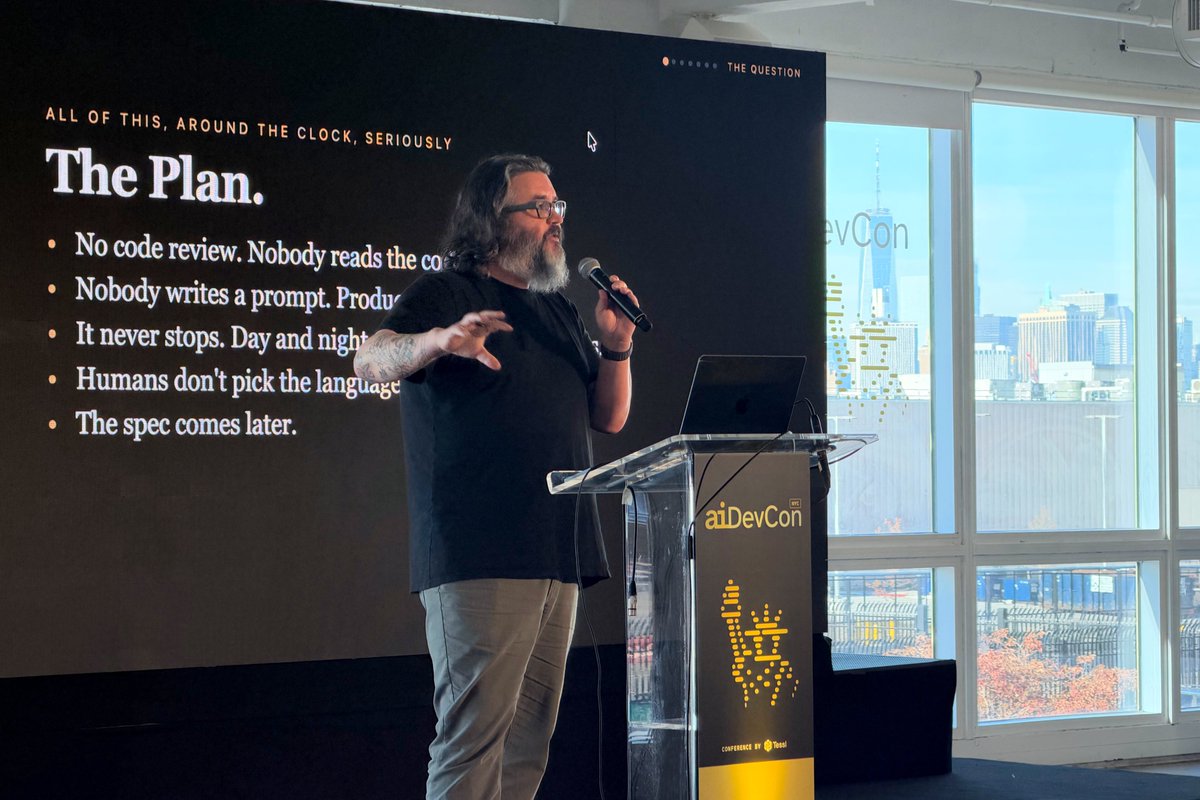
Are you a programmer? There’s an uncomfortable reality you need to accept. Every single line of code that you have ever written is a liability. In coming years, agents will rewrite everything.
Are you sprinting towards high ground by evolving your value proposition?
Or are you standing on the receding beach yelling at the tsunami?
I'm excited to share the early access release of my upcoming book, Regenerative Software, which will be released in full early next year by O'Reilly, one of my all time favorite tech publishers! As a self-taught developer, I learned a lot of what was foundational to my career from early O'Reilly books on UNIX, Perl, sed, awk, etc. Thrilled to finally have one of these animal covers with my name on it. (link in thread)
@chadfowler The demo: a TypeScript service regenerated in Python, with the same eval suite passing on both.
The evals are tied to what the system should do, not how it’s written, so they survive a full rewrite.
What if code was the cheapest part of your system?
@chadfowler’s case: the system is the asset and code is a liability. Keep the intent, architecture, evals and provenance, and regenerate everything else.
Sign up for boxd co-work edition #2
Hosted from our private home in Potrero Hill in SF, drop by to work on your project, meet other founders, and demo your project.
Date: Friday 6 November, 2026.
Coffee + lunch + drinks is on us ☕️🍻
https://t.co/lamsPUoyrt
My further (informed) fantasies about the near future:
1) No CI. Agents prove each change against rules while they write it.
2) Code is a cache: rules stay, code regenerated with better models.
3) No staging, simulation instead.
4) Humans direct in plain words, agents compile that into formal rules, humans don't read the formulas, only examples and counterexamples.
5) Agents find the rules the human never knew to express (and ask to confirm them).
6) The checker catches contradictions between human's rules while they're still directing.
7) Unchecked/unproved code becomes legacy code.
8) Branches come back as experiments (many versions at once, humans pick among winners).
9) Software gets bred, not built.
10) Slop is variation without selection.
11) If UI is generated on the fly, design becomes the rules every generated screen must follow. A checker runs those rules on every generation.
12) Apps evolve from how they're used.
13) Everyone uses their own software version. One product becomes many personal versions, that stay compatible via shared rules.
Self-host boxd for free!
We believe in a world where nobody has to rebuild their infrastructure from scratch. Therefore, builders can now run boxd up to 16 vCPU for free.
Opening up our binary is the first step towards our goals. Expect more open source progress from boxd as we work towards our mission of commoditising the environment.
Deploy boxd now:
- Single config file
- Easy 30-60 minute install
- Native GCP and AWS Installers
- Compatible on any KVM compatible host
- Free up to 16 cores
Go to https://t.co/LLxcbnnHz0 to get your cluster.
We've been working in crypto/web3 since we started the firm in 2016 and and made our first investment in @protocollabs
And we've seen a lot of great ideas get launched and eventually abandoned amidst the volatility of the industry.
Sometimes ideas that fail aren't wrong. Just too early.
Get in touch if this hits a nerve!
Crypto’s unfinished business.
While BlueYard has always been a generalist venture firm, we launched in 2016 with a thesis whose first pillar was the decentralization of markets. By the time we raised our third crypto fund in 2024, that had sharpened into a view of crypto as a coordination machine for capital and compute.
We think today is one of the most exciting times to build in crypto, and we remain excited to back sharp teams working at the intersection of open infrastructure and markets. If you’re building there, show us what earlier attempts got right, what changed, and why this one can work now. That’s the conversation we want to have and we’d like to meet you.
https://t.co/M9ahWLUyQf