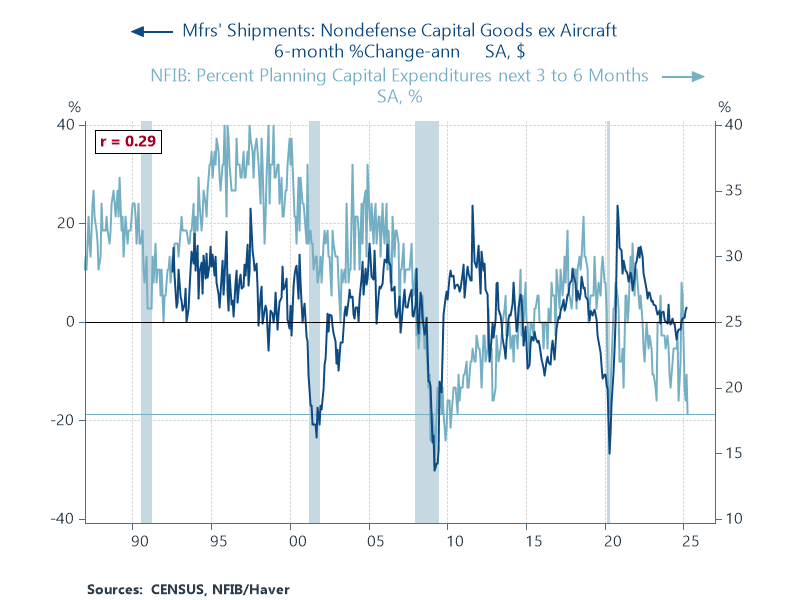
Small business capital spending intentions have tumbled, a bad sign for future business investment. According to NFIB, net percent of small firms planning capital expenditures over the next 3 to 6 months slid to just 18 in April, matching the pandemic low.
Thank you Emmy for showering me with 4,000 Diamonds and getting me to shamelessly tweet this out. If you've collected Ordinals, head to https://t.co/PjaafuXVvo to claim your taste of Diamonds on the best cross-chain rewards program.
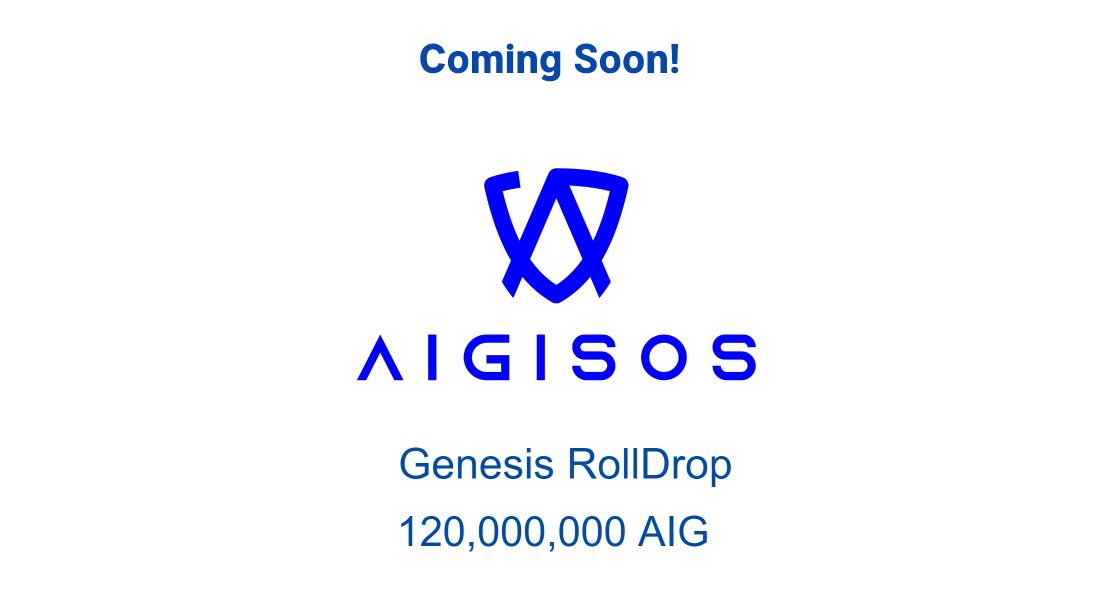
Aigisos $AIG Genesis RollDrop coming soon!🪂
@aigisos will allocate 12% of $AIG supply to $DYM stakers via Genesis RollDrop (Total Supply: 1B $AIG)
Claim Page: https://t.co/RlYOFm21Gi
About Aigisos:
Aigisos is a RollApp blockchain built on Dymesion with a parallel secure chain and a novel consensus algorithm.
I was invited to the Family & Friends Test of the highly anticipated MapleStory N.
Here's the alpha.
• Players can financially PvP each other (I like this a lot)
• PvP for items through PvE
• Duo combo of on-chain/off-chain assets & currency(ies)
• UI/UX for in-game asset trading is designed for Web3 (imagine your OpenSea/Blur vibes)
• I can imagine the TradingView charts for the in-game assets
• MapleStory Universe is reigniting the golden era of MMORPG
------
Let's dive a little deeper.
MapleStory may be an "MMORPG" but the gameplay effectively devolved into an "MMO-singleplayerRPG" -- the days of the party quests and guild raids have passed.
The social interaction and multiplayer gameplay were eroded over time due to the genre falling out of flavor and content compression. We see these across multiple MMORPG titles like Eve, WoW, etc.
MapleStory N reignites the "coopetitive" dynamism, putting the 'MMO' back into MMORPG.
------
How did the MapleStory Universe team do this?
According to the presentation by Keith (Head of Strategy) at GDC last month, the idea is to inject real-life economic principles into the base layer of the game while indexing on RX (Reward Experience).
The most basic economic tenet is supply and demand. But this isn't novel or new to Maplers. For the OGs reading this, you remember the 10-att work glove being extremely expensive because the supply was low but the demand was infinite. So what's different this time?
True scarcity and actual monetary PvP.
Sticking with our work glove example, not only would the work glove supply be limited but also, more importantly, the price of item enhancement is market-driven, meaning my enhancement attempts would take away from other players and vice versa.
This aspect makes the game exhilarating and electric. Trust me, I played it.
[Quick Reminder: RX is that butterfly feeling you get when acquiring the weapon that you grinded 69 hours for, or hitting that 0.0001% chance stat upgrade on your gear.]
------
Point 1: Limited Quantity & Special Item Hunting Fields
Balancing item-utility-weighted distribution combined with relative demand (class-specific items vs. general-use items)
+
A finite number of items is distributed over a discrete time (e.g. 100-item limit, 10 items distributed per week for 10 weeks).
The distribution of these items is based on the number of players and the utility (how many levels would this item be useful for and how many types of players could use it).
I experienced this system first-hand during my playtest. Compared to the Web2 MapleStory, the grind was real and the drop rate was tough. It brought me back to the OG 2005-era MapleStory.
Throughout the playtest, I had to weigh my options because of my limited resources (time and Neso). Do I hunt special items to sell for Neso or focus on grinding for levels?
The game designers carefully crafted this tradeoff. There are special hunting fields (aka maps) where special items are dropped. But the EXP and kill rates are subpar because they are too big, have too many platforms, etc.
The "normal" maps that do not offer special item rewards tend to have better EXP and kill rates. Thus allowing users to level up faster.
Players must choose between competing in crowded maps to acquire items or gaining EXP efficiently to level up. This is not the same in the Web2 version.
The motivation for speculation is much more enticing in MapleStory Universe because users could sell the item for IRL profit. Prioritizing leveling up comes with a real opportunity cost.
Game designers could conduct live ops to pit these two conflicting goals against each other to force players to choose a tradeoff (eg running a Double EXP event, which they did at the end of the Play Test!).
Additionally, this interaction introduces PvP through PvE; If Player B is stronger and has larger attack areas, they could commandeer Player A's special hunting field.
If the reward items are worth real money, then Player A would call for reinforcement from their Guild to attempt to regain control of the map -- reincorporating that social bonding in the game.
Interestingly, the game's core loop is indistinguishable from the Web2 version but these economical, financial, and social meta-layers add dimensions to MapleStory Universe.
TLDR;
• Fixed quantity of the item is distributed over discrete time and only from the specified map(s)
• Honey Pot Effect: If the item wasn't fully distributed over a set time, the drop rate doubles for the next time window, tripling afterward.
• Item distribution balanced by utility and usability
• PvP through PvE
-----
Point 2: Financial PvP in Item Enhancement
Acquiring the item from the special maps mentioned above is only a tiny fraction of the gameplay. The item enhancements and trading are the core of the experience.
This was the MOST exciting part for me. This made the game feel alive, like trading the markets.
Keith talked about the different tiers of items in his GDC presentation.
• Local Items = Infinite quantity but non-tradable and non-upgradable
• Unchained (Pre-NFT) Items = Finite Items before minted as NFTs
• NFT Items = Tradable, Upgradable, and Finite.
The demand-driven pricing for item upgrades adds a new resource. This resource is purchasable with Neso but the price fluctuates with demand. Price starts at a low price and then increases based on the demand count, after which it'll decrease by a preset percentage per minute until another player presses the enhance button.
On the last day of testing, I knew that the resource's price would be less in the morning but would skyrocket by the afternoon. Why? Because there was a DOUBLE EXP event and everyone wanted to grind for levels instead of upgrading their gear.
This was an opportunity.
I told my fellow tester to capitalize on this resource because the enhancements are priced at or near zero. So my group managed to get our items to a high rank with great stats.
Then in the afternoon when the game test was concluding, as expected, everyone tried to spend all their Neso and I saw the resource's price surge to astronomical highs. Seeing THAT play out as I predicted was exciting af.
The feeling of spotting an inefficiency in the market and being able to seize it. This freshness in the gameplay makes me so bullish on MapleStory Universe.
TLDR;
• Item Enhancement is driven by a demand-based price curve
• Price starts at a low point and then increases with each demand count
• Price decreases by a certain percentage over a set time until the next player presses the enhance button again
• This makes the game ALIVE, just like the markets
-----
One concern: onboarding new players.
I appreciated the in-game guide on interacting and using the blockchain, without mentioning "the blockchain". Nonetheless, the onboarding isn't friendly for new players.
Keith highlighted the learning curve issue in his presentation but I want to add more color to his point.
The majority of the tutorial consists of quests, which were long without feeling rewarding. MapleStory comes with two decades' worth of content so it's understandable that there's a lot to digest.
However, the game designer could cherry-pick the content to provide a tailored onboarding flow that exhibits the fun of MapleStory while highlighting the novel web3 elements.
The current introductory questing system is centered around the web2 gameplay. The importance and utility of each blockchain element weren't conveyed cogently, leading to player frustration.
Pleasantly, after Day 1, the usage of the blockchain functions became second nature and I played the game much more fluidly. This changed everything for Day 2. So the task is to instill that competency and confidence early in the user's journey.
But do not fear, the team is diligently working on delivering the most optimized approach to blending the content-rich world of MapleStory and the revolutionary blockchain technology.
After each day, the engineering team would work through the night to debug, optimize, and improve the game. Astounding dedication.
So I have full faith and belief that the team would deliver on this and MOAR.
-----
Special thanks to the MapleStory Universe team for inviting me to participate in the private playtest. I missed out on the Mark of the Beta Bandana in 2005 but now I can contribute to this new era of MapleStory.
Disclaimers: I am biased and even more so now that I've played the game.
ok, I got ChatGPT working with Additive Prompting
Here's a 1 paragraph ChatGPT prompt you can use to generate infinite interior design/architecture photographs w/ 90%+ coherence to the prompt in Midjourney
Full prompt w/ examples in thread. Try reading the prompts as you go
🧵
Look at Gaming #164 | Friday March 3rd 2023
🌤 Daily gaming news 🗞
Curated headlines across the web2 and web3 gaming industry. Keep up with the latest and greatest. Stay awhile and read.
Look at Gaming #157 | Wednesday February 22nd 2023
🌤 Daily gaming news 🗞
Curated headlines across the web2 and web3 gaming industry. Keep up with the latest and greatest. Stay awhile and read.


![0xkapital_k's tweet photo. I was invited to the Family & Friends Test of the highly anticipated MapleStory N.
Here's the alpha.
• Players can financially PvP each other (I like this a lot)
• PvP for items through PvE
• Duo combo of on-chain/off-chain assets & currency(ies)
• UI/UX for in-game asset trading is designed for Web3 (imagine your OpenSea/Blur vibes)
• I can imagine the TradingView charts for the in-game assets
• MapleStory Universe is reigniting the golden era of MMORPG
------
Let's dive a little deeper.
MapleStory may be an "MMORPG" but the gameplay effectively devolved into an "MMO-singleplayerRPG" -- the days of the party quests and guild raids have passed.
The social interaction and multiplayer gameplay were eroded over time due to the genre falling out of flavor and content compression. We see these across multiple MMORPG titles like Eve, WoW, etc.
MapleStory N reignites the "coopetitive" dynamism, putting the 'MMO' back into MMORPG.
------
How did the MapleStory Universe team do this?
According to the presentation by Keith (Head of Strategy) at GDC last month, the idea is to inject real-life economic principles into the base layer of the game while indexing on RX (Reward Experience).
The most basic economic tenet is supply and demand. But this isn't novel or new to Maplers. For the OGs reading this, you remember the 10-att work glove being extremely expensive because the supply was low but the demand was infinite. So what's different this time?
True scarcity and actual monetary PvP.
Sticking with our work glove example, not only would the work glove supply be limited but also, more importantly, the price of item enhancement is market-driven, meaning my enhancement attempts would take away from other players and vice versa.
This aspect makes the game exhilarating and electric. Trust me, I played it.
[Quick Reminder: RX is that butterfly feeling you get when acquiring the weapon that you grinded 69 hours for, or hitting that 0.0001% chance stat upgrade on your gear.]
------
Point 1: Limited Quantity & Special Item Hunting Fields
Balancing item-utility-weighted distribution combined with relative demand (class-specific items vs. general-use items)
+
A finite number of items is distributed over a discrete time (e.g. 100-item limit, 10 items distributed per week for 10 weeks).
The distribution of these items is based on the number of players and the utility (how many levels would this item be useful for and how many types of players could use it).
I experienced this system first-hand during my playtest. Compared to the Web2 MapleStory, the grind was real and the drop rate was tough. It brought me back to the OG 2005-era MapleStory.
Throughout the playtest, I had to weigh my options because of my limited resources (time and Neso). Do I hunt special items to sell for Neso or focus on grinding for levels?
The game designers carefully crafted this tradeoff. There are special hunting fields (aka maps) where special items are dropped. But the EXP and kill rates are subpar because they are too big, have too many platforms, etc.
The "normal" maps that do not offer special item rewards tend to have better EXP and kill rates. Thus allowing users to level up faster.
Players must choose between competing in crowded maps to acquire items or gaining EXP efficiently to level up. This is not the same in the Web2 version.
The motivation for speculation is much more enticing in MapleStory Universe because users could sell the item for IRL profit. Prioritizing leveling up comes with a real opportunity cost.
Game designers could conduct live ops to pit these two conflicting goals against each other to force players to choose a tradeoff (eg running a Double EXP event, which they did at the end of the Play Test!).
Additionally, this interaction introduces PvP through PvE; If Player B is stronger and has larger attack areas, they could commandeer Player A's special hunting field.
If the reward items are worth real money, then Player A would call for reinforcement from their Guild to attempt to regain control of the map -- reincorporating that social bonding in the game.
Interestingly, the game's core loop is indistinguishable from the Web2 version but these economical, financial, and social meta-layers add dimensions to MapleStory Universe.
TLDR;
• Fixed quantity of the item is distributed over discrete time and only from the specified map(s)
• Honey Pot Effect: If the item wasn't fully distributed over a set time, the drop rate doubles for the next time window, tripling afterward.
• Item distribution balanced by utility and usability
• PvP through PvE
-----
Point 2: Financial PvP in Item Enhancement
Acquiring the item from the special maps mentioned above is only a tiny fraction of the gameplay. The item enhancements and trading are the core of the experience.
This was the MOST exciting part for me. This made the game feel alive, like trading the markets.
Keith talked about the different tiers of items in his GDC presentation.
• Local Items = Infinite quantity but non-tradable and non-upgradable
• Unchained (Pre-NFT) Items = Finite Items before minted as NFTs
• NFT Items = Tradable, Upgradable, and Finite.
The demand-driven pricing for item upgrades adds a new resource. This resource is purchasable with Neso but the price fluctuates with demand. Price starts at a low price and then increases based on the demand count, after which it'll decrease by a preset percentage per minute until another player presses the enhance button.
On the last day of testing, I knew that the resource's price would be less in the morning but would skyrocket by the afternoon. Why? Because there was a DOUBLE EXP event and everyone wanted to grind for levels instead of upgrading their gear.
This was an opportunity.
I told my fellow tester to capitalize on this resource because the enhancements are priced at or near zero. So my group managed to get our items to a high rank with great stats.
Then in the afternoon when the game test was concluding, as expected, everyone tried to spend all their Neso and I saw the resource's price surge to astronomical highs. Seeing THAT play out as I predicted was exciting af.
The feeling of spotting an inefficiency in the market and being able to seize it. This freshness in the gameplay makes me so bullish on MapleStory Universe.
TLDR;
• Item Enhancement is driven by a demand-based price curve
• Price starts at a low point and then increases with each demand count
• Price decreases by a certain percentage over a set time until the next player presses the enhance button again
• This makes the game ALIVE, just like the markets
-----
One concern: onboarding new players.
I appreciated the in-game guide on interacting and using the blockchain, without mentioning "the blockchain". Nonetheless, the onboarding isn't friendly for new players.
Keith highlighted the learning curve issue in his presentation but I want to add more color to his point.
The majority of the tutorial consists of quests, which were long without feeling rewarding. MapleStory comes with two decades' worth of content so it's understandable that there's a lot to digest.
However, the game designer could cherry-pick the content to provide a tailored onboarding flow that exhibits the fun of MapleStory while highlighting the novel web3 elements.
The current introductory questing system is centered around the web2 gameplay. The importance and utility of each blockchain element weren't conveyed cogently, leading to player frustration.
Pleasantly, after Day 1, the usage of the blockchain functions became second nature and I played the game much more fluidly. This changed everything for Day 2. So the task is to instill that competency and confidence early in the user's journey.
But do not fear, the team is diligently working on delivering the most optimized approach to blending the content-rich world of MapleStory and the revolutionary blockchain technology.
After each day, the engineering team would work through the night to debug, optimize, and improve the game. Astounding dedication.
So I have full faith and belief that the team would deliver on this and MOAR.
-----
Special thanks to the MapleStory Universe team for inviting me to participate in the private playtest. I missed out on the Mark of the Beta Bandana in 2005 but now I can contribute to this new era of MapleStory.
Disclaimers: I am biased and even more so now that I've played the game.](https://pbs.twimg.com/media/GKp1wmza0AAByW4.jpg)
![0xkapital_k's tweet photo. I was invited to the Family & Friends Test of the highly anticipated MapleStory N.
Here's the alpha.
• Players can financially PvP each other (I like this a lot)
• PvP for items through PvE
• Duo combo of on-chain/off-chain assets & currency(ies)
• UI/UX for in-game asset trading is designed for Web3 (imagine your OpenSea/Blur vibes)
• I can imagine the TradingView charts for the in-game assets
• MapleStory Universe is reigniting the golden era of MMORPG
------
Let's dive a little deeper.
MapleStory may be an "MMORPG" but the gameplay effectively devolved into an "MMO-singleplayerRPG" -- the days of the party quests and guild raids have passed.
The social interaction and multiplayer gameplay were eroded over time due to the genre falling out of flavor and content compression. We see these across multiple MMORPG titles like Eve, WoW, etc.
MapleStory N reignites the "coopetitive" dynamism, putting the 'MMO' back into MMORPG.
------
How did the MapleStory Universe team do this?
According to the presentation by Keith (Head of Strategy) at GDC last month, the idea is to inject real-life economic principles into the base layer of the game while indexing on RX (Reward Experience).
The most basic economic tenet is supply and demand. But this isn't novel or new to Maplers. For the OGs reading this, you remember the 10-att work glove being extremely expensive because the supply was low but the demand was infinite. So what's different this time?
True scarcity and actual monetary PvP.
Sticking with our work glove example, not only would the work glove supply be limited but also, more importantly, the price of item enhancement is market-driven, meaning my enhancement attempts would take away from other players and vice versa.
This aspect makes the game exhilarating and electric. Trust me, I played it.
[Quick Reminder: RX is that butterfly feeling you get when acquiring the weapon that you grinded 69 hours for, or hitting that 0.0001% chance stat upgrade on your gear.]
------
Point 1: Limited Quantity & Special Item Hunting Fields
Balancing item-utility-weighted distribution combined with relative demand (class-specific items vs. general-use items)
+
A finite number of items is distributed over a discrete time (e.g. 100-item limit, 10 items distributed per week for 10 weeks).
The distribution of these items is based on the number of players and the utility (how many levels would this item be useful for and how many types of players could use it).
I experienced this system first-hand during my playtest. Compared to the Web2 MapleStory, the grind was real and the drop rate was tough. It brought me back to the OG 2005-era MapleStory.
Throughout the playtest, I had to weigh my options because of my limited resources (time and Neso). Do I hunt special items to sell for Neso or focus on grinding for levels?
The game designers carefully crafted this tradeoff. There are special hunting fields (aka maps) where special items are dropped. But the EXP and kill rates are subpar because they are too big, have too many platforms, etc.
The "normal" maps that do not offer special item rewards tend to have better EXP and kill rates. Thus allowing users to level up faster.
Players must choose between competing in crowded maps to acquire items or gaining EXP efficiently to level up. This is not the same in the Web2 version.
The motivation for speculation is much more enticing in MapleStory Universe because users could sell the item for IRL profit. Prioritizing leveling up comes with a real opportunity cost.
Game designers could conduct live ops to pit these two conflicting goals against each other to force players to choose a tradeoff (eg running a Double EXP event, which they did at the end of the Play Test!).
Additionally, this interaction introduces PvP through PvE; If Player B is stronger and has larger attack areas, they could commandeer Player A's special hunting field.
If the reward items are worth real money, then Player A would call for reinforcement from their Guild to attempt to regain control of the map -- reincorporating that social bonding in the game.
Interestingly, the game's core loop is indistinguishable from the Web2 version but these economical, financial, and social meta-layers add dimensions to MapleStory Universe.
TLDR;
• Fixed quantity of the item is distributed over discrete time and only from the specified map(s)
• Honey Pot Effect: If the item wasn't fully distributed over a set time, the drop rate doubles for the next time window, tripling afterward.
• Item distribution balanced by utility and usability
• PvP through PvE
-----
Point 2: Financial PvP in Item Enhancement
Acquiring the item from the special maps mentioned above is only a tiny fraction of the gameplay. The item enhancements and trading are the core of the experience.
This was the MOST exciting part for me. This made the game feel alive, like trading the markets.
Keith talked about the different tiers of items in his GDC presentation.
• Local Items = Infinite quantity but non-tradable and non-upgradable
• Unchained (Pre-NFT) Items = Finite Items before minted as NFTs
• NFT Items = Tradable, Upgradable, and Finite.
The demand-driven pricing for item upgrades adds a new resource. This resource is purchasable with Neso but the price fluctuates with demand. Price starts at a low price and then increases based on the demand count, after which it'll decrease by a preset percentage per minute until another player presses the enhance button.
On the last day of testing, I knew that the resource's price would be less in the morning but would skyrocket by the afternoon. Why? Because there was a DOUBLE EXP event and everyone wanted to grind for levels instead of upgrading their gear.
This was an opportunity.
I told my fellow tester to capitalize on this resource because the enhancements are priced at or near zero. So my group managed to get our items to a high rank with great stats.
Then in the afternoon when the game test was concluding, as expected, everyone tried to spend all their Neso and I saw the resource's price surge to astronomical highs. Seeing THAT play out as I predicted was exciting af.
The feeling of spotting an inefficiency in the market and being able to seize it. This freshness in the gameplay makes me so bullish on MapleStory Universe.
TLDR;
• Item Enhancement is driven by a demand-based price curve
• Price starts at a low point and then increases with each demand count
• Price decreases by a certain percentage over a set time until the next player presses the enhance button again
• This makes the game ALIVE, just like the markets
-----
One concern: onboarding new players.
I appreciated the in-game guide on interacting and using the blockchain, without mentioning "the blockchain". Nonetheless, the onboarding isn't friendly for new players.
Keith highlighted the learning curve issue in his presentation but I want to add more color to his point.
The majority of the tutorial consists of quests, which were long without feeling rewarding. MapleStory comes with two decades' worth of content so it's understandable that there's a lot to digest.
However, the game designer could cherry-pick the content to provide a tailored onboarding flow that exhibits the fun of MapleStory while highlighting the novel web3 elements.
The current introductory questing system is centered around the web2 gameplay. The importance and utility of each blockchain element weren't conveyed cogently, leading to player frustration.
Pleasantly, after Day 1, the usage of the blockchain functions became second nature and I played the game much more fluidly. This changed everything for Day 2. So the task is to instill that competency and confidence early in the user's journey.
But do not fear, the team is diligently working on delivering the most optimized approach to blending the content-rich world of MapleStory and the revolutionary blockchain technology.
After each day, the engineering team would work through the night to debug, optimize, and improve the game. Astounding dedication.
So I have full faith and belief that the team would deliver on this and MOAR.
-----
Special thanks to the MapleStory Universe team for inviting me to participate in the private playtest. I missed out on the Mark of the Beta Bandana in 2005 but now I can contribute to this new era of MapleStory.
Disclaimers: I am biased and even more so now that I've played the game.](https://pbs.twimg.com/media/GKp1qEHbsAATQX4.jpg)
![0xkapital_k's tweet photo. I was invited to the Family & Friends Test of the highly anticipated MapleStory N.
Here's the alpha.
• Players can financially PvP each other (I like this a lot)
• PvP for items through PvE
• Duo combo of on-chain/off-chain assets & currency(ies)
• UI/UX for in-game asset trading is designed for Web3 (imagine your OpenSea/Blur vibes)
• I can imagine the TradingView charts for the in-game assets
• MapleStory Universe is reigniting the golden era of MMORPG
------
Let's dive a little deeper.
MapleStory may be an "MMORPG" but the gameplay effectively devolved into an "MMO-singleplayerRPG" -- the days of the party quests and guild raids have passed.
The social interaction and multiplayer gameplay were eroded over time due to the genre falling out of flavor and content compression. We see these across multiple MMORPG titles like Eve, WoW, etc.
MapleStory N reignites the "coopetitive" dynamism, putting the 'MMO' back into MMORPG.
------
How did the MapleStory Universe team do this?
According to the presentation by Keith (Head of Strategy) at GDC last month, the idea is to inject real-life economic principles into the base layer of the game while indexing on RX (Reward Experience).
The most basic economic tenet is supply and demand. But this isn't novel or new to Maplers. For the OGs reading this, you remember the 10-att work glove being extremely expensive because the supply was low but the demand was infinite. So what's different this time?
True scarcity and actual monetary PvP.
Sticking with our work glove example, not only would the work glove supply be limited but also, more importantly, the price of item enhancement is market-driven, meaning my enhancement attempts would take away from other players and vice versa.
This aspect makes the game exhilarating and electric. Trust me, I played it.
[Quick Reminder: RX is that butterfly feeling you get when acquiring the weapon that you grinded 69 hours for, or hitting that 0.0001% chance stat upgrade on your gear.]
------
Point 1: Limited Quantity & Special Item Hunting Fields
Balancing item-utility-weighted distribution combined with relative demand (class-specific items vs. general-use items)
+
A finite number of items is distributed over a discrete time (e.g. 100-item limit, 10 items distributed per week for 10 weeks).
The distribution of these items is based on the number of players and the utility (how many levels would this item be useful for and how many types of players could use it).
I experienced this system first-hand during my playtest. Compared to the Web2 MapleStory, the grind was real and the drop rate was tough. It brought me back to the OG 2005-era MapleStory.
Throughout the playtest, I had to weigh my options because of my limited resources (time and Neso). Do I hunt special items to sell for Neso or focus on grinding for levels?
The game designers carefully crafted this tradeoff. There are special hunting fields (aka maps) where special items are dropped. But the EXP and kill rates are subpar because they are too big, have too many platforms, etc.
The "normal" maps that do not offer special item rewards tend to have better EXP and kill rates. Thus allowing users to level up faster.
Players must choose between competing in crowded maps to acquire items or gaining EXP efficiently to level up. This is not the same in the Web2 version.
The motivation for speculation is much more enticing in MapleStory Universe because users could sell the item for IRL profit. Prioritizing leveling up comes with a real opportunity cost.
Game designers could conduct live ops to pit these two conflicting goals against each other to force players to choose a tradeoff (eg running a Double EXP event, which they did at the end of the Play Test!).
Additionally, this interaction introduces PvP through PvE; If Player B is stronger and has larger attack areas, they could commandeer Player A's special hunting field.
If the reward items are worth real money, then Player A would call for reinforcement from their Guild to attempt to regain control of the map -- reincorporating that social bonding in the game.
Interestingly, the game's core loop is indistinguishable from the Web2 version but these economical, financial, and social meta-layers add dimensions to MapleStory Universe.
TLDR;
• Fixed quantity of the item is distributed over discrete time and only from the specified map(s)
• Honey Pot Effect: If the item wasn't fully distributed over a set time, the drop rate doubles for the next time window, tripling afterward.
• Item distribution balanced by utility and usability
• PvP through PvE
-----
Point 2: Financial PvP in Item Enhancement
Acquiring the item from the special maps mentioned above is only a tiny fraction of the gameplay. The item enhancements and trading are the core of the experience.
This was the MOST exciting part for me. This made the game feel alive, like trading the markets.
Keith talked about the different tiers of items in his GDC presentation.
• Local Items = Infinite quantity but non-tradable and non-upgradable
• Unchained (Pre-NFT) Items = Finite Items before minted as NFTs
• NFT Items = Tradable, Upgradable, and Finite.
The demand-driven pricing for item upgrades adds a new resource. This resource is purchasable with Neso but the price fluctuates with demand. Price starts at a low price and then increases based on the demand count, after which it'll decrease by a preset percentage per minute until another player presses the enhance button.
On the last day of testing, I knew that the resource's price would be less in the morning but would skyrocket by the afternoon. Why? Because there was a DOUBLE EXP event and everyone wanted to grind for levels instead of upgrading their gear.
This was an opportunity.
I told my fellow tester to capitalize on this resource because the enhancements are priced at or near zero. So my group managed to get our items to a high rank with great stats.
Then in the afternoon when the game test was concluding, as expected, everyone tried to spend all their Neso and I saw the resource's price surge to astronomical highs. Seeing THAT play out as I predicted was exciting af.
The feeling of spotting an inefficiency in the market and being able to seize it. This freshness in the gameplay makes me so bullish on MapleStory Universe.
TLDR;
• Item Enhancement is driven by a demand-based price curve
• Price starts at a low point and then increases with each demand count
• Price decreases by a certain percentage over a set time until the next player presses the enhance button again
• This makes the game ALIVE, just like the markets
-----
One concern: onboarding new players.
I appreciated the in-game guide on interacting and using the blockchain, without mentioning "the blockchain". Nonetheless, the onboarding isn't friendly for new players.
Keith highlighted the learning curve issue in his presentation but I want to add more color to his point.
The majority of the tutorial consists of quests, which were long without feeling rewarding. MapleStory comes with two decades' worth of content so it's understandable that there's a lot to digest.
However, the game designer could cherry-pick the content to provide a tailored onboarding flow that exhibits the fun of MapleStory while highlighting the novel web3 elements.
The current introductory questing system is centered around the web2 gameplay. The importance and utility of each blockchain element weren't conveyed cogently, leading to player frustration.
Pleasantly, after Day 1, the usage of the blockchain functions became second nature and I played the game much more fluidly. This changed everything for Day 2. So the task is to instill that competency and confidence early in the user's journey.
But do not fear, the team is diligently working on delivering the most optimized approach to blending the content-rich world of MapleStory and the revolutionary blockchain technology.
After each day, the engineering team would work through the night to debug, optimize, and improve the game. Astounding dedication.
So I have full faith and belief that the team would deliver on this and MOAR.
-----
Special thanks to the MapleStory Universe team for inviting me to participate in the private playtest. I missed out on the Mark of the Beta Bandana in 2005 but now I can contribute to this new era of MapleStory.
Disclaimers: I am biased and even more so now that I've played the game.](https://pbs.twimg.com/media/GKp1jowaYAAY1jG.jpg)


![0xkapital_k's tweet photo. I was invited to the Family & Friends Test of the highly anticipated MapleStory N.
Here's the alpha.
• Players can financially PvP each other (I like this a lot)
• PvP for items through PvE
• Duo combo of on-chain/off-chain assets & currency(ies)
• UI/UX for in-game asset trading is designed for Web3 (imagine your OpenSea/Blur vibes)
• I can imagine the TradingView charts for the in-game assets
• MapleStory Universe is reigniting the golden era of MMORPG
------
Let's dive a little deeper.
MapleStory may be an "MMORPG" but the gameplay effectively devolved into an "MMO-singleplayerRPG" -- the days of the party quests and guild raids have passed.
The social interaction and multiplayer gameplay were eroded over time due to the genre falling out of flavor and content compression. We see these across multiple MMORPG titles like Eve, WoW, etc.
MapleStory N reignites the "coopetitive" dynamism, putting the 'MMO' back into MMORPG.
------
How did the MapleStory Universe team do this?
According to the presentation by Keith (Head of Strategy) at GDC last month, the idea is to inject real-life economic principles into the base layer of the game while indexing on RX (Reward Experience).
The most basic economic tenet is supply and demand. But this isn't novel or new to Maplers. For the OGs reading this, you remember the 10-att work glove being extremely expensive because the supply was low but the demand was infinite. So what's different this time?
True scarcity and actual monetary PvP.
Sticking with our work glove example, not only would the work glove supply be limited but also, more importantly, the price of item enhancement is market-driven, meaning my enhancement attempts would take away from other players and vice versa.
This aspect makes the game exhilarating and electric. Trust me, I played it.
[Quick Reminder: RX is that butterfly feeling you get when acquiring the weapon that you grinded 69 hours for, or hitting that 0.0001% chance stat upgrade on your gear.]
------
Point 1: Limited Quantity & Special Item Hunting Fields
Balancing item-utility-weighted distribution combined with relative demand (class-specific items vs. general-use items)
+
A finite number of items is distributed over a discrete time (e.g. 100-item limit, 10 items distributed per week for 10 weeks).
The distribution of these items is based on the number of players and the utility (how many levels would this item be useful for and how many types of players could use it).
I experienced this system first-hand during my playtest. Compared to the Web2 MapleStory, the grind was real and the drop rate was tough. It brought me back to the OG 2005-era MapleStory.
Throughout the playtest, I had to weigh my options because of my limited resources (time and Neso). Do I hunt special items to sell for Neso or focus on grinding for levels?
The game designers carefully crafted this tradeoff. There are special hunting fields (aka maps) where special items are dropped. But the EXP and kill rates are subpar because they are too big, have too many platforms, etc.
The "normal" maps that do not offer special item rewards tend to have better EXP and kill rates. Thus allowing users to level up faster.
Players must choose between competing in crowded maps to acquire items or gaining EXP efficiently to level up. This is not the same in the Web2 version.
The motivation for speculation is much more enticing in MapleStory Universe because users could sell the item for IRL profit. Prioritizing leveling up comes with a real opportunity cost.
Game designers could conduct live ops to pit these two conflicting goals against each other to force players to choose a tradeoff (eg running a Double EXP event, which they did at the end of the Play Test!).
Additionally, this interaction introduces PvP through PvE; If Player B is stronger and has larger attack areas, they could commandeer Player A's special hunting field.
If the reward items are worth real money, then Player A would call for reinforcement from their Guild to attempt to regain control of the map -- reincorporating that social bonding in the game.
Interestingly, the game's core loop is indistinguishable from the Web2 version but these economical, financial, and social meta-layers add dimensions to MapleStory Universe.
TLDR;
• Fixed quantity of the item is distributed over discrete time and only from the specified map(s)
• Honey Pot Effect: If the item wasn't fully distributed over a set time, the drop rate doubles for the next time window, tripling afterward.
• Item distribution balanced by utility and usability
• PvP through PvE
-----
Point 2: Financial PvP in Item Enhancement
Acquiring the item from the special maps mentioned above is only a tiny fraction of the gameplay. The item enhancements and trading are the core of the experience.
This was the MOST exciting part for me. This made the game feel alive, like trading the markets.
Keith talked about the different tiers of items in his GDC presentation.
• Local Items = Infinite quantity but non-tradable and non-upgradable
• Unchained (Pre-NFT) Items = Finite Items before minted as NFTs
• NFT Items = Tradable, Upgradable, and Finite.
The demand-driven pricing for item upgrades adds a new resource. This resource is purchasable with Neso but the price fluctuates with demand. Price starts at a low price and then increases based on the demand count, after which it'll decrease by a preset percentage per minute until another player presses the enhance button.
On the last day of testing, I knew that the resource's price would be less in the morning but would skyrocket by the afternoon. Why? Because there was a DOUBLE EXP event and everyone wanted to grind for levels instead of upgrading their gear.
This was an opportunity.
I told my fellow tester to capitalize on this resource because the enhancements are priced at or near zero. So my group managed to get our items to a high rank with great stats.
Then in the afternoon when the game test was concluding, as expected, everyone tried to spend all their Neso and I saw the resource's price surge to astronomical highs. Seeing THAT play out as I predicted was exciting af.
The feeling of spotting an inefficiency in the market and being able to seize it. This freshness in the gameplay makes me so bullish on MapleStory Universe.
TLDR;
• Item Enhancement is driven by a demand-based price curve
• Price starts at a low point and then increases with each demand count
• Price decreases by a certain percentage over a set time until the next player presses the enhance button again
• This makes the game ALIVE, just like the markets
-----
One concern: onboarding new players.
I appreciated the in-game guide on interacting and using the blockchain, without mentioning "the blockchain". Nonetheless, the onboarding isn't friendly for new players.
Keith highlighted the learning curve issue in his presentation but I want to add more color to his point.
The majority of the tutorial consists of quests, which were long without feeling rewarding. MapleStory comes with two decades' worth of content so it's understandable that there's a lot to digest.
However, the game designer could cherry-pick the content to provide a tailored onboarding flow that exhibits the fun of MapleStory while highlighting the novel web3 elements.
The current introductory questing system is centered around the web2 gameplay. The importance and utility of each blockchain element weren't conveyed cogently, leading to player frustration.
Pleasantly, after Day 1, the usage of the blockchain functions became second nature and I played the game much more fluidly. This changed everything for Day 2. So the task is to instill that competency and confidence early in the user's journey.
But do not fear, the team is diligently working on delivering the most optimized approach to blending the content-rich world of MapleStory and the revolutionary blockchain technology.
After each day, the engineering team would work through the night to debug, optimize, and improve the game. Astounding dedication.
So I have full faith and belief that the team would deliver on this and MOAR.
-----
Special thanks to the MapleStory Universe team for inviting me to participate in the private playtest. I missed out on the Mark of the Beta Bandana in 2005 but now I can contribute to this new era of MapleStory.
Disclaimers: I am biased and even more so now that I've played the game.](https://pbs.twimg.com/media/GKp1133bkAAhN45.jpg)