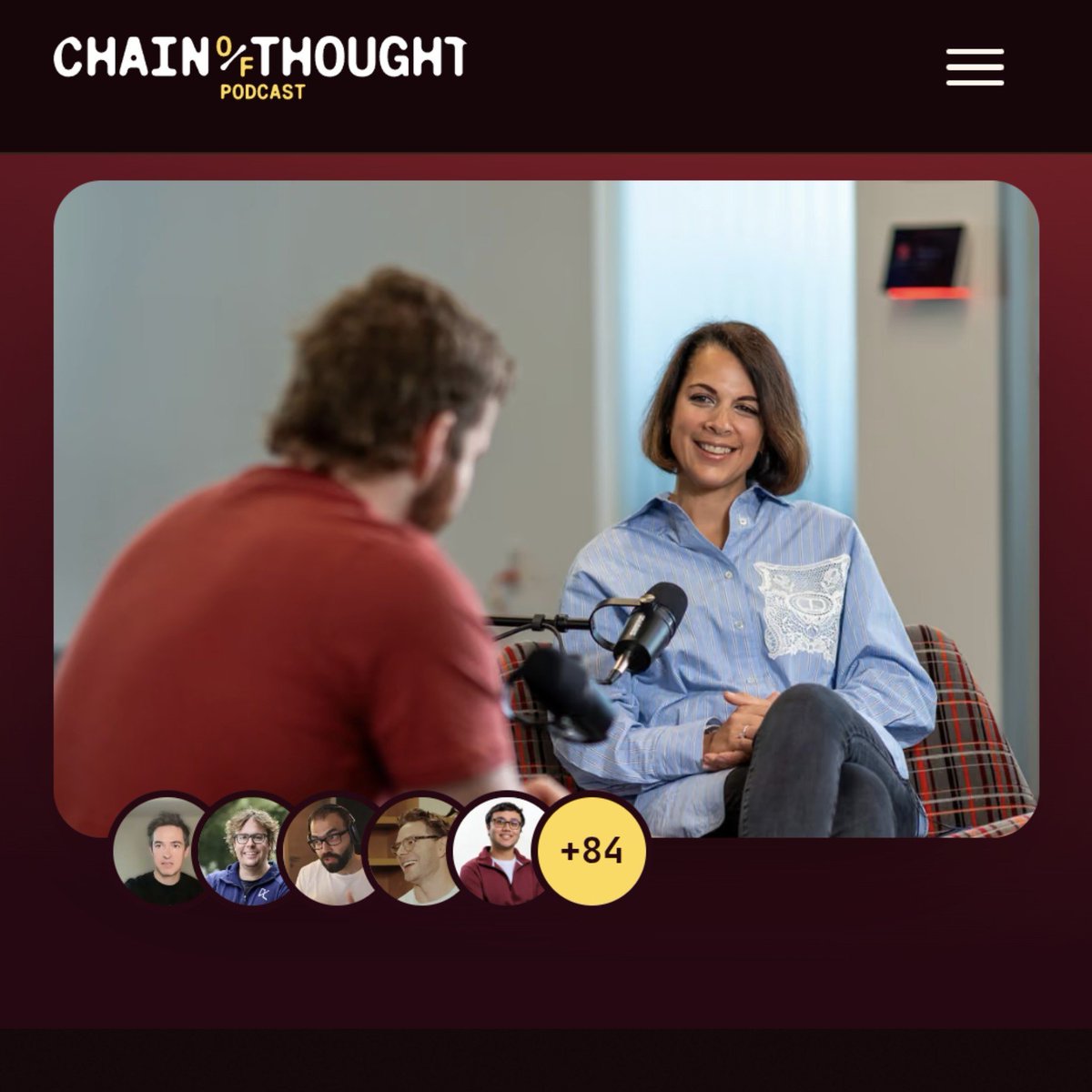
Whoa. I just realized I've been doing @chain_ofthought for two years!
80+ episodes. Episode 1 was four faces on a video call. Now it's often three 4K cameras and a crew 🤯
Thank you to every guest who has shared their insights, and to everyone who listens. On to year three!
To celebrate one year of @openclaw, I sat down with its Chief Architect, @vincent_koc🦞
Vincent joined me to talk multiplayer AI, building OpenClaw, how he cut their CI bill 95% from $1.3M a month, proof engineering, and more.
His warning: everyone building a software factory will hit the same CI bottleneck. OpenClaw just got there early.
Chapters:
0:00 Cutting a $1.27M CI bill by 95%
1:04 Why fast AI change is an opportunity
4:19 Keeping product taste by watching users
10:21 Applying DORA metrics to agent PRs
13:38 Making agents delete code with confidence
16:42 Devices, compute and daily driver models
25:05 Background gardening agents and abstraction
31:07 Where the OpenClaw foundation goes next
33:05 Multiplayer AI and agents that negotiate
43:31 AI security reports and slop fixes
46:12 @clawcon Shenzhen and hackable badges
49:35 A CPU inside model weights
Some highlights:
- Why agent cycle time may be the metric that matters most for a software factory, and how a choking CI drags it down until everything grinds to a halt
- Proof engineering, and pushing models built to write code to delete a million lines of tests
- How OpenClaw went multiplayer: a team working with the same agents at the same time
Brought to you by:
- @inngest, presenting sponsor of Season 4 - durable execution for long running agents - the fastest way to orchestrate all your async code. Failed steps retry; completed steps are saved and skipped: https://t.co/hwYyz8SM0D
My key takeaways:
1. Agent cycle time may be the most important metric for a software factory right now: because it speaks to unlocking iteration at agent speed. I run my own software factory for this show, and running all that CI locally bogs the machine down . Vincent applies DORA metrics to agents by timing each pull request from open to merge. When OpenClaw's CI started choking, cycle time got worse, which made it harder to ship fixes, until it snowballed.
2. Run the right tests, not all of them: Vincent's fix was adaptive testing: look at what a change touched and what broke before, and run only those tests. Other optimizations had already cut test volume by 50-60% before that. Full breakdown in the episode, and in his article (feed it to your agent): https://t.co/4zZXscdCAZ
3. Models are built to add code, not remove it: You have to push agents hard to delete a million lines of tests - like the OpenClaw team did. At one point, 60% of OpenClaw's code was tests.
4. Truly multiplayer AIg oes past a shared bot in a Discord channel: OpenClaw's team works with the same agents at the same time, and each person's agent can push work up to a shared hive or pull a colleague's work down. We talked a bit about how to unlock this, and the right team structures (more on this coming next week!).
Look up the @chain_ofthought podcast on YouTube, Spotify, Apple Podcasts (links below), or wherever you listen. Thanks, Vincent!
- NVIDIA paid $6B to license Poolside's model factory and put in about $1B more
- 100+ Poolside staff got offers to join NVIDIA
- the founders didn't
What does Poolside become? We don't know yet. But there are clues in Jason and Eiso's first joint interview with me, 15 months before the deal 👇
@CiscoAI Pictured: Giovanna Carofiglio, Distinguished Engineer and Sr Director at @outshiftbycisco 🙌
https://t.co/Ob9vOhBE0p
See all 89+ of our past guests: https://t.co/QDUVhRAUs9
In May 2025, @jasoncwarner and @eisokant told me the road to general intelligence runs through code.
In August, their bet paid off: NVIDIA paid $6 billion to license @poolsideai's Model Factory (and recruit their team) + invested another $1 billion in the company.
So I went back to our @chain_ofthought convo and remastered it with updates from this year:
- An intro on what's happened since, from their Laguna S 2.1 launch to the NVIDIA deal
- A segment on why Anthropic's focus on code is the strongest evidence for their bet so far
- My closing take on whether Poolside was right
Chapters (new in the remaster marked *):
0:00 Poolside is building AGI out of compute
0:23 *What's happened since, from Laguna to the NVIDIA deal
1:51 How Jason and Eiso met and started Poolside
5:49 A working definition of AGI
8:11 Why Poolside starts with code
13:07 *Why Anthropic is the strongest evidence for the bet
15:11 Why build models just for software engineering
17:13 The race for synthetic data
20:26 AI coding tools as critical infrastructure
26:10 The devil's trade over private source code
30:45 Reinforcement learning beyond compute and data
33:49 Known and unknown compute budget problems
38:36 Will software developers still exist?
45:00 Agency and Poolside's near-term vision
48:29 *My closing take: was Poolside right?
Watch the story of Poolside 👇
@itstonyhb on why security is a job for a long-running agent: "what was good now might not be good in three months' time."
A dependency in your supply chain can turn on you long after the code merged. Every company needs to be asking what its security loop is.
Sponsored by @inngest: https://t.co/hwYyz8SM0D
https://t.co/TveTkuExWM
90,000+ personal AI agents. One big question: How do you secure them at scale?
On a recent @chain_ofthought episode, Cisco's @djsampath shares how we're putting AI agents to work across @Cisco, and the security and governance needed to make it possible.
Watch or listen now: https://t.co/3k6eDoGpr5
Whoa. I just realized I've been doing @chain_ofthought for two years!
80+ episodes. Episode 1 was four faces on a video call. Now it's often three 4K cameras and a crew 🤯
Thank you to every guest who has shared their insights, and to everyone who listens. On to year three!
Whoa. I just realized I've been doing @chain_ofthought for two years!
80+ episodes. Episode 1 was four faces on a video call. Now it's often three 4K cameras and a crew 🤯
Thank you to every guest who has shared their insights, and to everyone who listens. On to year three!
New episode: @CloudBees CEO @moritzplassnig on why writing code was never the bottleneck in big companies.
He says builds at an average Fortune 500 company might run 12 hours, and enterprise releases wait weeks. Faster code generation fixes neither.
https://t.co/9HmEKHVRyH